 |
Gillespie, S.R., M.S. Tudor, A.J. Moore, and C.W. Miller (2014). Sexual selection is influenced by both developmental and adult environments. Evolution 68: 3421-3432. |
 |
Miller, C.W. and U. Somjee (2014) Male-male competition. In Oxford Bibliographies in Evolutionary Biology. Ed. Jonathan Losos. New York: Oxford University Press. |
 |
Miller, C.W. and E. Svensson (2014). Sexual selection in complex environments. Annual Review of Entomology 59: 427-445. |
 |
Helmey-Hartman, W. and C.W. Miller (2014). Context-dependent mating success in Murgantia histrionica (Hemiptera: Pentatomidae). Annals of the Entomological Society of America: 107: 264-273. |
 |
Addesso, K.M., K.A. Short, A.J. Moore, and C.W. Miller (2014). Context-dependent female mate preferences in leaf-footed cactus bugs. Behaviour 151: 479-492.
|
 |
Miller, C.W. (2013). Sexual selection: Male-male competition. In: J. Losos, Editor. The Princeton Guide to Evolution. Princeton University Press.
|

|
Miller, C.W., J. Hamel, K. D. Holmes, W.L. Helmey Hartman, and D. Lopatto (2013). Expanding your research team: learning gains when a laboratory partners with a classroom. Bioscience 63: 754-762. |
 |
Miller, C.W., R.J. Fletcher, Jr., and S.R. Gillespie (2013). Conspecific and heterospecific cues override resource quality to influence offspring production. PLoS One 8 (7):e70268. doi: 10.1371/journal.pone.0070268
|
|
Procter, D.S. Moore, A.J. and C.W. Miller (2012). The form of sexual selection arising from male-male competition depends on the presence of females in the social environment. Journal of Evolutionary Biology 25: 803-812.
|
 |
Austin, J.D., C.W. Miller , and R.J. Fletcher, Jr. (2012). What role can natural selection and phenotypic plasticity play in wildlife adaptation to climate change? In: J. Brodie, E. Post, J. Berger, and D. Doak, Editors, Conserving wildlife populations in a changing climate. University of Chicago Press.
|
 |
Miller, C.W., R.J. Fletcher, Jr., B.D. Anderson, and L.D. Nguyen (2012). Natal social environment influences habitat selection later in life. Animal Behaviour 83: 473-477. Manuscript written with undergraduate students, Ben & Chi.
|
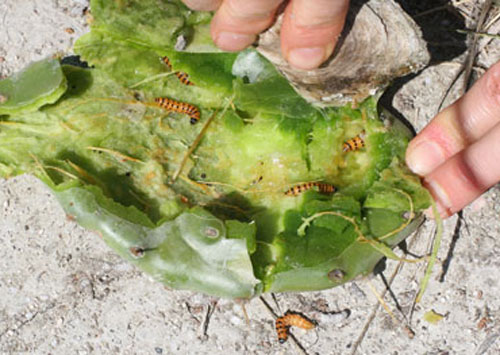 |
Halbeck, D.H., F.D. Bennett, and C.W. Miller (2012). The cactus moth, Cactoblastis cactorum. Featured Creatures, http://entomology.ifas.ufl.edu/creatures/BFLY/cactus_moth.htm
|
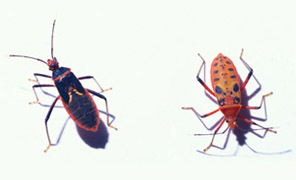 |
C.W. Miller (2011). The heliconia bug, Leptoscelis tricolor. Featured Creatures, http://entnemdept.ufl.edu/creatures/misc/bugs/heliconia_bug.htm
|
 |
Miller, C.W. and D.J. Emlen (2010). Dynamic effects of oviposition site on offspring sexually-selected traits and scaling relationships. Evolutionary Ecology 24(2): 375-390.
|
|
Miller, C.W. and D.J. Emlen (2010). Across and within population differences in the size and scaling relationship of a sexually-selected trait in Leptoscelis tricolor (Hemiptera: Coreidae). Annals of the Entomological Society of America 103: 209-215.
|
 |
Miller, C.W. and S.E. Hollander (2010). Predation on heliconia bugs, Leptoscelis tricolor (Hemiptera: Coreidae): examining the influences of crypsis and predator color preferences. Canadian Journal of Zoology 88:122-128.
|
|

|
Nageon de Lestang, F. and C.W. Miller (2009). Effects of diet on the development and survivorship of Narnia femorata nymphs (Hemiptera: Coreidae). Florida Entomologist 92:511-512. Manuscript written with undergraduate student.
|
 |
Miller, C.W. (2008). Seasonal effects on offspring reproductive traits through maternal oviposition behavior.
Behavioral ecology 19(6): 1297-1304. |
 |
Fletcher, R.J., Jr., and C.W. Miller (2008). The type and timing of social information alters offspring production. Biology Letters 4:482-485.
|
 |
Miller, C.W. and A.J. Moore. (2007). A potential resolution to the lek paradox through indirect genetic effects.
Proceedings of the Royal Society of London (B) 274:1279-1286.
|
|
Fletcher, R.J., Jr., and C.W. Miller. (2006). On the evolution of hidden leks and implications for reproductive and habitat selection behaviours. Animal Behaviour 71:1247-1251.
|