common name: heliconia bug
scientific name: Leptoscelis tricolor Westwood (Insecta: Hemiptera: Coreidae)
Introduction - Distribution - Description - Life Cycle and Biology - Hosts - Predation and Parasitism - Sexual Selection - Selected References
Introduction (Back to Top)
The heliconia bug, Leptoscelis tricolor Westwood, lives in Central America on many species of tropical heliconia plants (Zingiberales: Heliconiaceae). This insect has primarily been used to examine insect behavior, sexual selection, plant-insect interactions and color variation.
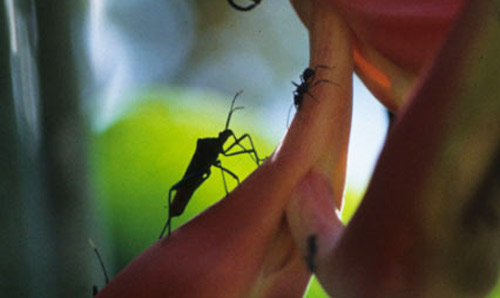
Figure 1. Adult heliconia bug, Leptoscelis tricolor Westwood, feeding on Heliconia platystachys on Barro Colorado Island, Panama. Photograph by Christine W. Miller, University of Florida.
Distribution (Back to Top)
Leptoscelis tricolor has been recorded in many areas of Panama, Costa Rica and Nicaragua, wherever Heliconia plants grow. This insect and its host plants are mostly found in low-lying areas in tropical forests. It is not currently found in Florida, though it has the potential to be introduced via heliconia plant nursery stock.
Description (Back to Top)
The original description (Westwood 1942) is as follows:
"Fulvo-rufescens, capitis thoracisque disco, antennis pedibus et hemelytris nigris, his fascia obliqua ad apicem corii, albida, antice bi-emarginata; tarsis pallidis; abdomine supra fulvo-rufescenti maculis sex parvis nigris, per paria dispositis; thoracis angulis posticis prominulis; corpore subtus toto fulvo-rufescenti." (Latin)
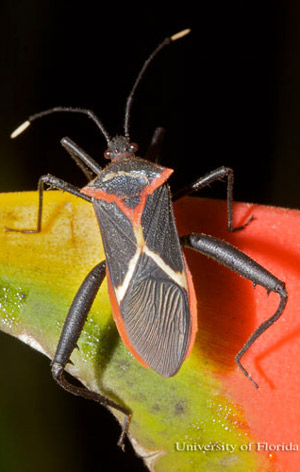
Adults: The adults are elongate-ovoid shaped with 4-segmented antennae. They are primarily black in color, with red lining the dorsal posterior edges of the pronotum and the sides of the abdomen. A yellowish-white color lines the juncture between the tegmina and membranous part of the forewings. The distal antennae segment is white. The hind femurs of males are enlarged with several pairs of spines on the proximal-ventral side. Female femurs are much more slender, though small spines are still visible under close inspection.
Figure 2. Adult heliconia bug, Leptoscelis tricolor Westwood, feeding on the inflorescence of a Heliconia sp. in Costa Rica. Photograph by J. Court Whelan, University of Florida.
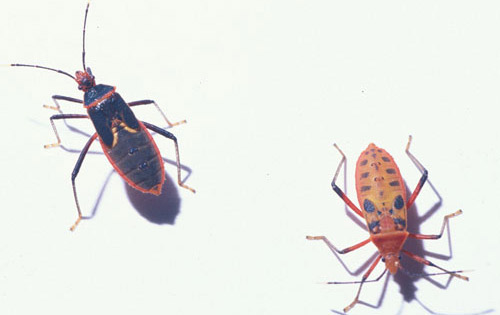
Nymphs: Young nymphs are red and black. Fourth and fifth instar nymphs vary in color, from yellow to orange, red, or black. The variation in color appears to be a form of background matching; nymphs raised on lighter species of heliconia, such as Heliconia latispatha, are more likely to be light in color than nymphs raised on darker species, such as Heliconia mariae. Color variation in nymphs does not translate into variation in adult color, i.e. yellow nymphs and black nymphs will both molt into similar-looking adults (Miller & Hollander 2010). There is no evidence of these insects forming aggregations, though other members of this family do aggregate.
Figure 3. Two fifth instar nymphs of the heliconia bug, Leptoscelis tricolor Westwood, showing variation in color. Photograph by Christine W. Miller, University of Florida.
Life Cycle and Biology (Back to Top)
Females lay eggs singly, and may spread their eggs among several different heliconia plants. Nymphs complete five instars on a single host plant. Both nymphs and adults feed on developing fruits, nectar from flowers, and the phloem of inflorescences.
The generation time of Leptoscelis tricolor is approximately 30 days. Eggs hatch after approximately 14 days. The first instar nymphs do not feed, but require access to water. This first instar is approximately two days, with the remaining nymphal instars from five to ten days long. The cuticle of new adults remains soft for at least two days after eclosion, and reproductive maturity can occur within ten days. Adults can live for up to 80 days or more.
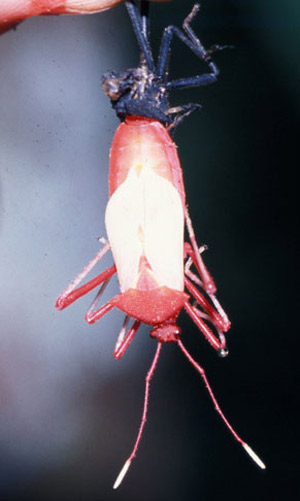
Figure 4. An almost newly emerged adult heliconia bug, Leptoscelis tricolor Westwood. Photograph by Christine W. Miller, University of Florida.
The species of heliconia where nymphs grow and develop and the time of year can have significant effects on adult size; the size of adult male hind femurs, used as weapons in contests with other males (Miller & Emlen 2010b); and adult mating behaviors (Miller 2008). Females lay more eggs on Heliconia platystachys, the host plant where offspring are most likely to succeed in the middle of the wet season (Miller 2007).
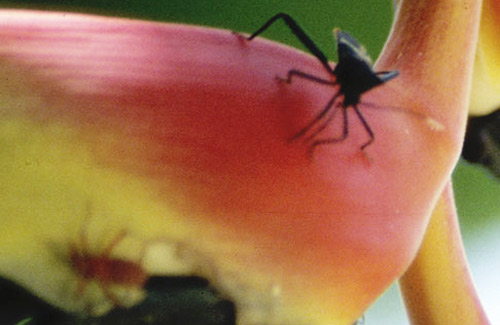
Figure 5. Adult (upper right) and nymph (red insect, lower left) heliconia bugs, Leptoscelis tricolor Westwood, on Heliconia platystachys. Photograph by Christine W. Miller, University of Florida.
Hosts (Back to Top)
Leptoscelis tricolor relies upon the inflorescences of heliconia plants for all life stages. It has been recorded on Heliconia hirsuta, Heliconia imbricata, Heliconia irrasa, Heliconia latispatha, Heliconia mariae, Heliconia platystachys, Heliconia pogonantha, and Heliconia vaginalis, though it probably uses many other species of heliconia as well (Miller & Emlen 2010a). Mark-recapture studies have revealed insect movement between the different species of heliconia (Miller 2007).
Predation and Parasitism (Back to Top)
Leptoscelis tricolor is parasitized by a member of the family Encyritidae (Hymenoptera). This wasp parasitoid is very close to Hexacladia townsendi (Crawford), described as a parasitoid of Stenomacra (Hemiptera: Largidae) in Peru (John Noyes, personal communication). Parasitism by this encyritid species appears to be rare. Occasionally, red mites have also been found feeding externally on Leptoscelis tricolor.
The predators of juvenile Leptoscelis tricolor are primarily invertebrates, including many species of spiders and ants. Adult predators include spiders and insectivorous birds (Miller & Hollander 2010).
Sexual Selection (Back to Top)
Male Leptoscelis tricolor defend territories on heliconia inflorescences. When two males encounter one another, one male usually begins twitching his front legs up and down. If the competition continues to escalate, the second male will also begin twitching his front legs up and down. The two males turn around, end-to-end, and wrap their hind legs around one another. Short squeezing bursts may then be observed, with the spines of one or both of the male's legs pressing into the abdomen of the opponent. Squeezing may continue for some time, and males will even continue to wrestle if they fall off the host plant.
Female pairs have been observed competing in a similar fashion, though only rarely.
In addition to male-male competition, as described above, mate choice also occurs. Either a male or a female will approach a member of the opposite sex. Next, the male will begin twitching his front legs up and down, similar to the initiation of a male-male competition. The male will touch a female with his front legs. At this point, females may remain motionless, kick the male away, or leave the area. If a female remains motionless, the male will climb upon the female and initiate copulation (Miller 2007).
Figure 6. Adult heliconia bugs, Leptoscelis tricolor Westwood, copulating. The female is in the foreground. Note that females nearly always feed while mating. Photograph by Christine W. Miller, University of Florida.
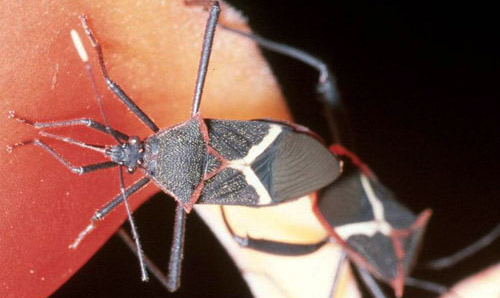
Females nearly always feed while mating. Copulatory courtship is common in this species, where males stroke females and rock while mating (Miller 2008). Both females and males mate multiple times over their lifetimes.
Selected References (Back to Top)
- Miller CW. (2007). Maternal effects and sexual selection in the heliconia bug, Leptoscelis tricolor (Hemiptera: Coreidae). Ph.D. Dissertation: Division of Biological Sciences. University of Montana, Missoula, Montana.(16 November 2011).
- Miller CW. 2008. Seasonal effects on offspring reproductive traits through maternal oviposition behavior. Behavioral Ecology 19: 1297-1304.
- Miller CW, Emlen DJ. 2010a. Across and within population differences in the scaling relationship of a sexually-selected trait. Annals of the Entomological Society of America 103: 209-215.
- Miller CW, Emlen DJ. 2010b. Dynamic effects of oviposition site on offspring sexually-selected traits and scaling relationships. Evolutionary Ecology 24: 375-390.
- Miller CW, Hollander SD. 2010. Predation on heliconia bugs, Leptoscelis tricolor (Hemiptera: Coreidae): examining the influences of crypsis and predator color preferences. Canadian Journal of Zoology 88: 122-128.
- Packauskas RJ. 2008. The position of the Leptoscelini and other taxonomic changes within the family Coreidae (Hemiptera: Heteroptera). Zootaxa 63-68.
- Somjee U, Allen PE, Miller CW. 2015. Different environments lead to a reversal in the expression of weapons and testes in the heliconia bug, Leptoscelis tricolor (Hemiptera: Coreidae). Biological Journal of the Linnean Society 115: 802-209.
- Westwood. 1842. A catalogue of hemiptera in the collection of the Rev. F. W. Hope. 2: 4,17.