My long-term research goal is to improve understanding of the evolution of the elaborate ornaments, weapons, and behaviors of sexual selection through both field and laboratory experiments and observations.
The fantastic shapes, sounds, and colors of sexual selection have awed people for centuries. Our understanding of sexual selection has increased dramatically in recent years, yet many outstanding questions remain. One of the most profound gaps in our understanding concerns the influence of natural environmental variation on the process and outcomes of sexual selection. Sexually-selected traits are often condition dependent and are therefore extremely sensitive to environmental influences. This environmental sensitivity may have far-reaching implications, including affecting the reliability of sexual signals, the strength of selection pressures, the direction and speed of the response to selection, and the maintenance of genetic variation in sexually-selected traits. While there has been considerable work on sexual selection in constant environments, the implications of variation and uncertainty in the process of sexual selection are less well studied. Indeed, we are only just beginning to appreciate how dramatically environmental heterogeneity can influence the performance of males as well as the mating decisions of females.
I use a diverse set of research tools to explore the role of environmental variation in the process and outcomes of sexual selection. Central to my empirical studies and a source of inspiration for my theoretical work are the leaf-footed bugs (Hemiptera: Coreidae). Insects in this family are well-suited to address fundamental issues in sexual selection and phenotypic plasticity.
Major Research Areas:
- Evolutionary ecology
- Behavioral ecology
- Sexual selection
- Chemical ecology
- Phenotypic plasticity
- Maternal effects
Natural history of the leaf-footed bugs
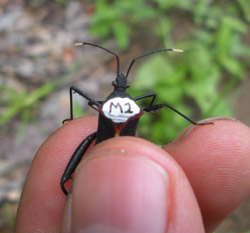
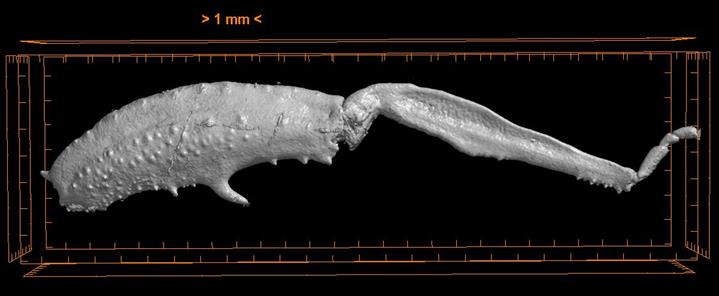
Over 2000 species of leaf-footed bugs exist worldwide, and many have intriguing shapes associated with the process of sexual selection. Males of numerous species use their hind legs to squeeze each other in contests over host plant resources where females visit to feed, mate, and lay eggs. The hind femurs of these males are spiny and proportionately larger than the femurs of females. Males with larger legs can be more likely to win male-male contests and have greater mating success.
The developmental environment experienced by juveniles can have a large influence on their developmental rate, coloration, the expression of adult male sexually-selected traits (hind femora; Drawing on right by David Tuss), the mating behaviors of both males and females, and female fecundity.
Maternal effects and sexual selection
Parents often influence the phenotypes of offspring through their habitat selection, parental care, and other behaviors. These parental effects can modify the development of offspring, affecting growth, survival, morphology, and even adult behaviors. Parental effects are likely ubiquitous in nature, and theoretical work suggests that they can influence the rate and the direction of the evolutionary response to selection pressures. However, relatively little is known about how parental effects operate in natural populations.
Through a combination of field experiments and observations, I examined maternal effects on the expression of secondary-sexual traits and reproductive behaviors in Leptoscelis tricolor, the heliconia bug. Mothers select different species of heliconia host plants as oviposition sites, and offspring emerging from these different hosts vary significantly in the expression of secondary-sexual traits, mating behaviors, and fecundity. Interestingly, early in the season one species of host plant appears to be superior for the growth and development of offspring, but later in the season another plant species becomes superior. Thus, the maternal behavior of choosing a host plant species for egg laying has different implications for offspring at different times of the year. Such dynamic maternal effects have only begun to be demonstrated. Much of this work was done in collaboration with Dr. Douglas J. Emlen (University of Montana).
Indirect genetic effects
Maternal effects can have a genetic basis in mothers (for example, there may be a genetic basis to the rate of offspring provisioning), and such genetically-based effects are called “indirect genetic effects”. Indirect genetic effects have received very little attention relative to their likely importance in the evolutionary process. In collaboration with Prof. Allen J. Moore (University of Exeter in Cornwall), I explored the implications of indirect genetic effects for the long-debated lek paradox.
Females in many species prefer males with elaborate secondary-sexual characteristics including bright plumage, complex songs, and exaggerated morphological structures. Understanding what benefits females may be obtaining when they discriminate among males has been a long-standing puzzle for biologists. One source of genetic benefits that females obtain for offspring may come through indirect genetic effects. Indirect genetic effects occur when genes expressed by one individual (such as a parent) have phenotypic effects on other individuals (such as offspring). Parents often shape offspring environments, and variation among parents in their influences can be genetically based. Thus, males with elaborate secondary-sexual traits might not honestly indicate superior additive genetic factors directly contributing to their condition, as is often envisioned. Instead, they may be signaling additive genetic factors indirectly influencing their condition, factors from their parents. Females choosing males with elaborate secondary-sexual traits may be receiving “good genes” for offspring in the form of effective parenting characteristics. Empirical work is now needed to explore the potential for indirect genetic effects to serve as a resolution to the lek paradox.
Phenotypic plasticity in color
Phenotypic plasticity, or the capability of a single genotype to produce more than one phenotype, has attracted considerable attention in recent years. Morphological, physiological, and behavioral traits all are subject to phenotypic plasticity, and this plasticity may at times be adaptive. Nymphs of Leptoscelis tricolor, the heliconia bug, express color plasticity; nymphs grow to match the color of their surrounding environment. Using a quantitative genetic breeding experiment conducted in the field, I quantified the color plasticity and also examined whether some genotypes are more plastic than others. In collaboration with a student intern (Sonya Hollander) and Robert J. Fletcher Jr., I also examined whether this color plasticity may be effective in camouflaging nymphs against avian predators.
Major current and future directions in the Miller lab
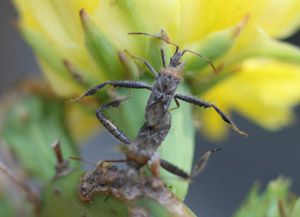
I am currently investigating genetic and environmental influences on sexual selection in the cactus bug, Narnia femorata. This species is excellent for both field and laboratory studies of sexual selection. I am conducting behavior experiments and morphological measurements to examine the role of natural environmental variation on 1) the expression of a male weapon (spiny hind legs), 2) male-male competitive success, and 3) male attractiveness.
I am also very interested in the mating decisions of females and males. Recent studies suggest that, across taxa, mate choice may vary according to context and condition of individuals, with possible far-reaching consequences for sexual selection. I am in the process of examining factors hypothesized to be important in shaping mating decisions: individual condition and current reproductive context. Much of this work is in collaboration with Dr. Allen J. Moore (University of Exeter, UK).
Other projects
Finally, I am also examining the use of information in reproductive decision-making by another species of cactus bug, Chelinidea vittiger. Animals use both personal information (e.g. habitat quality) and public information (e.g. information from the behavior of other individuals) in decision making. Public information can be particularly useful, in that it can be easier to gather and more directly relevant for animal decisions. We studied the use of public information (the presence of conspecific eggs and juveniles) in the egg production of female cactus bugs. Females produced a greater number of eggs when eggs and juveniles were present, and the timing of the information was also important. We conclude that the type and timing of social information may be an important, yet unappreciated, influence on reproductive allocation. This work is in collaboration with Dr. Robert J. Fletcher, Jr.