common name: cheese skipper, ham skipper
scientific name: Piophila casei (Linnaeus) (Insecta: Diptera: Piophilidae)
Introduction - Synonymy - Distribution and Habitat - Description - Life Cycle - Medical Importance - Economic Importance - Forensic Importance - Management - Selected References
Introduction (Back to Top)
The cheese skipper, Piophila casei (Linnaeus), sometimes called the ham skipper, is a member of the "skipper fly" family (Piophilidae). These flies receive their name due to the unusual ability of the larvae to propel themselves through the air. The flies are detritivores, feeding on decaying matter, and even have been found on the exhumed remains of Egyptian mummies (Cockburn et. al 1975). Because of their delayed infestation of decaying remains, Piophila casei (Linnaeus) have been implicated as useful in the forensic investigation of postmortem remains and the determination of "time since death" (Triplehorn and Johnson 2005).
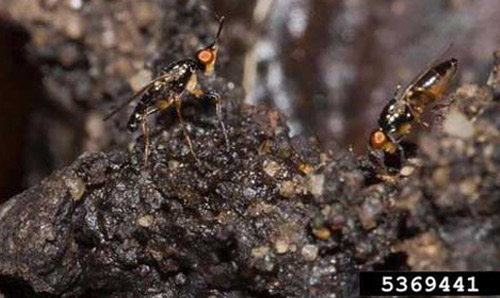
Figure 1. Adult cheese skippers, Piophila casei Linnaeus. Photograph by Susan Ellis, United States Department of Agriculture, Animal and Plant Health Inspection Service, Plant Protection and Quarantine, Bugwood.org.
Often found as pests in meat and cheese, these small flies often are cited as a cause of accidental enteric (intestinal) myiasis, where the fly larvae invade the living tissue of animals including humans (Scott 1964). Researchers have reported cases of myiasis in red foxes in Iowa (Smith 1943).
Intentional introduction of Piophila casei larvae into pecorino cheese produces the famous, but illegally-produced, Italian cheese known as "casu marzu," a delicacy desired for the famous pungent taste left behind when the larvae digest and ferment the cheese (Overstreet 2003). Individuals eat the goo-like paste as well as the living maggots.
Insect groups similar to the cheese skippers include black scavenger flies (Sepsidae), eye gnats (Chloropidae), and small fruit flies (Drosophilidae) (Smith and Whitman 2000).
Synonymy (Back to Top)
Musca casei Linnaeus, 1758
Piophila pusilla Meigen, 1838
From Integrated Taxonomic Information System
Distribution and Habitat (Back to Top)
Cheese skippers have a worldwide distribution, including the United States, and are not limited to any specific geographic location (Smith and Whitman 2000).
Piophila casei usually feed on overripe (three or more months old) and moldy cheese, and slightly salted or putrid-smelling meats, such as ham, bacon, and beef. Larvae are typically found on high-protein substrates ranging from salted beef to smoked fish and animal carcasses (Smith and Whitman 2000).
Signs of Piophila casei in foods include the presence of whitish-colored eggshells as well as small grooves or creases found in the surface of cheeses made by first-instar larvae. Infested cheeses will usually have soft or sunken areas, and meats may have a shiny grease-like liquid drip from infested areas (Smith and Whitman 2000). Eggs, larvae, pupae, and adults are found near or on infested materials.
Description (Back to Top)
Piophila casei are small metallic-colored flies, usually black/bluish-black with bronze-colored tints on the head, thorax, and abdomen, with reddish-brown eyes and iridescent wings (Smith and Whitman 2000).
Figure 2. Dorsal view of adult cheese skipper, Piophila casei Linnaeus. Photograph by Caitlin Lewis, University of Florida.
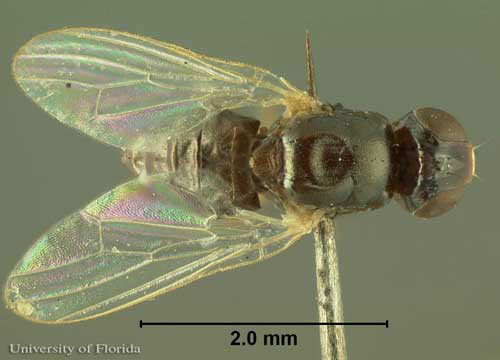
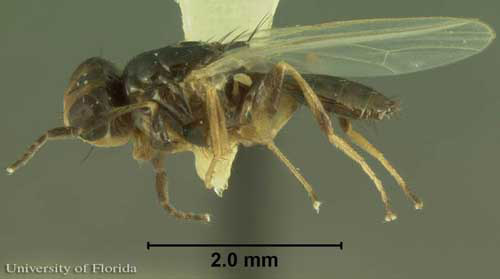
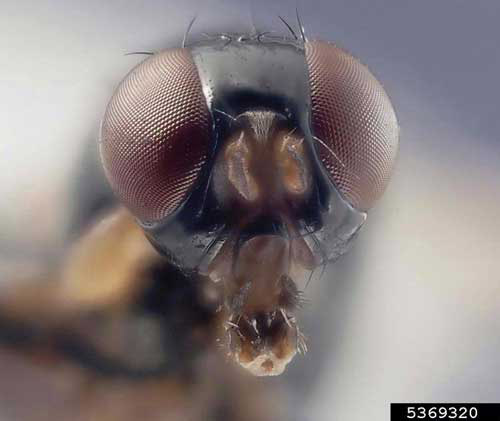
Adults: Cheese skipper adults are usually about half the size of a common house fly. Males are 4.4-4.5 mm from the tip of the head to the tip of the wings, whereas females are slightly larger, usually measuring 5.0-5.2 mm. The dominant color of both males and females is a metallic black-bronze (Triplehorn and Johnson 2005). The palps and proboscis are usually covered with bristles, and the antennae are short. The compound eyes found on both sexes are usually bare and red in color. The thorax has distinct rows of setae, and long setae are also found on the sides of the insect. The legs are covered with short spines and often have both yellow and brown colorations. The wings are iridescent and nearly overlap when resting. Halteres, rudimentary second wings, are typically a pale yellow color (Mote 1914). Adults live for three to seven days (Smith and Whitman 2000).
Figure 3. Lateral view of adult cheese skipper, Piophila casei Linnaeus. Photograph by Caitlin Lewis, University of Florida.
Figure 4. Anterior view of head of adult cheese skipper, Piophila casei Linnaeus. Photograph by Susan Ellis, United States Department of Agriculture, Animal and Plant Health Inspection Service, Plant Protection and Quarantine, Bugwood.org.
Eggs: The eggs of the cheese skipper are 0.63-0.74 mm long (Lui and Greenberg 1989) and 0.18-0.2 mm wide. A female usually deposits 140-500 eggs on meat or cheese (Smith and Whitman 2000). The chorion (shell) of each egg is oval/cylindrical and a smooth, pearly white color. Eggs usually hatch between 23 and 54 hours in a temperature range of 15° to 27°C (Mote 1914).
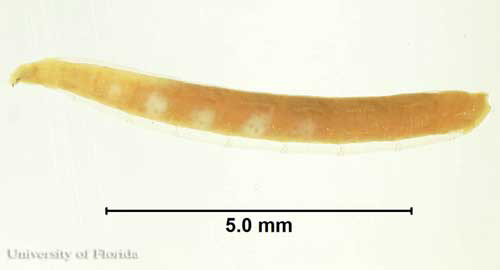
Larvae: The larvae of the cheese skipper are active as soon as they hatch from the egg and appear fairly cylindrical and white, except for scleratized black mouthparts. Oftentimes, the larvae can leap 4 to 5 inches through the air by using their mouth hooks as grapples and then flexing/jerking themselves forward, earning the flies the name "cheese skippers." Larvae tend to avoid light and congregate near each other on fairly lean portions of meat (Smith and Whitman 2000). The three larval instars typically last 14 days total and are found on substrates ranging from meats (bacon, ham, beef) to cheeses, fatty foods and decaying bodies. Full-grown larvae are 13-segmented, typically 9-10 mm long and approximately 1 mm wide, and appear white or yellowish-white to the unaided eye (Mote 1914). Larvae are fairly resistant to changes in heat and cold (Smith and Whitman 2000).
Figure 5. Larva of the cheese skipper, Piophila casei Linnaeus. Photograph by Caitlin Lewis, University of Florida.
Pupae: The dark brown pupae of the cheese skipper are formed approximately 32 hours after the larvae abandon the substrate on which they are feeding. Though they prefer dry, dark locations, Piophila casei larvae will pupate on open concrete floors if such spaces are not available. The oval puparium is typically 2.9-3.9 mm long and 1-1.7 mm wide (Lui and Greenberg 1989). Adults emerge after approximately 12 days (Mote 1914).
Life Cycle (Back to Top)
Piophila casei undergo complete metamorphosis. Females mate almost immediately after adult emergence (Smith and Whitman 2000). Although feeding on protein sources increases fecundity of the insects, Piophila casei females are autogenous, able to produce eggs without a protein meal, in a laboratory setting (Zuzka 1978).
The complete life cycle of a cheese skipper in appropriate nourishment and temperature conditions can be as short as 12 days (1 day for egg development, 5 day larval maturation, 5 day pupal maturation, 1 day of adult feeding before reproduction). However, the typical life cycle is as follows (Mote 1914): Egg ~23 to 54 hours - Larva ~14 days - Pupa ~12 days - Adult ~3 to 7 days.
Medical Importance (Back to Top)
Cheese skippers are commonly cited as a cause of enteric (intestinal) myiasis in humans (MacGregor 1918). Once a female oviposits (lays eggs) on meats, cheese, and other surfaces, the larvae hatch and penetrate deeply into the substrate (White et al. 2006). Unintentional human ingestion of cheese skipper larvae causes the maggots to pass through the human digestive system, often leading to serious intestinal lesions that result in diarrhea, pain, nausea, and other gastric symptoms. Cheese skippers are cited as one of the most problematic fly species associated with accidental myiasis (White et al. 2006).
When myiasis occurs, Piophila casei larvae are usually found in the intestines, but larvae sometimes infest the chests and nasal passages of human patients. Because of their filth-feeding lifestyles, the adults are believed to be able to act as mechanical vectors of disease pathogens, similar to house flies (Smith and Whitman 2000).
Economic Importance (Back to Top)
Piophila casei are cited as pests of stored products ranging from salted meats to overripe cheeses. Damage to the stored products can incur both pest management costs and possible medical costs from accidental ingestion of the fly larvae (Smith and Whitman 2000).
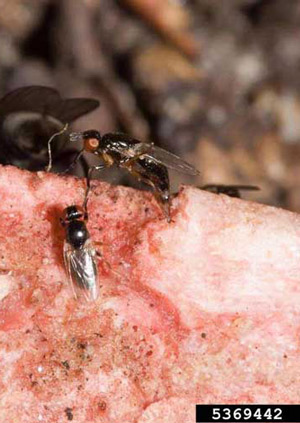
Figure 6. Adult cheese skippers, Piophila casei Linnaeus, on meat. Photograph by Susan Ellis, United States Department of Agriculture, Animal and Plant Health Inspection Service, Plant Protection and Quarantine, Bugwood.org.
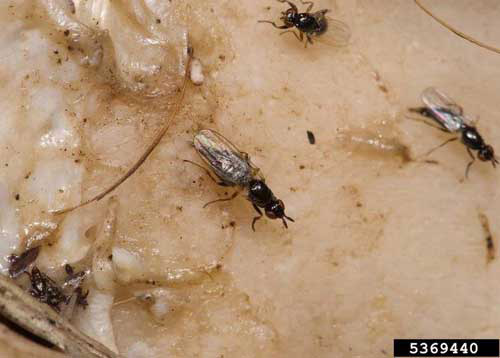
Figure 7. Adult cheese skippers, Piophila casei Linnaeus, on cheese. Photograph by Susan Ellis, United States Department of Agriculture, Animal and Plant Health Inspection Service, Plant Protection and Quarantine, Bugwood.org.
In Italy, Piophila casei larvae are often introduced into pecorino cheese to promote fermentation as they feed and create a unique flavor in the cheese. Though this "casu marzu" (cheese with worms) is not produced commercially, the pungent/burning flavor created by the decomposing fats is considered a delicacy in Italian areas ranging from Piedmont and Bergamo to Sardinia (Overstreet 2003).
Forensic Importance (Back to Top)
Forensic entomologists have used the presence of Piophila casei larvae as a tool to assist in the estimation of time of death for human remains. Though they can appear on remains less than two months old in geographic locations such as Florida, the flies sometimes do not appear on an exposed corpse until three to six months postmortem (after death), usually after the body has completed the "active decay" decomposition stage and is beginning to dry (Nanzi et al 2008). Entomologists utilize knowledge of the current instar of collected larvae, coupled with measurements of weather and temperature conditions, to provide an estimation of the postmortem interval (Benecke 1998). Furthermore, unlike some other insects used in forensic investigation, the presence of drugs such as heroin do not significantly alter the development of Piophila casei larvae (Benecke 1998).
Management (Back to Top)
Sanitation is considered the most important aspect of management of cheese skippers. Exclusion of Piophila casei from all levels of food production (processing, curing, and storage) ranges from proper sanitation techniques to proper wrapping/protection of food products. Light infestations of Piophila casei larvae can be removed individually, but the judicious use of fumigation techniques if often required for more severe infestations (Smith and Whitman 2000).
Pachycrepoideus dubius Ashmead, a small pteromalid wasp, is the primary parasite of the cheese skipper. The wasp attacks the pupal stage of Piophila casei, as well as other cyclorrhaphan flies, including the Mediterranean fruit fly Ceratitis capitata (Wiedemann). Pachycrepoideus dubius is reported to provide effective control of the cheese skipper, especially during summer months (Crandell 1939). However, other research conducted at Ohio State University states that Pachycrepoideus dubius does not act as an economically viable method for natural control of the cheese skipper (Crandell 1939). The small beetle Necrobia rufipes De Geer is also reported as a predator of cheese skipper larvae.
Selected References (Back to Top)
- Cockburn A, Barraco RA, Reyman TA, Peck WH. 1975. Autopsy of an Egyptian mummy. Science, New Series 187: 1155-1160.
- Crandell HA. 1939. The biology of the Pachycrepoideus dubius Ashmead (Hymenoptera), a pteromalid parasite of Piophila casei. Annals of the Entomological Society of America 32: 632-654.
- Benecke M. 1998. Six forensic entomology cases: Description and commentary. Journal of Forensic Science 43: 797-80.
- Lui D, Greenberg B. 1989. Immature stages of some flies of forensic importance. Annals of the Entomological Society of America 82: 80-93.
- MacGregor ME. 1918. Insects as carriers of diseases. Transactions of the American Microscopical Society 37: 7-17.
- Mote DC. 1914. The cheese skipper (Piophila casei Linne). The Ohio Naturalist 14: 309-315.
- Nanzi WA, Jeffery J, Sa'diyah I, Noorjuliana WM, Chen CD, Rohayu SA, Hafizam AH, Lee HL. 2008. First report of maggots of family Piophilidae recovered from human cadavers in Malaysia. Tropical Biomedicine 25: 173-175.
- Overstreet RM. 2003. Presidential address: Flavor buds and other delights. Journal of Parasitology 89: 1093-1107.
- Scott HG. (1964). Human myiasis in North America (1952-1962 Inclusive). Florida Entomologist 47. (23 April 2013).
- Smith EH, Whitman RC. 2003. Ham/Cheese Skipper. In National Pest Control Association Field Guide to Structural Pests: Stored Product Pests. Fairfax, VA.
- Smith LF. 1943. Internal parasites of the red fox in Iowa. The Journal of Wildlife Management 7: 174-178.
- Triplehorn CA, Johnson NF. 2005. Borror and Delong's Introduction to the Study of Insects, 7th edition. Thomson Brooks/Cole Publishers. 864 pp.
- White G, Prendergast PF, Rosales AL, Evans Jr ES, Hogsette Jr JA. (2006). Filth Flies: Significance, Surveillance, and Control in Contingency Operations. Technical Guide No. 30. Armed Forces Pest Management Board. (23 April 2013).
- Zuzka J. 1978. Autogeny in Piophila casei (Diptera, Piophilidae). Folia Parasitologica, Prague 25: 173-77.