common name: Mediterranean fruit fly
scientific name: Ceratitis capitata (Wiedemann) (Insecta: Diptera: Tephritidae)
Introduction - Synonymy - Distribution - Identification - Hosts - Mediterranean Fruit Fly Host List - Detection and Survey - Management - Selected References
Introduction (Back to Top)
The Mediterranean fruit fly, Ceratitis capitata (Wiedemann), is one of the world's most destructive fruit pests. The species originated in sub-Saharan Africa and is not known to be established in the continental United States. When it has been detected in Florida, California, and Texas, especially in recent years, each infestation necessitated intensive and massive eradication and detection procedures so that the pest did not become established.
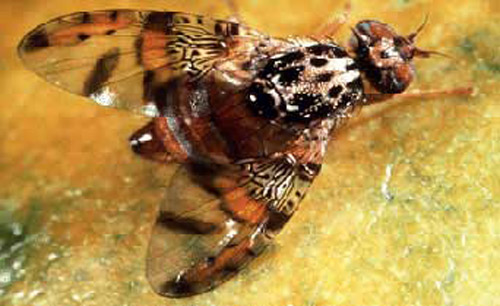
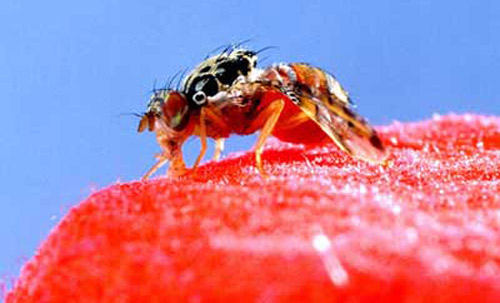
Figure 1. Adult male Mediterranean fruit fly, Ceratitis capitata (Wiedemann). Photograph by USDA.
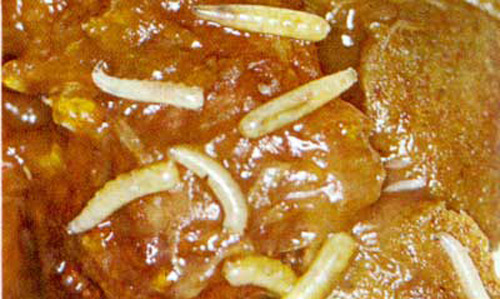
Because of its wide distribution over the world, its ability to tolerate cooler climates better than most other species of tropical fruit flies, and its wide range of hosts, it is ranked first among economically important fruit fly species. Its larvae feed and develop on many deciduous, subtropical, and tropical fruits and some vegetables. Although it may be a major pest of citrus, often it is a more serious pest of some deciduous fruits, such as peach, pear, and apple. The larvae feed upon the pulp of host fruits, sometimes tunneling through it and eventually reducing the whole to a juicy, inedible mass. In some of the Mediterranean countries, only the earlier varieties of citrus are grown, because the flies develop so rapidly that late season fruits are too heavily infested to be marketable. Some areas have had almost 100% infestation in stone fruits. Harvesting before complete maturity also is practiced in Mediterranean areas generally infested with this fruit fly.
In this age of jet transportation, the medfly can be transported from one part of the world to some distant place in a matter of hours, which greatly complicates efforts to contain it within its present distribution. Once it is established, eradication efforts may be extremely difficult and expensive. In addition to reduction of crop yield, infested areas have the additional expense of control measures and costly sorting processes for both fresh and processed fruit and vegetables. Some countries maintain quarantines against the medfly, which could jeopardize some fresh fruit markets if it should become established in Florida.
Synonymy (Back to Top)
Ceratitis citriperda MacLeay
Ceratitis hispanica De Brême
Paradalaspis asparagi Bezzi
Tephritis capitata Wiedemann
Ceratitis capitata (Wiedemann)
Distribution (Back to Top)
Countries with established infestations include (CABI 1999):
Africa: Algeria, Angola, Berin, Botswana, Burkina Faso, Burundi, Cameroon, Cape Verde, Congo, Congo Democratic Republic, Cote d'Ivoire, Egypt, Ethiopia, Gabon, Ghana, Guinea, Keyna, Liberia, Libya, Madagascar, Malwai, Mali, Maritius, Morocco, Mozambique, Niger, Nigeria, Reunion, Sao Tome and Principe, Senegal, Seychelles, Sierra Leone, South Africa, St. Helena, Sudan, Tanzania, Togo, Tunisia, Uganda, Zimbabwe
Asia: Cyprus, Israel, Jordan, Lebanon, Saudi Arabia, Syria, Turkey, Yemen
Australia: Western Australia
Central American and Caribbean: Costa Rica, El Salvador, Guatemala, Honduras, Jamaica, Netherlands Antilles, Nicaragua, Panama, Puerto Rico
Europe: Albania, Azores, Balearic Islands, Canary Islands, Corsica, Croatia, France, Greece, Italy, Maderia Islands, Portugal, southern Russia, Sardinia, Sicily, Slovenia, Spain, Yugoslavia
South American: Argentina, Brazil, Columbia, Ecuador, Paraguay, Peru, Uruguay, Venezuela
Mediterranean fruit fly infestations in the United States occurred in:
Hawaii since 1907 (Mau et al. 2007), and became established by 1910;
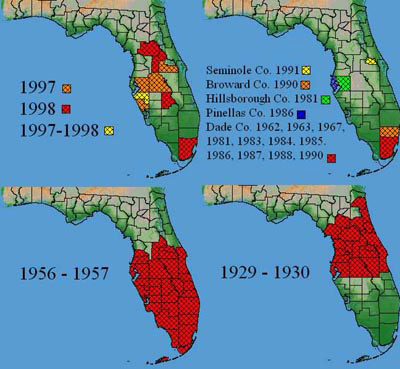
Florida from April 1929 to July 1930, April 1956 to November 1957, June 1962 to February 1963, June to August 1963, 3-14 August 1981, and April to August 1998; with one or two flies found in various counties during 1967, 1983 to 1988, 1990 to 1991 and in May to October, 1997. During June–August 2010, the largest outbreak since the 1997-1998 infestations was discovered and eradicated in Palm Beach County in the Boca Raton area (FDACS 2010a, 2010c);
Texas during June and July 1966;
California in 1975, and periodically since 1980. Reinfestations in the same areas leads some experts to believe the California infestion was never eradicated but was instead reduced to subdetectable levels that periodically resurface (Dawson et al. 1998, Papadopoulos 2008).
Figure 2. Incidence of the Mediterranean fruit fly, Ceratitis capitata (Wiedemann), in Florida, 1929-1998. Drawing by G.J. Steck and B.D. Sutton, Division of Plant Industry.
Identification (Back to Top)
The medfly has no near relatives in the Western Hemisphere. The adults are slightly smaller than a house fly and have picture wings typical of fruit flies. They can be distinguished fairly readily from any of the native fruit flies of the New World.
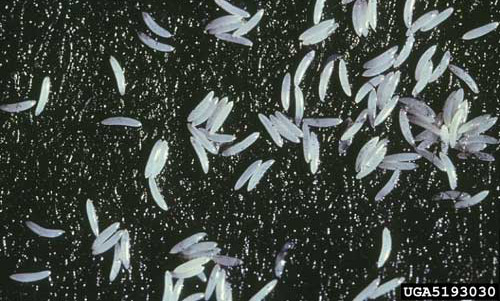
Egg: The egg is very slender, curved, 1 mm long, smooth and shiny white. The micropylar region is distinctly tubercular.
Figure 3. Eggs of the Mediterranean fruit fly, Ceratitis capitata (Wiedemann). Photograph by Jeffery Lotz, Florida Department of Agriculture and Consumer Services-Division of Plant Industry.
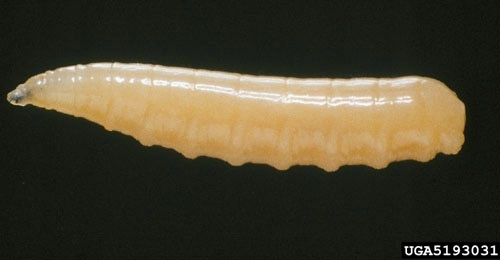
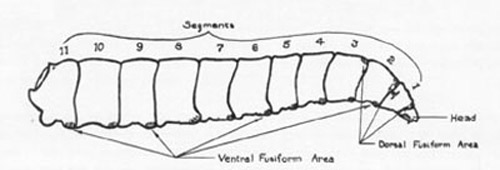
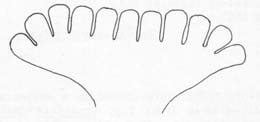
Larva: Larva are white with a typical fruit fly larval shape, i.e., cylindrical maggot-shape, elongate, anterior end narrowed and somewhat recurved ventrally, with anterior mouth hooks, and flattened caudal end. The last instar is usually 7 to 9 mm in length, with eight ventral fusiform areas. The anterior buccal carinae are usually nine to 10 in number. The anterior spiracles are usually nearly straight on dorsal edge of tubule row (often more straight than illustrated). There are usually nine to 10 tubules, although there may be seven to 11.
Figure 4. Larva of the Mediterranean fruit fly, Ceratitis capitata (Wiedemann). Head is to the left. Photograph by Jeffery Lotz, Florida Department of Agriculture and Consumer Services-Division of Plant Industry; www.forestryimages.org.
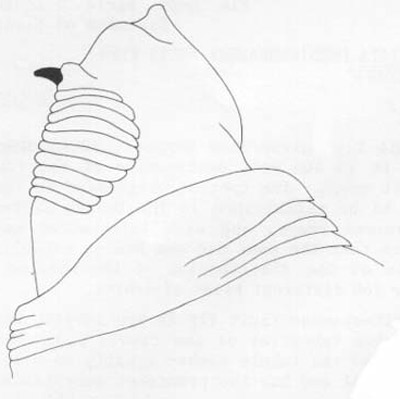
Figure 5. Lateral view of a mature larva of the Mediterranean fruit fly, Ceratitis capitata (Wiedemann). Head is to the right. Graphic by Division of Plant Industry.
Figure 6. Head and buccal carinae of larva of the Mediterranean fruit fly, Ceratitis capitata (Wiedemann). Graphic by Division of Plant Industry.
Figure 7. Anterior spiracles of larva
The cephalo-pharyngeal skeleton has a large convex mouth hook each side, approximately 2X hypostome in length. The hypostomium has prominent, rounded subhypostomium; post-hypostomial plates curved dorsally to the dorsal bridge, fused with sclerotized rays of central area of dorsal wing plate. The parastomium is prominent. The anterior of the dorsal bridge has a prominent sclerotized point. The dorsal wing plate is nearly as long as the pharyngeal plate. The median area is relatively unsclerotized. The pharyngeal plate is elongate, with prominent median hood and anterior sclerotized area.
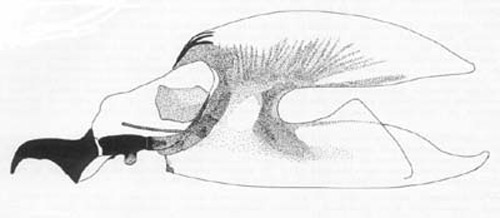
Figure 8. Larval cephalo-pharyngeal skeleton of the Mediterranean fruit fly, Ceratitis capitata (Wiedemann). Graphic by Division of Plant Industry.
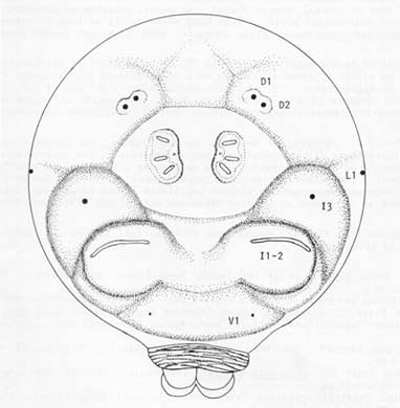
The caudal end has bifurcate or paired dorsal papillules (D1 and D2) on small mount of relatively flat plate; intermediate papillules (I1-2) as a line of fused elevations on a very enlarged subspiracular tubercle, plus a remote I3 at approximately 45 degrees from I1-2; L1 on the median edge of the caudal end; V1 not prominent; posterior spiracles elongate (4.5 to 5X width), with dorsal and ventral spiracles angled away from relatively planar median spiracle; interspiracular processes (hairs) usually not branched; anal lobe bifid or entire.
Figure 9. Caudal end of larva of the Mediterranean fruit fly, Ceratitis capitata (Wiedemann). Graphic by Division of Plant Industry.
Figure 10. Posterior spriacles (left side) (after Phillips 1946) of a larva of the Mediterranean fruit fly, Ceratitis capitata (Wiedemann). Graphic by Division of Plant Industry.
Figure 11. Anal lobes of larva
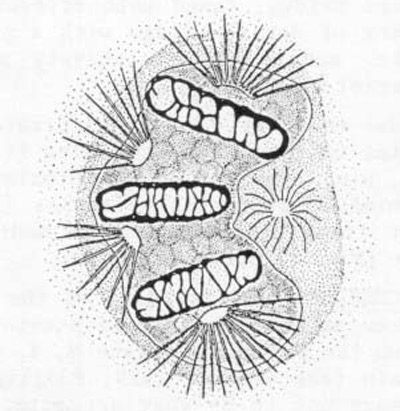
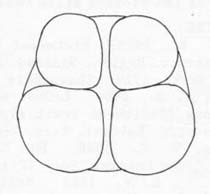
Larval Diagnosis The primary diagnostic characters for Mediterranean fruit fly larvae involve the anterior spiracles, the buccal carinae, and the prominent subspiracular tubercles of the caudal end. The anterior spiracles have the tubule edge relatively straight dorsally and the tubule number usually is nine to 10, although it can be from seven to 11. The buccal carinae number nine to 10. The caudal end has two prominent subspiracular tubercles, each with a crescent of irregularly fused papillules (approximately equivalent to 11-2). The anal lobe is either bifid or entire. The pharyngeal skeleton is distinctive in overall configuration, particularly the enlarged subhypostomium of the hypostomium (posterior to each mouth hook). There is a heavily sclerotized dorsal bridge point at the anterior of the dorsal wing plate. The shape of the interior sclerotizations of the dorsal wing plate and the hood of the pharyngeal plate are also distinctive for the species.
The features of the larvae of C. capitata, as noted in the description, are variable to some degree as indicated. Most previous illustrations of the cephalo-pharyngeal skeleton of the species have not shown the pharyngeal plate hood, and details of the illustrations also vary among themselves (see Greene 1929, Phillips 1946). The figure of the cephalo-pharyngeal skeleton in Greene (1929) appears not to be very accurate. The supposed supernumerary lateral papillules of the caudal end, noted by Phillips (1946), are not usually evident in specimens or at most represent only slight plate elevations on the very lateral edge dorsal to L1.
Larvae examined came from verified samples from Florida, Hawaii, and Portugal (all are in the larval collection of the Museum of Entomology, Florida State Collection of Arthropods).
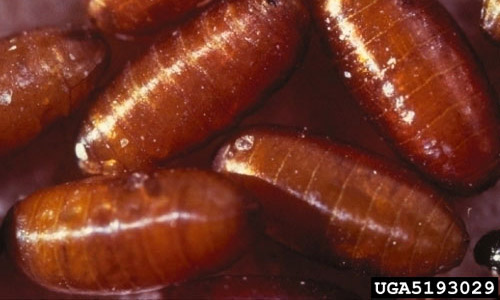
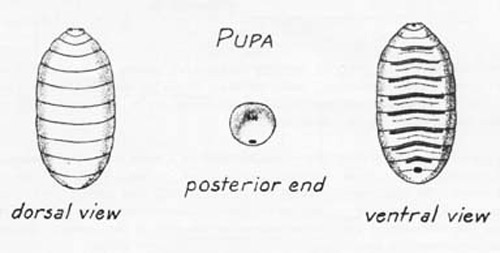
Pupa: The pupa is cylindrical, 4 to 4.3 mm long, dark reddish brown, and resembles a swollen grain of wheat.
Figure 12. Pupae of the Mediterranean fruit fly, Ceratitis capitata (Wiedemann). Photograph by Jeffery Lotz, Florida Department of Agriculture and Consumer Services-Division of Plant Industry; www.forestryimage.org.
Figure 13. Pupal views.
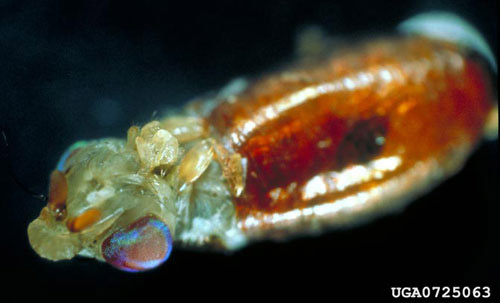
Figure 14. An adult Mediterranean fruit fly, Ceratitis capitata (Wiedemann), emerging from a puparium. Head is to the left. Photograph by Anne-Sophie Roy, European and Mediterranean Plant Protection Organization; www.forestryimages.org.
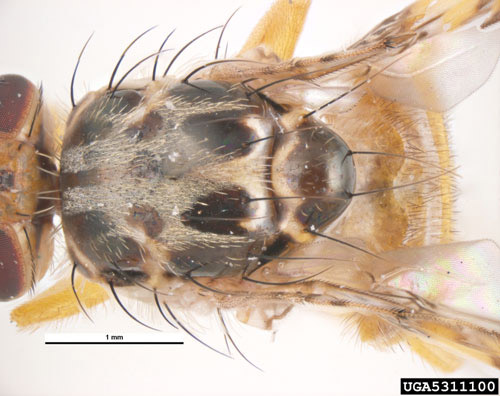
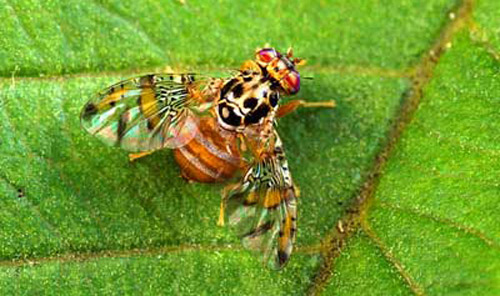
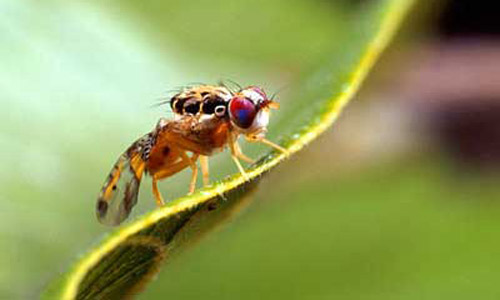
Adult: The adult fly is 3.5 to 5 mm in length. The color is yellowish with brown tinge, especially on abdomen, legs, and some markings on wings. The lower corners of the face have white setae. Eyes are reddish purple (fluoresce green, turning blackish within 24 hours after death). Ocellar bristles are present. The male has a pair of bristles with enlarged spatulate tips next to the inner margins of the eyes. The thorax is creamy white to yellow with a characteristic pattern of black blotches. Light areas have very fine white bristles. Humeral bristles are present. Dorsocentral bristles are anterior of the halfway point between supraalar and acrostichal bristles. The scutellum is inflated and shiny black. The abdomen is oval with fine black bristles scattered on dorsal surface and two narrow transverse light bands on basal half.
Figure 15. The thorax of the adult Mediterranean fruit fly, Ceratitis capitata (Wiedemann), is creamy white to yellow with characteristic pattern of black blotches. The light areas have very fine white bristles. Photograph by Ken Walker, Museum Victoria, Melbourne, Australia; www.forestryimages.org.
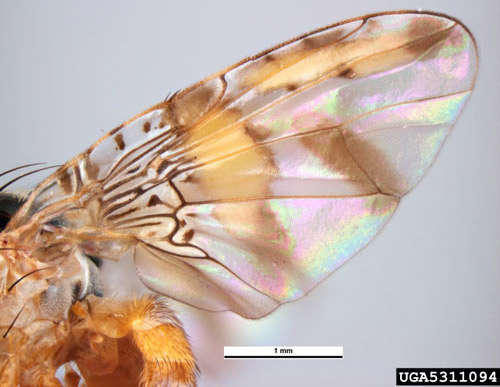
Wings, usually held in a drooping position on live flies, are broad and hyaline with black, brown, and brownish yellow markings. Ther is a wide brownish yellow band across the middle of the wing. The apex of the wing's anal cell is elongate. There are dark streaks and spots in middle of wing cells in and anterior to anal cell.
Figure 16. Wing of the adult Mediterranean fruit fly, Ceratitis capitata (Wiedemann). Wings are usually held in a drooping position on live flies, are broad and hyaline with black, brown, and brownish yellow markings. There is a wide brownish yellow band across middle of wing. Photograph by Ken Walker, Museum Victoria, Melbourne, Australia; www.forestryimages.org.
The males are easily separated from all other members of this family by the black pointed expansion at the apex of the anterior pair of orbital setae. The females can be separated from most other species by the characteristic yellow wing pattern and the apical half of the scutellum being entirely black (White and Elson-Harris 1994). The female's extended ovipositor is 1.2 mm long.
Figure 17. Dorsal view of adult male Mediterranean fruit fly, Ceratitis capitata (Wiedemann). Photograph by Scott Bauer, USDA.
Figure 18. Lateral view of adult Mediterranean fruit fly, Ceratitis capitata (Wiedemann). Photograph by Scott Bauer, USDA.
Life History and Habits (Back to Top)
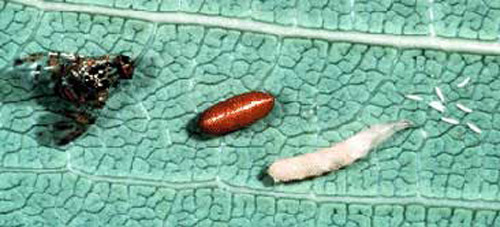
The length of time required for the medfly to complete its life cycle under typical Florida summer weather conditions, and on which eradication schedules in Florida are based, is 21 to 30 days. A female medfly will lay one to 10 eggs in an egg cavity 1 mm deep, may lay as many as 22 eggs per day, and may lay as many as 800 eggs during her lifetime (usually about 300). The number of eggs found at any time in the reproductive organs is no indication of the total number of eggs an individual female is capable of depositing, as new eggs are being formed continually throughout her adult life. Females usually die soon after they cease to oviposit.
Figure 19. Life cycle of the Mediterranean fruit fly, Ceratitis capitata (Wiedemann), from left to right: adult, pupa, larva and eggs. Photograph by USDA.
Eggs are deposited under the skin of fruit which is just beginning to ripen, often in an area where some break in the skin already has occurred. Several females may use the same deposition hole with 75 or more eggs clustered in one spot. When the eggs hatch, the larvae promptly begin eating. At first tunnels are formed by the feeding larvae. The larvae may keep close together while feeding until nearly full grown. Fruit in a hard or semiripe condition is better for oviposition than fully ripened fruit. Ripe fruit is likely to be more juicy, and such fruits often are associated with a high mortality of eggs and young larvae.
Females will not oviposit when temperatures drop below 60.8°F (16°C) except when exposed to sunlight for several hours. Development in egg, larval, and pupal stages stops at 50°F (10°C). Pupae carry the species through unfavorable conditions, such as lack of food, water, and temperature extremes. During warm weather eggs hatch in 1.5 to three days. The duration of the egg stage is considerably increased by lower temperatures.
Larvae pass through three instars. Larval life may be as short as six to 10 days when the mean temperatures average 77 to 79°F (25 to 26.1°C). The kind and condition of the fruit often influence the length of the larval stage. In citrus fruits, especially limes and lemons, it appears to be longer. Thus larvae require 14 to 26 days to reach maturity in a ripe lemon, as compared with 10 to 15 days in a green peach. Larvae leave the fruit in largest numbers at or just after daybreak and pupate in the soil or whatever is available.
Minimum duration of the pupal stage is six to 13 days when the mean temperature ranges from about 76 to 79°F (24.4 to 26.1°C). Back and Pemberton (1915) noted that this period may be increased to at least 19 days when the daily temperature means drop to about 69 to 71°F (20.6 to 21.7°C).
Adults emerge in largest numbers early in the morning during warm weather and emerge more sporadically during cool weather. They can fly short distances, but winds may carry them a mile or more away. Copulation may occur at any time throughout the day. Newly emerged adults are not sexually mature. Males often show sexual activity four days after emergence, and copulation has been observed five days after emergence. Both sexes are sexually active throughout the day. When the daily mean temperature averages from 76 to 78°F (24.4 to 25.6°C), most females are ready to mate from six to eight days after eclosion. Oviposition may take place as early as four to five days after emergence during very warm weather, but not for about 10 days when temperatures range between 68 to 72°F (20 to 22.2°C) (Back and Pemberton 1915).
Adults die within four days if they cannot obtain food. Usually about 50% of the flies die during the first two months after emergence. Some adults may survive up to six months or more under favorable conditions of food (fruit, honeydew, or plant sap), water, and cool temperatures. When host fruit is continuously available and weather conditions favorable for many months, successive generations will be large and continuous. Lack of fruit for three to four months reduces the population to a minimum.
Hosts (Back to Top)
The Mediterranean fruit fly attacks more than 260 different fruits, flowers, vegetables, and nuts. Thin-skinned, ripe succulent fruits are preferred. Host preferences vary in different regions. Although several species of cucurbits have been recorded as hosts of the medfly, they are considered to be very poor hosts. Some hosts have been recorded as medfly hosts only under laboratory conditions and may not be attacked in the field. Knowledge of the hosts in one country often aids in correctly predicting those which are most likely to be infested in a newly infested country, but what may be a preferred host in one part of the world may be a poor host in another.
Figure 20. Peach infested with larvae of the Mediterranean fruit fly, Ceratitis capitata (Wiedemann). Photograph by Division of Plant Industry.
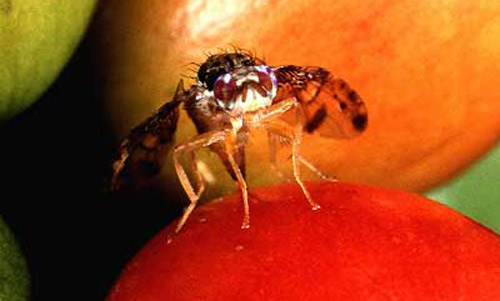
Figure 21. A female Mediterranean fruit fly, Ceratitis capitata (Wiedemann), pumps eggs through her ovipositor into the soft outer layers of a ripe coffee berry. Photograph by Scott Bauer, USDA.
Mediterranean Fruit Fly Host List (Back to Top)
Attached is a world list of hosts grouped according to their importance according to best available information.
Heavily or Generally Infested
- Blighia sapida K König (Cupania sapida (K König) Voigt), akee.
- Calophyllum inophyllum L., indiapoon beauty-leaf, kamani, Alexander laurel.
- Casimiroa edulis Llave, white sapote, casimiroa, Mexican apple.
- Chrysophyllum cainito L., cainito, star apple.
- Chrysophyllum oliviforme L., satin leaf, star apple, caimitillo, damson plum (Jamaica).
- Chrysophyllum polynesicum Hillebr., chrysophyllum.
- X Citrofortunella mitis (Blanco) J. Ingram and H.E. Moore (Citrus mitis Blanco), calamondin, Panama orange.
- Citrus aurantiifolia (Christm.) Swingle, lime.
- Citrus aurantium L., sour orange, Seville orange, bitter-sweet orange; (Citrus myrtifolia Raf.), myrtle-leaf orange.
- Citrus limon (L.) Burm. f., lemon, except 'Eureka', 'Lisbon', and 'Villa Franca' cultivars (smooth-skinned sour lemon).
- Citrus x limonia Osbeck (Citrus taitensis Risso), lemon.
- Citrus maxima (Burm.) Merrill (Citrus grandis (L.) Osbeck; Citrus decumana (L.) L.), pummelo, pomelmous shaddock, Pernambuco.
- Citrus x nobilis Lour., king orange.
- Citrus x paradisi Macfady, grapefruit, pomelo.
- Citrus reticulata Blanco (Citrus deliciosa Ten.; Citrus nobilis Andr. var. deliciosa Ten.), mandarin orange, tangerine.
- Citrus sinensis (L.) Osbeck 'Valencia' and 'Parson Brown' and 'Lue Gim Gong' , Malta orange, Lambs summer orange.
- Coffea canephora Pierre ex Froehn., robusta coffee, Coffea arabica L., Arabian coffee, common coffee.
- Coffea liberica Bull ex Hiern, Liberian coffee.
- Cydonia oblonga Mill. (C vulgaris Pers.), quince, mannela.
- Diospyros decandra Lour., persimmon.
- Diospyros kaki L. f. (Diospyros chinensis Blume; Diospyros roxburghii Carr.; Diospyros schi-tse Bunge), kaki persimmon, Oriental persimmon.
- Dovyalis caffra (Hook. f. & Harv.) Warb. (Aberia caffra Hook. f. & Harv.), kei-apple, umkokolo.
- Eriobotrya japonica (Thunb.) Lindl. (Photinia japonica Thunb.), loquat, Malta plum.
- Eugenia uniflora L. (Eugenia michelii Lam.; Stenocalyx michelii Berg), Surinam cherry, pitanga, Brazil cherry, cayenne cherry, Florida cherry, French cherry.
- Ficus carica L., common fig, lemon fig.
- Fortunella japonica (Thunb.) Swingle (Citrus japonica Thunb.), round and marumi kumquat.
- Malus pumila Mill. (M. communis Poir.; Pyrus pumila (Mill.) C. Koch), common apple.
- Mangifera indica L., mango.
- Mimusops elengi L., elengi tree, pogada, West Indian medlar, elengi bulletwood.
- Murraya paniculata (L.) Jacq. (Murraya exotica L.), orange-jessamine, mock orange.
- Prunus americana Marsh., native plum, American plum.
- Prunus armeniaca L. (Armeniaca vulgaris Lam.), apricot.
- Prunus domestica L., garden plum, Prunus domestica L. spp. insitita (L.) Schneid., damson,bullace.
- Prunus persica (L.) Batsch. (Amygdalus persica L.; Mill.), Persica vulgaris (Mill.), peach.
- Prunus persica (L.) Batsch. var. nucipersica (Suckow) C.K. Schneid. (P. persica (L.) Batsch. var. nectarina (Ait. f.) Maxim.), nectarine.
- Psidium cattleianum Sab. (Psidium littorale Raddi var. longipes (O. Berg.) Fosb.), strawberry guava, cattley guava, waiawi.
- Psidium guajava L., guava.
- Pyrus communis L., common pear.
- Pyrus x leconte Rehd., leconte pear.
- Syzygium jambos (L.) Alston (Eugenia jambos L.; Caryophyllus jambos Stokes), rose apple, jambos, Malabar plum.
- Terminalia catappa L., tropical almond, false kamani, winged kamani.
- Terminalia chebula Retz., black myrobalan, chebula terminalia.
Occasionally Infested
- Annona muricata L., soursop, guan -bana.
- Averrhoa carambola L., carambola, star-fruit.
- Capsicum annuum L. (Capsicum frutescens auct.; Capsicum baccatum Vell.), Conoides Group: red pepper; Grossum Group: bell pepper, sweet pepper; Cerasiforme Group: cherry pepper; Longum Group: cayenne pepper, chili, long red.
- Carica papaya L., papaya, papaw.
- Carica quercifolia Solms, dwarf papaya, oakleaf papaya.
- Carissa bispinosa (L.) Desf. ex Brenan (Carissa arduina Lam.; Carissa acuminata A. DC.), hedge thorn.
- Fragaria x ananassa Duchesne (Fragaria chilonensis (L.) Duchesne x F. virginiana Duchesne), cultivated or garden strawberry.
- Garcinia mangostana L., mangosteen.
- Garcinia xanthochymus Hook. f. ex T. Anderson, garcinia, gourka.
- Gossypium sp., cotton.
- Juglans sp., walnut.
- Lycopersicon esculentum Mill., tomato.
- Ochrosia elliptica Labill., ochrosia.
- Opuntia sp., prickly pear. Opuntia humifusa (Raf.) Raf. (Opuntia compressa (Salisb.) Macbr.; Opuntia opuntia (L.) Karst.; Opuntia. rafinesquei Engelm.; Opuntia mesacantha Rafin.), Opuntia humifusa Raf. 'Variegata', Opuntia dilleni Haw., Opuntia tuna (L.) Mill.(Opuntia humilis Haw.; Opuntia horrida Salm-Dyck ex DC.), Opuntia polyantha Haw., Opuntia vulgaris Mill. (Opuntia monocantha (Willd.) Haw.; Opuntia nana DC.).
- Opuntia ficus-indica (L.) Mill. (Opuntia engelmanni Salm-Dyck; Opuntia megacantha Salm-Dyck; Opuntia occidentalis Engelm. & Bigel.), Indian fig, spineless cactus.
- Persea americana Mill. (Persea gratissima C.F. Gaertn.), avocado, alligator pear.
- Syzygium malaccense (L.) Merrill & L.M. Perry (Eugenia malaccensis L.; Jambosa malaccensis (L.) DC.; Caryophyllus malaccensis Stokes), ohia, Malay apple, pomerack, mountain apple.
Rarely Infested
- Annona reticulata L., bullocks-heart, custard apple, anona.
- Arenga pinnata (Wurmb) Merrill, (Arenga saccharifera Labill.), gomuti, sugar palm.
- Artocarpus altilis (Parkins.) Fosb. (Artocarpus incisus L.F.; Artocarpus communis Forst.), breadfruit.
- Carissa grandiflora (E.H. Mey.) A. DC., Natal plum, carissa.
- Cestrum sp., cestrum, jessamine: Cestrum nocturnum L., night-jessamine, Chinese inkberry, night-blooming jasmine.
- Clausena lansium (Lour.) Skeels (Clausena punctata (Sonn.) Rehd. & E.H. Wils.; Clausena wampi (Blanco) D. Oliver), Chinese wampee, wampi.
- Latania loddigesii Mart. (Latania glaucophylla Hort. ex Baker), blue palm.
- Litchi chinensis Sonn. (Nephelium litchi Camb.), litchi, lychee.
- Lycium europaeum L., European wolfberry.
- Malpighia glabra L., Barbados cherry, acerola.
- Manilkara zapota (L.) Van Royen (Achras zapota L.; Sapota achras Mill.; Manilkara zapotilla (Jacq.) Gilly), sapodilla.
- Musa acuminata Colla (Musa cavendishii Lamb. ex Paxt.; Musa nana auct.; Musa chinensis Sweet), dwarf banana, Chinese banana.
- Musa x paradisiaca L. (Musa x sapientum L.), common banana, plantain.
- Noronhia emarginata (Lam.) Thouars ex Hook., Madagascar olive, noronhia, Chinese plum.
- Passiflora sp., passion flower, Passiflora caerulea L., blue-crown passion flower, Passiflora foetida L., tagua passion flower.
- Phoenix dactylifera L., date palm.
- Punica granatum L., pomegranate.
- Rubus sp., blackberry, youngberry.
- Santalum freycinetianum Gaudich. (S. paniculatum Hook. & Arn.), beach sandalwood.
- Solanum incanum L. (S. coagulans Forssk.).
- Solanum melongena L. var. esculentum Nees, garden eggplant.
- Spondias cytherea Sonn. (Spondias dulcis G. Forst.), ambarella, otaheite apple, vi-apple, wi.
- Syagrus campestris (Mart.) H. Wendl. (Cocos campestris Mart.), field syagrus palm.
- Syzygium samarangense (Blume) Merrill & L.M. Perry (Eugenia javanica Lam.).
- Vitis lambrusca L., fox grape, Isabella grape.
Laboratory Infestations
- Acanthocereus sp., acanthocereus. Acanthocereus pentagonus (L.) Britt. & Rose (Cereus baxaniensis Karw. ex Pfeiff.; Cereus pentagonus (L.) Haw.), barbwire acanthocereus, dildoe, cactus.
- Aronia arbutifolia (L.) Pers. (Pyrus arbutifolia (L.) L.f.), red chokeberry.
- Coccoloba diversifolia Jacq. (Coccoloba floridana Meissn.; Coccoloba laurifolia Lindau), pigeon plum, dove plum.
- Crataegus floridana Sarg., Jacksonville hawthorn.
- Crataegus galbana Beadle, hawthorn.
- Cucumis anguria L. (Cucumis erinaceus Hort.; Cucumis grossulariiformis Hort.), West Indian gherkin, wild cucumber.
- Cydonia sp., quince. Cydonia sinensis Thouin (Chaenomeles sinensis (Thouin) Koehne; Pseudocydonia sinensis Schneid.), Chinese quince.
- Echinocereus triglochidiatus Engelm. var. neomexicanus (Standl.) Standl. ex W.T. Marsh. (Echinocereus polyacanthus Engelm.), cactus.
- Eugenia axillaris (Swartz) Willd., whitestopper eugenia.
- Forestiera sp. (Adelia sp.), adelia. Forestiera segregata (Jacq.) Krug & Urban, Florida privet.
- Fortunella hindsii (Chapm.) Swingle, Hong Kong kumquat.
- Fragaria chiloensis (L.) Duchesne, strawberry, chiloe strawberry.
- Hibiscus sabdariffa L., roselle, Jamaica sorrell.
- Hylocereus undatus (Haw.) Britt. & Rose (Cereus undatus Haw.), night-blooming cereus, pitaya.
- Ilex glabra (L.) A. Gray, inkberry, gallberry.
- Licania michauxii Prance (Geobalanus oblongifolius Michx.), gopher apple.
- Osmanthus americanus (L.) A. Gray (Osmanthus floridanus Chapm.), wild olive, hammock osmanthus.
- Solanum erianthum D. Don (Solanum verbascifolium auct.), potato tree, mullein nightshade.
- Solanum seaforthianum Andr., Brazilian nightshade.
- Solanum sisymbriifolium Lam., nightshade.
- Ximenia americana L., tallow-wood.
Unknown Importance
- Acokanthera sp. (Toxicophlaea). Acokanthera longiflora Stapf, Bushman's-poison.
- Ananas comosus (L.) Merrill (Ananas sativus Schult.), pineapple.
- Annona cherimola Mill., cherimoya.
- Annona glabra L., pondapple, alligator apple.
- Annona squamosa L., sugar apple, sweetsop.
- Arbutus unedo L., strawberry madrone.
- Argania spinosa (L.) Skells (Argania sideroxylon Roem. & Schult.), hardwood evergreen tree, Morocco ironwood.
- Argemone mexicana L., Mexican prickle poppy, cardosanta, cardo.
- Artabotrys hexapetalus (L.f.) Bhand. (Artabotrys uncinatus (Lam.) Merrill; Artabotrys odoratissimus R. Br.), fragrant tailgrape, climbing ylang-ylang.
- Asimina triloba (L.) Dunal, papaw, pawpaw.
- Asimina obovata (Willd.) Nash, bigflower pawpaw.
- Asimina parviflora (Michx.) Dunal, smallflower pawpaw.
- Asimina pygmaea (Bartr.) Dunal, sprawling pawpaw.
- Asimina reticulata Schuttlw. ex Chapm., seminoletea pawpaw, common pawpaw.
- Asparagus densiflorus (Kunth) Jessop 'Sprengeri', Sprenger asparagus.
- Atropa belladonna L., belladonna.
- Berberis holstii Engl., barberry.
- Brucea ferruginea L'Her. (Brucea antidysenterica Lam.).
- Bumelia lycioides (L.) Pers., buckthorn bumelia.
- Bumelia tenax (L.) Willd., tough bumelia, buckthorn.
- Butia sp., butia palm. Butia capitata (Mart.) Becc. (Cocos capitata Mart.), jelly palm, Brazilian butia palm, pindo palm.
- Cananga odorata (Lam.) Hook. f. & T. Thoms., ylang-ylang.
- Capparis citrifolia Lam., caper.
- Carissa carandas L., karanda carissa.
- Chrysobalanus ellipticus Soland. ex Sabine.
- Chrysobalanus icaco L., icaco coco plum, gopher apple, gopher plum.
- Chrysophyllum africanum A. DC. (Chrysophyllum argyrophyllum Hiern), African star apple.
- Chrysophyllum viridifolium Wood & Franks.
- Citharexylum fruticosum L. (Citharexylum cinereum L.), Florida fiddlewood.
- Citrullus lanatus (Thunb.) Matsum. & Nakai (Citrullus vulgaris Schrad.), watermelon.
- Citrus medica L., citron.
- Clintonia umbellulata (Michx.) Morong, spreckled beadlily.
- Coccoloba uvifera (L.) L., sea grape.
- Cotoneaster adpressus Bois. var. praecox Bois. & Berthault (Cotoneaster praecox (Bois & Berthault) Hort. Vilm. - Andr. ex Meuniss.), early creeping cotoneaster.
- Crataegus azarolus L., azarole hawthorn, haw.
- Crinum asiaticum L. (Crinum sinicum Roxb. ex Herb.) St. John's lily.
- Cucumis dipsaceus C.G. Ehrenb. ex Spach, hedgehog, teaselgourd, wild cucumber.
- Cucumis melo L., Cantalupensis Group: cantaloupe; Inodorns Group: casaba melon; Reticulatus Group: muskmelon.
- Cucumis sativus L., cucumber.
- Cucurbita maxima Duchesne, winter squash, hubbard squash.
- Cucurbita moschata (Duchesne) Poir., cushaw pumpkin, Canada and winter crookneck pumpkin.
- Cucurbita pepo L., pumpkin, vegetable marrow.
- Cyphomandra betacea (Cav.) Sendtn., tree tomato.
- Diospyros mespiliformis Hochst. ex A. DC., medlar persimmon.
- Diospyros virginiana L., common persimmon, wild persimmon.
- Dovyalis hebecarpa (G. Gardn.) Warb., kitembilla, Ceylon gooseberry.
- Ekebergia capensis Sparrm., dog plum.
- Eugenia brasiliensis Lam. (Stenocalyx brasiliensis Berg), Brazil eugenia, Brazilian plum, Spanish cherry.
- Euphorbia lathyris L., caper euphorbia, gopher apple.
- Euphoria longan (Lour.) Steud. (Nephelium longan Lour.; Dimocarpus longan Lour.), longan, dragon's eye.
- Feijoa sellowiana O. Berg, feijoa guavasteen, pineapple guava.
- Ficus benghalensis L. (Ficus indica L.), glabrous tree, India fig.
- Flacourtia indica (Burm. f.) Merrill (Flacourtia ramontchi L'Her.), ramontchi, governor's plum.
- Fortunella crassifolia Swingle, meiwa kumquat.
- Fortunella margarita (Lour.) Swingle, Eustis limequat, megami kumquat.
- Gardenia sp., gardenia.
- Glycosmis pentaphylla (Retz.) Correa, glycomis, Malay glycosmis.
- Harpephyllum caffrum Bernh. ex C.F. Krauss, Kafir plum.
- Hevea brasiliensis (Willd. ex A. Juss.) Mull. Arg., para rubber tree, caoutchoue, Brazil rubber.
- Homalocladium platycladum (F.J. Muell.) L.H. Bailey, ribbon bush.
- Ilex vomitoria Ait., Carolina holly, yaupon.
- Juglans hindsii (Jeps.) Jeps.
- Landolphia sp., gumvine.
- Lycium carolinanum Walt., Carolina wolfberry, boxthorn.
- Lycium chinense Mill. (L. carnosum Hort.), (L. campanulatum Drege ex Dun.), boxthorn.
- Lycium horridum Thunb., African buckthorn.
- Maclura pomifera (Raf.) C.K. Schneid. (M. aurantiaca Nutt.; Toxylon pomifera Raf.), osage orange.
- Malpighia punicifolia L., Barbados cherry, acerola.
- Mammea americana L., mamey, mammee apple.
- Marrubium vulgare L., common hoarhound.
- Mastichodendron foetidissimum (Jacq.) Lam. (Sideroxylon mastichodendron Jacq.; Sideroxylon foetidissimum Jacq.), mastic, jungle plum, ironwood.
- Melicoccus bijugatus Jacq. (Melicocca bijuga L.), mamoncillo, mamon, Spanish lime, genip.
- Melothria pendula L., creeping cucumber.
- Mespilus germanica L., medlar.
- Mimusops sp., milkwood.
- Mimusops caffra E.H. Mey. ex A. DC., Kafir bulletwood.
- Mimusops kirkii Bak.
- Momordica balsamina L., balsam apple.
- Monstera deliciosa Liebm. (Philodendron pertusum Kunth & Bouche), ceriman.
- Morus sp., mulberry.
- Myrciaria edulis (Vell.) Skeels (Eugenia edulis Vell.), willow-leaved eugenia.
- Nyssa ogeche Bartr., ex Marsh., ogeche lime, ogechi plum, ogeechee tupelo.
- Nyssa sylvatica Marsh., sour gum.
- Nyssa sylvatica Marsh. var. biflora (Walt.) Sarg., black gum, swamp black tupelo.
- Olea europaea L., common olive.
- Passiflora edulis Sims, purple granadilla, lilikoi, passion fruit.
- Passiflora incarnata L., wild passion flower, maypop.
- Passiflora laurifolia L., yellow granadilla, water lemon, Jamaica honeysuckle.
- Passiflora lingularis Juss., sweet granadilla.
- Passiflora mollissima (HBK) L.H.Bailey, lilikoi, soft-leaf passion flower.
- Passiflora quadrangularis L. (Passiflora macrocarpa M.T. Mast.), giant granadilla.
- Peponia mackennii Naud., wild cucurbit.
- Pereskia aculeata Mill. (Pereskia pereskia (L.) Karst.), Barbados gooseberry.
- Phaseolus limensis Macfady., lima bean.
- Phaseolus lunatus L., sieva bean, cibet bean.
- Phaseolus vulgaris L., kidney bean, haricot, string bean.
- Phyllantus acidus (L.) Skeels, otaheite gooseberry, leafflower, Ceylon gooseberry.
- Physalis peruviana L., cape gooseberry, poha.
- Pimenta dioica (L.) Merrill (P. officinalis Lindl.), allspice, pimenta.
- Pleiogynium cerasiferum (F.J. Muell.) R. Parker (Pleiogynium solandri (Benth.) Engl.; Spondias solandri Benth.), burdekin plum.
- Podocarpus elongatus (Ait.) L'Her. ex Pers., yellowood, fern podocarpus.
- Poncirus trifoliata (L.) Raf., trifoliate orange.
- Pouteria campechiana (HBK) Baehni (Lucuma nervosa A. DC.; Lucuma rivicoa Gaertn. f.), canistel incuma, egg fruit.
- Pouteria sapota (Jacq.) H.E. Moore & Stern (Calocarpum sapota (Jacq.) Merrill; C. mammosum auct.; Lucuma mammosa auct.), sapote.
- Prunus cerasus L. (Cerasus caproniana DC.), sour cherry.
- Prunus dulcis (Mill.) D.A. Webb (Prunus amygdalus Batsch; Prunus communis (L.) Arcang.) almond.
- Prunus japonica Thunb., Chinese bushcherry, plum.
- Prunus salicina Lindl., Japanese plum.
- Prunus umbellata Ell., wild plum, flatwoods plum.
- Psidium guineense Swartz, Brazilian guava.
- Psidium littorale Raddi var. littorale (Psidium littorale Raddi var. lucidum (Degener) Fosb.), yellow cattley guava.
- Putranjiva roxburghii Wallich, wild olive, India amulet plant.
- Pyracantha coccinea M.J. Roem. 'Lalandei', laland firethorn.
- Ribes sp., currant, gooseberry.
- Robinia sp., locust.
- Rosa sp., rose.
- Royena pallens Thunb. (Royena pubescens Willd.), pale-branched royena.
- Salix sp., willow leaf.
- Santalum album L., sandalwood, white sandalwood.
- Scaevola plumieri (L.) Vahl, goodenia beechberry.
- Schinus molle L., California pepper tree (blossoms).
- Sechium edule (Jacq.) Swartz (Chayota edulis Jacq.); chayote, christophine.
- Selenicereus pteranthus (Link & Otto) Britt. & Rose (Cereus nycticalus Link; Cereus pteranthus Link ex Dietr.), cactus.
- Serenoa repens (Bartr.) Small (S. serrulata (Michx.) Nichols; Brahea serrulata H. Wendl.; Chamerops serrulata Michx.; Sabal serrulatum Shult. f.), saw palmetto.
- Severinia buxifolia (Poir.) Ten. (Atalantia buxifolia (Poir.) D. Oliver; Triphasia monophylla DC.), Chinese box orange.
- Sideroxylon inerme L., ironwood.
- Smilax beyrichii Kunth, Smilax sandwicensis Kunth, smilax.
- Solanum aculeatissimum Jacq., solanum, Sodoms apple, nightshade.
- Solanum capsicastrum Link ex Schauer, solanum cherry, false Jerusalem cherry.
- Solanum carolinense L., Caroline horse nettle.
- Solanum melanocerasum All. (Solanum nigrum L. var. guineense L.), solanberry, black nightshade, garden huckleberry.
- Solanum pseudocapsicum L., Jerusalem cherry.
- Solanum sodomeum L., apple of Sodom.
- Sorbus sp., mountain ash.
- Spondias sp., West Indian plum.
- Spondias mombin L. (Spondias axillaris Roxb.; Spondias lutea L.), yellow mombin, Spanish plum, hog plum, jobo, cajamerin.
- Strychnos atherstonei Harv., cape teak.
- Strychnos pungens Solered., poison nut, wild orange.
- Syzygium cumini (L.) Skeels (Syzygium jambolana (Lam.) DC. Eugenia cumini (L.) Druce; Eugenia jambolana Lam.), jambolan, Java palm.
- Teclea trichocarpa (Engl.) Engl.
- Terminalia pallida Brandis, terminalia.
- Theobroma cacao L., cacao, cocoa.
- Thevetia peruviana (Pers.) K. Schum. (Thevetia neriifolia A. Juss. ex Steud.; Cerbera thevetia L.), yellow oleander, be-still, lucky nut thevetia.
- Vaccinium cereum Forst. f., blueberry.
- Vangueria edulis Vahl (Vangueria madagascariensis J.F. Gmel.), vangueria.
- Vangueria infausta Burchell, wild medlar, vangueria.
- Vicia faba L., broad bean, horse bean.
- Vitis sp. (hybrid), beacon grape.
- Vitis vinifera L., wine grape, European grape.
- Wikstroemia phillyreifolia Gray, wikstroemia.
- Ziziphus jujuba Mill. (Ziziphus vulgaris Lam., Ziziphus sativa Gaertn.), jujube, Chinese date.
Detection and Survey (Back to Top)
A primary method of collecting larvae is by cutting infested fruit. Fully grown larvae, when the surrounding air temperature is warm, flex and "jump" repeatedly as much as 25 mm when removed from fruit. Larval identification is extremely difficult, so that when feasible it is best to rear them to adults for identification. If collected larvae must be killed, they should be placed in hot water and then transferred to 70% isopropenol. Larval identification is based primarily on characters of mature 3rd instar larvae.
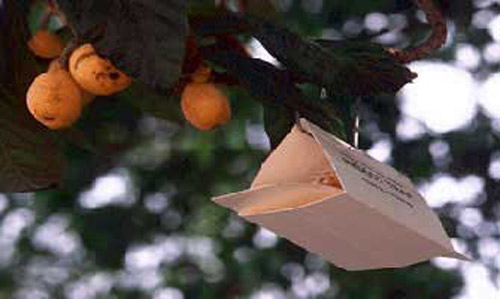
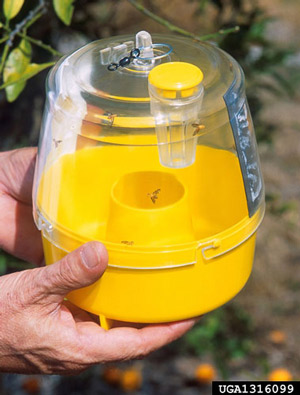
Adults are collected primarily by use of sticky-board traps and baited traps (USDA 1997). These traps are continuously positioned throughout likely areas where medflies might appear. In Florida, Inspectors from the Department of Agriculture and Consumer Services-Division of Plant Industry continually monitor the traps for the appearance of pest fruit flies. Once an adult Mediterranean fruit fly is positively identified, the number of baited traps throughout that area is greatly increased to capture the flies and remove them from the environment, and to serve as a monitoring tool for the effectiveness of the eradication program. Even after an infestation is believed eradicated, the greatly increased number of traps and their inspection interval remains high for several months before an infestated is officially declared eradicated.
Figure 22. Older version of trap used to capture adults of the Adult Mediterranean fruit fly, Ceratitis capitata (Wiedemann). Photograph by USDA.
Figure 23. Newer version of trap used to capture adult of the Mediterranean fruit fly, Ceratitis capitata (Wiedemann). The improved version of the McPhail trap uses a combination of three chemicals to attract male and female fruit flies. The older version of the trap used a protein bait that captured large numbers of non-target insects. Photograph by Peggy Greb, USDA; www.forestryimages.org.
Management (Back to Top)
As a Mediterranean fruit fly infestation falls under the control of Florida's regulatory agency - the Department of Agriculture and Consumer Services (FDACS) and its Division of Plant Industry (DPI), there are no University of Florida management recommendations. Plus treatment strategies change in an environment of public concern about aerial application of insecticidal baits.
For the 2010 infestation, the following treatments are being used by FDACS-DPI and the USDA (FDACS 2010b):
Foliar Spot Treatments: Spraying trees with Spinosad (product FG-120 NF Naturalyte Fruit Fly Bait) which is an insecticide derived from a naturally occurring soil organism. Spraying will take place in the core area of a positive find and extend out 1-1/2 miles.
Soil Drenching: The soil under host trees with fruit known or suspected to be infested with medfly larvae and host trees under adjacent properties will be treated.
Fruit Stripping: Fruit will be stripped from all host trees on a known larval properties and within 200 meters (656 feet). Fruit is placed in heavy plastic bags and removed to a local landfill to be buried.
Sterile Fruit Fly Release: This control method relies on flooding the area of an infestation of wild flies with sterile flies produced in rearing facilities. When the sterile flies mate with the fertile population, no offspring are produced. Gradually, the wild flies can only find sterile flies to mate, the wild population is eradicated.
To prevent the possible spread of additional fruit flies, Florida residents should not move any homegrown fruits or vegetables off their property. Thank you for your cooperation in the eradication of Mediterranean fruit fly. If you have any questions, please call the toll-free Mediterranean fruit fly helpline at 1-888-397-1517.
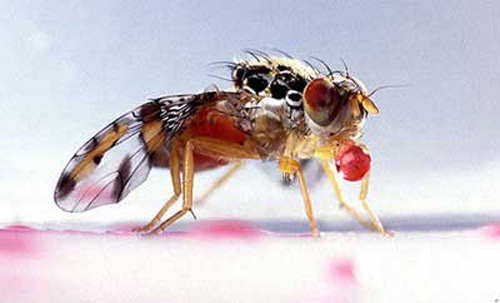
USDA-ARS scientists in Hawaii and Texas collaborated in investigating phloxine B, better known as the FDA-approved red dye number 28. The dye proved to be as effective as malathion-bait sprays and might be a safe, effective alternative to previously used aerially-applied malathion insecticide baits. Medflies often share regurgitated food. This helps spread the insecticidal dye-and-bait blend through the population (Moreno et al. 2001).
Figure 24. Adult Mediterranean fruit fly, Ceratitis capitata (Wiedemann), feeding on a cotton wick soaked with a bait-dye mixture. Photograph by Scott Bauer, USDA.
Figure 25. Lateral view of adult Mediterranean fruit fly, Ceratitis capitata (Wiedemann), regurgitating food. Photograph by Scott Bauer, USDA.
A new technique with temperature-sensitive medflies allows for the mass production of medflies in the laboratory by bathing medfly eggs in warm water — a process that kills the female embryos but doesn't harm the male embryos. In the pupal stage, the males can be irradiated to render them sexually sterile (USDA 2000).
USDA-APHIS, in cooperation with threatened states, has established action plans that go into effect when fruit flies are trapped and reported (USDA 2008).
In Florida, the FDACS-Division of Plant Industry will cooperate with USDA-APHIS in regulating the actions of both commercial entities and homeowners.
Selected References (Back to Top)
- Ayers EL. 1957. The two medfly eradication programs in Florida. Proceedings of the Florida State Horticultural Society 70: 67-69.
- Back EA, Pemberton CE. 1915. Life history of the Mediterranean fruit fly from the standpoint of parasite introduction. Journal of Agricultural Research 3: 363-374. United States Department of Agriculture, Washington, D.C.
- Back EA, Pemberton CE. 1918. The Mediterranean fruit fly in Hawaii. United States Department of Agriculture Bulletin 536: 1-119.
- Back EA, Pemberton CE. 1918. The Mediterranean fruit fly. United States Department of Agriculture Bulletin 640: 1-43.
- Berg GH. 1979. Pictorial key to fruit fly larvae of the family Tephritidae. San Salvador: Organ. Internac. Region. Sanidad. Agropee. 36 pp.
- Christenson LD, Foote RH. 1960. Biology of fruit flies. Annual Review of Entomology 5: 171-192.
- Conley KL. 1981 (publication date not given). Field guide to medfly infestation. Cooperative Mediterranean Fruit Fly Project (California). 13 pp.
- De Woskin R. 1981. Medfly training manual. Joint cooperative Mediterranean fruit fly eradication project. United States Deptartment of Agriculture, California Department of Food and Agriculture, Santa Clara County Agriculture Commissioner, Alameda County Department of Agriculture 215 pp.
- Foote RH. 1967. Family Tephritidae. In Vanzolini, M., ed., A catalogue of the Diptera of the Americas south of the United States 57: 1-91. Dept. Zool., Sec. Agric., Sao Paulo, Brasil.
- Greene CT. 1929. Characters of the larvae and pupae of certain fruit flies. Journal of Agricultural Research 38: 489-504.
- Hardy DE. 1949. Studies in Hawaiian fruit flies. Proceedings of the Entomology Society of Washington 51: 81-205.
- Heppner JB. 1984. Larvae of fruit flies. I. Anastrepha ludens (Mexican fruit fly) and Anastrepha suspensa (Caribbean fruit fly) (Diptera: Tephritidae). Florida Department of Agriculture and Consumer Services, Division of Plant Industry Entomology Circular 260: 4 pp.
- Liquido NJ, Shinoda LA, Cunningham RT. 1991. Host Plants of the Mediterranean Fruit Fly (Diptera Tephritidae): An Annotated World Review. Entomological Society of America. Miscellaneous Publications, No. 77.
- Meyer CA. 1976. Mediterranean fruit fly impact in Central America. United States Department of Agriculture Cooperative Plant Pest Report 1: 117-118.
- Mitchell WC, Andrew CO, Hagen KS, Hamilton RA, Harris EJ, Maehler KL, Rhode RH. 1977. The Mediterranean fruit fly and its economic impact on Central American countries and Panama. UC/AID Pest Management and Related Environmental Protection Project at the University of California, Berkeley. 189 pp.
- Papadopoulos NT. 2008. Mediterranean fruit fly, Ceratitis capitata (Wiedemann) (Diptera: Tephritidae). pp. 2318-2322. In Encyclopedia of Entomology Vol. 3. Capinera JL. (editor). Springer, Heidelberg.
- Phillips VT. 1946. The biology and identification of trypetid larvae (Diptera: Trypetidae). Memoirs of the American Entomological Society 12: 1-161.
- Rhode RH, Simon J, Perdomo A, Gutierrez J, Dowling Jr. CF, Linquist DA. 1971. Application of the sterile-insect-release technique in Mediterranean fruit fly suppression. Journal of Economic Entomology 64: 708-713.
- Stephenson DP. Mediterranean fruit fly not present in New Zealand. StephensonB@maf.govt.nz. (17 July 2001).
- USDA. 1975. Mediterranean fruit fly in the U.S. - 1975. Cooperative Economic Insect Report 25: 825-839. Plant Protection and Quarantine Programs, Animal and Plant Health Inspection Service, United States Department of Agriculture.
- White IM, Elson-Harris MM. 1994. Fruit Flies of Economic Significance: Their Identification and Bionomics. CAB International. Oxon, UK. 601 pp.