common name: Florida wax scale
scientific name: Ceroplastes floridensis Comstock (Insecta: Hemiptera: Coccoidea: Coccidae)
Introduction - Synonymy - Distribution - Description - Life Cycle and Biology - Hosts - Economic Importance and Damage - Management - Selected References
Introduction (Back to Top)
The Florida wax scale, Ceroplastes floridensis Comstock, is one of the most commonly encountered soft scales throughout the southern United States, where it is a serious pest of citrus and several ornamental plants, like holly.
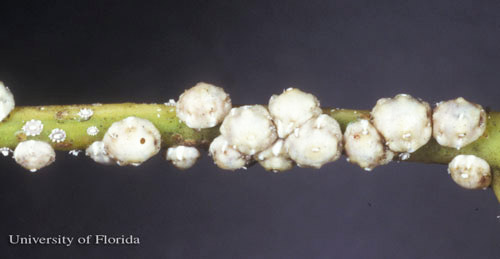
Figure 1. Adult Florida wax scales, Ceroplastes floridensis Comstock. A few nymphs are visible at the left. Photograph by Lyle J. Buss, University of Florida.
Synonymy (Back to Top)
Ceroplastes vinsonii Signoret, 1872 (Ben-Dov 2012)
Cerostegia floridensis (Comstock), Gimpel et al. 1974
Distribution (Back to Top)
Florida wax scale is thought to have originated from the northern Neotropical region and now occurs throughout the world, including, but not restricted to, the following countries:
Africa: Algeria, Egypt, Kenya, Libya, Madagascar, Madeira, Mauritius, Morocco, Mozambique, Seychelles, Sierra Leone, Sudan, Tanzania, Uganda
Asia: Bonin Islands, Brunei, China, Cyprus, India, Iran, Israel, Japan (including the Ryukyu Islands), Korea, Lebanon, Malaysia, Pakistan, Sri Lanka, Syria, Taiwan, Turkey, and the more southern member countries of the former Union of Soviet Socialist Republics
Australasia and Pacific Islands: Australia, Caroline Islands, Mariana Islands, New Zealand
Central America and Caribbean: Costa Rica, Guatemala, Honduras, Panama, West Indies
Europe: France (including Corsica), Greece, Italy (including Sicily), Malta, Spain
North America: Mexico, United States
South America: Brazil, Colombia, Ecuador, Guyana, Venezuela
(CABI 1982)
In the United States, it occurs from New York to Florida and west to New Mexico (Hamon and Williams 1984). It may occur in the northern U.S., but it has not achieved pest status there because it cannot survive the winter (Hodges et al. 2000).
Description (Back to Top)
Adults: Adult female Florida wax scales are elliptical, reddish brown with a short anal process (Hamon and Williams 1984), and range from 2 to 4 mm in length and 1 to 3.5 mm in width. Each female has a reddish body that is coated with a thick layer of pinkish-white wax. Males are not known in this species (Futch et al. 2009).
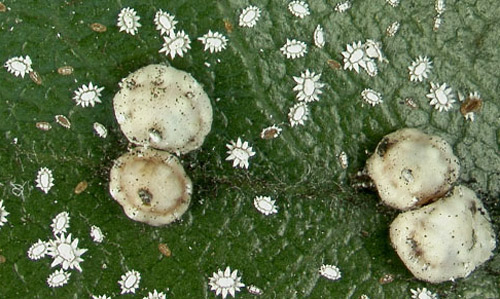
Figure 2. Adults and early instars of the Florida wax scale, Ceroplastes floridensis Comstock. Photograph by Lyle J. Buss, University of Florida.
Eggs: The eggs are pink to dark red and they are laid under the adult female scale's wax covering.
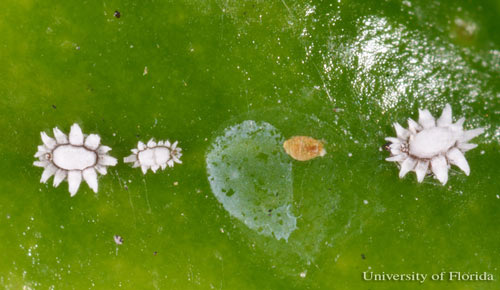
Nymphs: The first instars are pink in color and have functional legs. The second and third instars secrete a wax covering around them, giving them a star-like appearance.
Figure 3. Crawler (pink instar - second from right) and settled nymphs of the Florida wax scale, Ceroplastes floridensis Comstock. Photograph by Lyle J. Buss, University of Florida.
Life Cycle and Biology (Back to Top)
Three generations of Florida wax scale occur in Florida (Johnson and Lyon 1991), but two generations per year are common throughout its global range. Each generation lasts about three to four months. The first generation occurs in April and May, the second is in July and August, and the third one occurs in October and November. There are three instars (Drees et al. 2006). First instars (crawlers) hatch after two to three weeks of egg development, emerge from underneath the female, disperse and settle on other leaves, stems, and twigs to begin feeding and secreting wax around their bodies. Those scales that settle on the leaves often align themselves along the leaf midrib (Drees et al. 2006). Older nymphs can move around within the same plant to search for new flushes of growth on which to feed. Florida wax scales can also overwinter as newly mature females (Drees et al. 2006).
Hosts (Back to Top)
This scale is considered a major pest of citrus (Citrus spp.) throughout its range. In Florida, it also infests a variety of other plants, including:
- avocado, Persea americana
- crape myrtle, Lagerstroemia spp.
- deodar cedar, Cedrus deodara
- elm, Ulmus spp.
- holly, Ilex spp.
- Indian hawthorn, Rhapiolepsis indica
- loblolly pine, Pinus taeda
- oaks, Quercus spp.
- Virginia creeper (Parthenocissus quinquefolia), and other plants
(Drees et al. 2006)
Economic Importance and Damage (Back to Top)
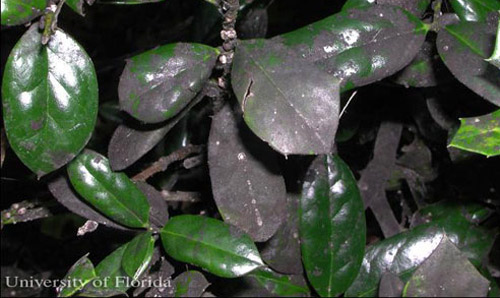
The direct damage is caused by nymphs inserting their mouthparts into the plant tissue and withdrawing large amounts of plant fluids. Heavy infestations can discolor leaves, cause premature leaf drop, and branch dieback. Plant death is also possible. As a result of the scales consuming so much plant fluid, they excrete a considerable amount of a sugary, sticky honeydew, which then becomes colonized by a sooty mold fungus (Argov et al. 1987).
The sooty mold can cause a significant reduction in photosynthesis and aesthetic value (Hodges et al. 2000). Other insects are also attracted to and feed on the honeydew, including various bees, paper wasps, hornets, velvet ants, imported fire ants and other ant species.
Figure 4. Sooty mold on holly leaves. Photograph by Eileen Buss, University of Florida.
Management (Back to Top)
Biological control. Three parasitoids are known to attack Florida wax scales in some parts of the United States. They are: Coccophagus lycimnia (Walker) (Aphelinidae), Metaphycus eruptor Howard (Encyrtidae), and Scutellista cynea Motschulsky (Pteromalidae) (Drees et al. 2006a).
Cultural control. When purchasing any plant material for installation into a landscape, be certain that each plant is pest-free. Prune off and destroy any infested plant parts. When planting, install them in a location that is suitable to their duration of light and soil type needs.
Minimizing pest-prone plant species or varieties in a landscape is important when trying to reduce pesticide use. For example, susceptible hollies (e.g., ‘Burford’ holly) could be replaced with resistant species, such as Ilex buergeri, Ilex crenata, Ilex glabra, Ilex myrtifolia, Ilex verticillata and Ilex vomitoria (Hodges et al. 2000). Consider junipers, ligustrum, privet, wax myrtle, or boxwood as alternative plants. Use the proper amount of irrigation and fertilization based on the needs of the particular plant species or variety (Drees et al. 2006a).
Chemical control. Systemic insecticides applied to the soil as a drench or sprayed onto foliage can effectively control scale infestations. When treating plants with waxy leaves, like holly, the addition of a spreader-sticker or horticultural oil may be needed. Some scales may remain on the plant, dead, after being treated with an insecticide. A simple way to ensure that the treatment worked is to squish a scale and see if it is still juicy (= alive) or if it is dry and dead.
Florida Citrus Pest Management Guide for soft-bodied insects
Selected References (Back to Top)
- Argov Y, Podoler H, Bar-Shalom O and Rosen D. 1987. Mass rearing of the Florida wax scale, Ceroplastes floridensis,for production of natural enemies. Phytoparasitica 15: 277-287.
- Ben-Dov, Y. 1993. A Systematic Catalogue of the Soft Scale Insects (Homoptera: Coccoidea: Coccidae) of the World. Flora and Fauna Handbook No. 9. Sandhill Crane Press. 536 pp.
- Ben-Dov, Y. 2012. ScaleNet: a database of the scale insects of the world. (5 December 2014).
- Buss EA, Turner JC. (June 2006). Scale insects and mealybugs on ornamental plants. EDIS. (no longer available online).
- CABI. (December 1982). Ceroplastes floridensis. Distribution Maps of Plant Pests. (22 August 2018).
- Drees BM, Reinert JA,Williams ML. 2006. Florida wax scales: A major pest of hollies and other landscape shrubs and trees. EEE-00023. Texas Cooperative Extension, The Texas A&M University, College Station, TX.
- Drees BM, Reinert JA,Williams ML. 2006a. Florida wax scales: Control measures in Texas for hollies. L-5479. Texas Cooperative Extension, The Texas A&M University, College Station, TX, 6 pp.
- Futch SH, McCoy Jr CW, Childers CC. (April 2009). A guide to scale insect identification. EDIS. (22 August 2018).
- Gimpel Jr WF, Miller DR, Davidson JA. 1974. A systematic revision of the wax scales, genus Ceroplastes, in the United States (Homoptera: Coccoidea: Coccidae). Agricultural Experiment Station Miscellanous Publication 841, University of Maryland. 85 pp.
- Gossard HA. 1900. Some common Florida scales. Florida Agricultural Experiment Station. Bulletin No. 51. 117 pp.
- Hamon AB, Williams ML. 1984. Arthropods of Florida and neighboring land areas, Vol. 2. Florida Department of Agricultural and Consumer Services, Division of Plant Industry.
- Hodges GS, Ruter JR, Braman SK. 2000. Susceptibility of Ilex species, hybrids and cultivars to Florida wax scale. Journal of Environmental Horticulture 19: 32-36.
- Johnson WT, Lyon HH. 1991. Insects That Feed on Trees and Shrubs, 2nd ed.. Cornell University Press. 356 pp.