common name: broad mite
scientific name: Polyphagotarsonemus latus (Banks) (Arachnida: Acari: Tarsonemidae)
Introduction - Distribution - Description - Biology - Hosts - Economic Importance - Survey and Detection - Management - Selected References
Introduction (Back to Top)
The broad mite, Polyphagotarsonemus latus, was first described by Banks (1904) as Tarsonemus latus from the terminal buds of mango in a greenhouse in Washington, D.C., USA (Denmark 1980). This species has a large host range and is distributed worldwide.
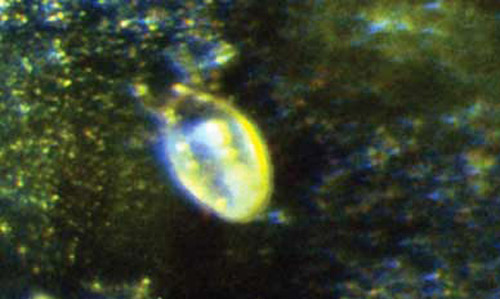
Figure 1. Broad mite, Polyphagotarsonemus latus (Banks), highly magnified. Photograph by J. Peña, University of Florida.
Distribution (Back to Top)
Polyphagotarsonemus latus has a worldwide distribution and is known by a number of common names. In India and Sri Lanka it is called the yellow tea mite, while those in Bangladesh call it the yellow jute mite. In some European countries it is called the broad spider. In parts of South America it is called the tropical mite or the broad rust mite (Anonymous a).
Description (Back to Top)
General description.
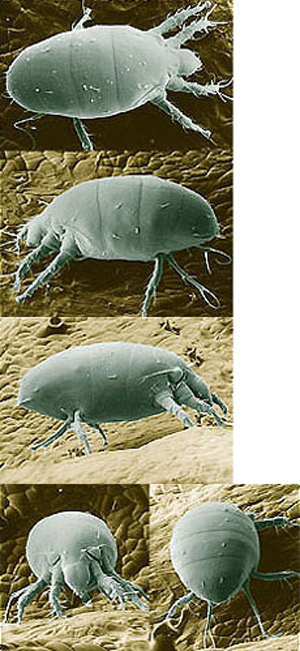
Adults: Female mites are about 0.2 mm long and oval in outline. Their bodies are swollen in profile and a light yellow to amber or green in color with an indistinct, light, median stripe that forks near the back end of the body. Males are similar in color but lack the stripe. The two hind legs of the adult females are reduced to whip-like appendages. The male is smaller (0.11mm) and faster moving than the female. The male's enlarged hind legs are used to pick up the female nymph and place her at right angles to the male's body for later mating (Peña and Campbell 2005).
Figure 2. Photographs of a female broad mite, Polyphagotarsonemus latus (Banks), on the surface of a pepper leaf. The photographs were taken with a low temperature scanning electron microscope (views from top to bottom: dorsal, left lateral, right lateral, front, rear). The specimen was held on a new, height-angle, azimuth rotation specimen holder and frozen in its natural position with liquid nitrogen. The USDA has a Build-A-Mite Web site where these five photographs can be copied, cut and folded to create a box that depicts the mite's three-dimensional shape. Photograph by Eric Erbe; digital colorization by Chris Pooley, USDA.
Eggs: The eggs are colorless, translucent and elliptical in shape. They are about 0.08 mm long and are covered with 29 to 37 scattered white tufts on the upper surface (Denmark 1980, Peña and Campbell 2005, Baker 1997).
Larvae: Young broad mites have only three pairs of legs. They are slow moving and appear whitish due to minute ridges on the body (Peña and Campbell 2005). As they grow they range in size from 0.1 to 0.2 mm long (Anonymous a). The quiescent stage appears as an immobile, engorged larva (Baker 1997).
Nymph: After one day, the larva becomes a quiescent nymph that is clear and pointed at both ends. The nymphal stage lasts about a day. Nymphs are usually found in depressions on the fruit, although female nymphs are often carried about by males (Peña and Campbell 2005).
Technical description.
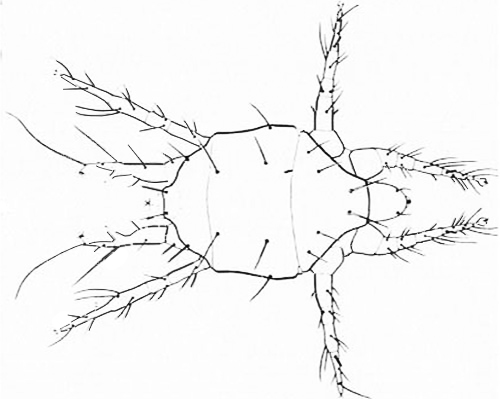
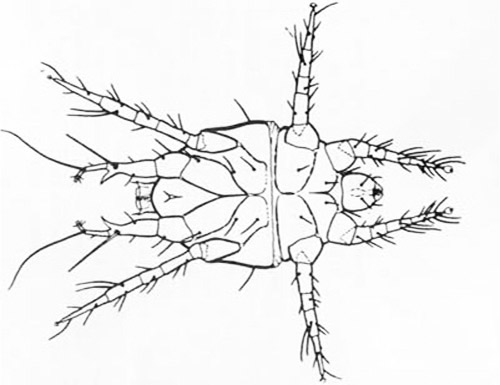
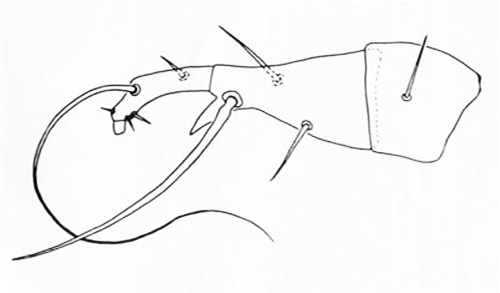
In the male, the body is short and oval. It is broadest at mid-length. The legs are long and spindly. Apodemes (chitinous ingrowths to which muscles are attached) are distinct and well defined. The propodosoma has four pairs of dorsal setae. The capitulum, including palpi, is 32µ long and 34µ wide. Leg IV is 1.5 times as long as the coxa. The coxa is rectangular and as broad as long, 2/3 as long as femur III, and with 1 stout seta. Genital papillae are 24µ long and 28µ wide, and are subcircular with posterior margin truncate. The anal plate is large and well defined. Triadiate apodemes have an expanse equal to 2/3 greatest width of the genital papillae (Denmark 1980).
Figure 3. Dorsal view of a male broad mite, Polyphagotarsonemus latus (Banks). Graphic by Division of Plant Industry.
Figure 4. Ventral view of a male broad mite, Polyphagotarsonemus latus (Banks). Graphic by Division of Plant Industry.
Figure 5. Leg IV of male broad mite, Polyphagotarsonemus latus (Banks). Graphic by Division of Plant Industry.
Biology (Back to Top)
The broad mite has four stages in its life cycle: egg, larva, nymph and adult. Adult females lay 30 to 76 eggs (averaging five per day) on the undersides of leaves and in the depressions of small fruit over an eight- to 13-day period and then die. Adult males may live five to nine days. While unmated females lay eggs that become males, mated females usually lay four female eggs for every male egg.
The eggs hatch in two or three days and the larvae emerge from the egg to feed. Larvae are slow moving and do not disperse far. After two or three days, the larvae develop into a quiescent larval (nymph) stage. Quiescent female larvae become attractive to the males which pick them up and carry them to the new foliage. Males and females are very active, but the males apparently account for much of the dispersal of a broad mite population in their frenzy to carry the quiescent female larvae to new leaves. When females emerge from the quiescent stage, males immediately mate with them (Anonymous a, Baker 1997, Peña and Campbell 2005). There are also reports of the broad mite using insect hosts, specifically some whiteflies, to move from plant to plant (Palevsky et al. 2001).
Figure 6. Adult broad mite, Polyphagotarsonemus latus (Banks), carrying an immature broad mite. Photograph by D. Riley, University of Gerogia; www.forestryimages.org.
Hosts (Back to Top)
The broad mite has a wide host range in tropical areas. It attacks greenhouse plants in temperate and subtropical regions (Peña and Campbell 2005).
Crops listed as hosts include: apple, avocado, cantaloupe, castor, chili, citrus, coffee, cotton, eggplant, grapes, guava, jute, mango, papaya, passion fruit, pear, potato, sesame, string or pole beans, tea, and tomato (Peña and Campbell 2005). USDA-ARS identified it for the first time on watermelons in the U.S. in 2006 (Pons 2007).
Broad mites infest many ornamentals, including African violet, ageratum, azalea, begonia, chrysanthemum, cyclamen, dahlia, gerbera, gloxinia, ivy, jasmine, impatiens, lantana, marigold, peperomia, pittosporum, snapdragon, verbena, and zinnia (Baker 1997).
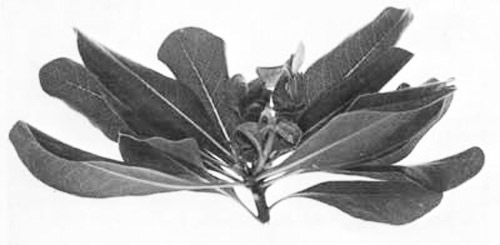
The broad mite is considered a serious pest of Pittosporum spp. in Florida (Johnson and Lyon 1991).
Economic Importance (Back to Top)
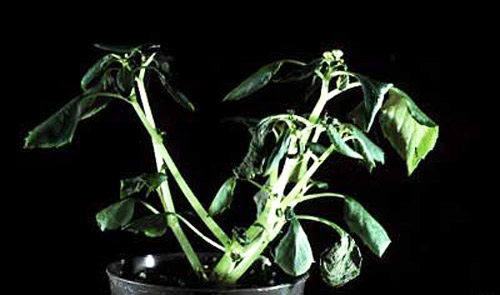
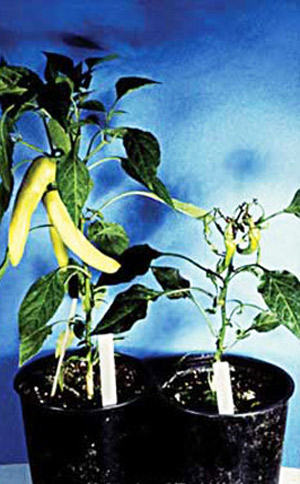
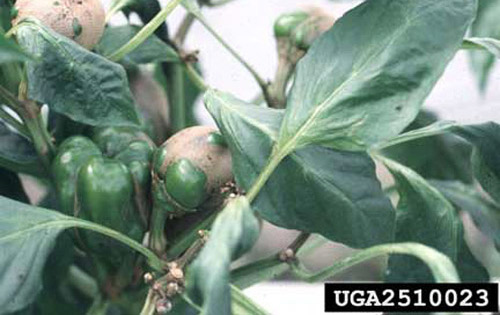
This destructive pest causes terminal leaves and flower buds to become malformed. The mite's toxic saliva causes twisted, hardened and distorted growth in the terminal of the plant (Baker 1997). Mites are usually seen on the newest leaves and small fruit. Leaves turn downward and turn coppery or purplish. Internodes shorten and the lateral buds break more than normal. The blooms abort and plant growth is stunted when large populations are present (Denmark 1980, Wilkerson et al. 2005, Anonymous a). On fruit trees the damage is usually seen on the shaded side of the fruit, so it is not readily apparent. Fruit is discolored by feeding and in severe cases premature fruit drop may occur. Severely damage fruit is not salable in the fresh market but may be used for processing (Peña and Campbell 2005).
Figure 7. Damage to pittosporum caused by the broad mite, Polyphagotarsonemus latus (Banks). Photograph by Division of Plant Industry.
Figure 8. Damage to Impatiens sp. by the broad mite, Polyphagotarsonemus latus (Banks). Photograph by University of Florida.
Figure 9. Broad mite, Polyphagotarsonemus latus (Banks), damage to pepper. Photograph by J. Peña, University of Florida.
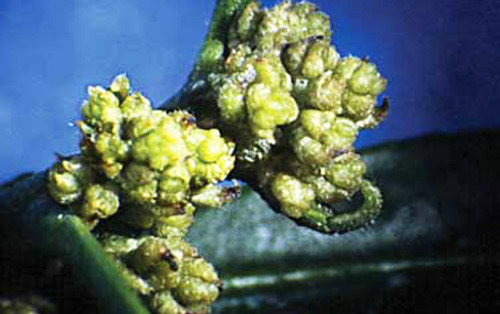
Figure 10. Broad mite, Polyphagotarsonemus latus (Banks), damage to pepper bud proliferation. Photograph by J. Peña, University of Florida.
Figure 11. Broad mite, Polyphagotarsonemus latus (Banks), damage to pepper a few weeks after infestation. Photograph by D. Riley, University of Georgia; www.forestryimages.org.
Survey and Detection (Back to Top)
Look for malformed terminal buds and stunted growth. The mites may crowd into crevices and buds (Denmark 1980). Mites prefer the shaded side of fruit, which usually faces the plant, so time and effort must be expended for proper fruit inspection. Broad mites are very small and difficult to see without a 10 × or stronger hand lens (Peña and Campbell 2005).
Try not to confuse broad mite injury with herbicide injury, nutritional (boron) deficiencies or physiological disorders. For example, during late winter production, with cool temperatures and high humidity, some leaf curling and twisting seen on New Guinea impatiens, is a physiological disorder and not broad mite injury (Anonymous b).
Management (Back to Top)
While a number of miticides are labeled for control of this pest, insecticidal oils or soaps are usually just as effective and less toxic to the environment. For large area or greenhouse control, biological control agents are available, including several species of predatory mites (Wilkerson 2005, Peña and Campbell 2005, Fan and Petitt 1994, Peña et al. 1996). In addition, hot water treatments may be used to control the mites without injuring the plants. This involves lowering the plant into water held at 43 to 49°C (109.4-120.2°F) for 15 minutes (Anonymous a).
Selected References (Back to Top)
- Banks N. 1904. Class III, Arachnida, Order 1, Acarina, four new species of injurious mites. Journal of the New York Entomological Society 12: 53-56
- Denmark HA. 1980. Broad mite, Polyphagotarsonemus latus (Banks). FDACS-DPI Bureau of Entomology Circular No. 213. 2 pp.
- Fan Y, Petitt FL. 1994. Biological control of broad mite, Polyphagotarsonemus latus (Banks), by Neoseiulus barkeri Hughes on pepper. Biological Control 4: 390-395.
- Gerson U. 1992. Biology and control of the broad mite, Polyphagotarsonemus latus (Banks) (Acari: Tarsonemidae). Experimental & Applied Acarology 13: 163-178.
- Johnson WT, Lyon HH. 1991. Insects that Feed on Trees and Shrubs. 2nd ed., rev. Comstock Publishing Associates. 560 pp.
- Palevsky E, Soroker V, Weintraub P, Mansour F, Abo-Moch F, Gerson U. 2001. How species-specific is the phoretic relationship between the broad mite, Polyphagotarsonemus latus (Acari: Tarsonemidae), and its insect hosts? Experimental & Applied Acarology 25: 217-24.
- Peña JE, Osborne LS, Duncan RE. 1996. Potential of fungi as biocontrol agents of Polyphagotarsoneumus latus. Entomophaga 41: 27-36.