common name: clavate tortoise beetle
scientific name: Plagiometriona clavata (Fabricius) (Insecta: Coleoptera: Chrysomelidae)
Introduction - Synonymy - Distribution - Description - Hosts and Biology - Selected References
Introduction (Back to Top)
Plagiometriona clavata (Fabricius) is common and can be recognized easily by its general form and appearance.
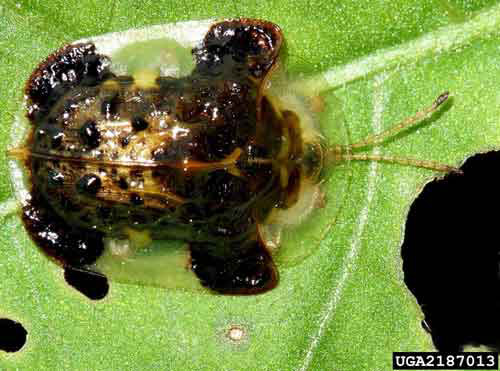
Figure 1. Adult clavate tortoise beetle, Plagiometriona clavata (Fabricius). Photograph by David Cappaert, www.forestryimages.org.
The Integrated Taxonomic Information System lists two subspecies:
- Plagiometriona clavata clavata (Fabricius, 1798)
- Plagiometriona clavata testudinaria (Boheman, 1855)
(ITIS 2010)
Synonymy (Back to Top)
Unfortunately, this relatively common beetle has gone under several names which created some confusion. The formal synonymy follows:
Plagiometriona clavata (Fabricius). Fattig 1948
Coptocycla clavata (Fabricius). Boheman 1855
Deloyala clavata (Fabricius). Dejean 1837
Cassida clavata Fabricius 1798
Some of the taxonomic confusion was discussed by Barber (1918, 1946) and Hincks (1952). Although there is no specific synonym listed, Barber (1918) suggested the possibility that Deloyala testudinaria from Central America may intergrade with clavata in Texas, New Mexico and Arizona.
Distribution (Back to Top)
The most extensive distribution records were provided by Barber (1918): Arizona, Florida, Kansas, Kentucky, Louisiana, Maryland, Massachusetts, Michigan, Missouri, Nebraska, New Jersey, New Mexico, Rhode Island, Tennessee, and Texas.
Blatchley recorded it from Lake, Wells, Putnam, and Posey counties, Indiana (1918) and from Lake Worth, Enterprise, Eustis, and Gainesville, Florida (1924), suggesting that it is apparently confined to the northern half of the state.
Fattig (1948) recorded it from Atlanta, Georgia, Balsbaugh and Hays (1972) listed it from Lee, Madison, and Mobile counties, Alabama, and Wilcox (1954) reported it as common in Ohio.
Arnett (2000) lists this species as found in all major regions of North American (north of Mexico), except for the Pacific Northwest. However, this does not mean it is found in all the states or provinces in those regions.
Description (Back to Top)
Adult: The adult is an oval, convex, tortoise-shaped beetle with translucent carapace, except at the dark humeral areas. The length is 6.5 to 7.5 mm, while the width is 5.5 to 6.3 mm. Color varies from brilliant brassy green, golden and brown in life to a dull yellow brown to tan with dark markings in dead specimens. In side view, it is dome-shaped with a conical peak near the middle, behind the scutellum.
Figure 2. Adult clavate tortoise beetle, Plagiometriona clavata (Fabricius). Line represents 3 mm. Illustration by Division of Plant Industry.
Figure 3. Lateral view of an adult clavate tortoise beetle, Plagiometriona clavata (Fabricius), showing conical peak. Photograph by Division of Plant Industry.
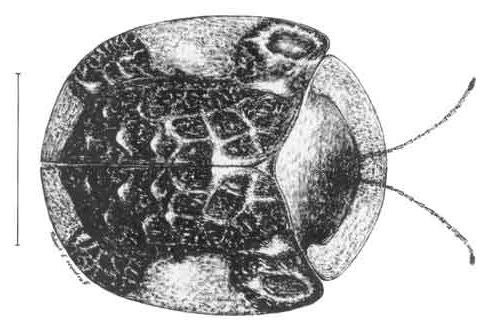
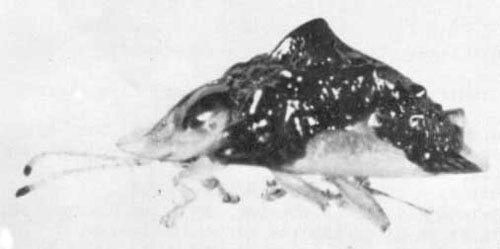
The dorsal surface is rugose and tuberculate (no other species of United States tortoise beetle, subfamily Cassidinae, has such a surface). The antenna is variable in color, but at least some of the terminal segments are black; the segments are free when at rest, and there is no antennal groove on the underside of the prothorax; the third segment is slightly longer than the second segment. The head is covered by the arcuate front margin of the pronotum. The tarsal claws are angularly dilated at their base. [The illustration of this species by Dillon and Dillon (1961) has the legend reversed with that of Metriona bivittata (Say); Plagiometriona clavata is actually figure 9 on plate 74.]
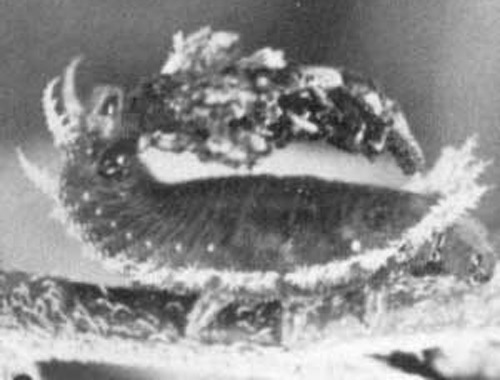
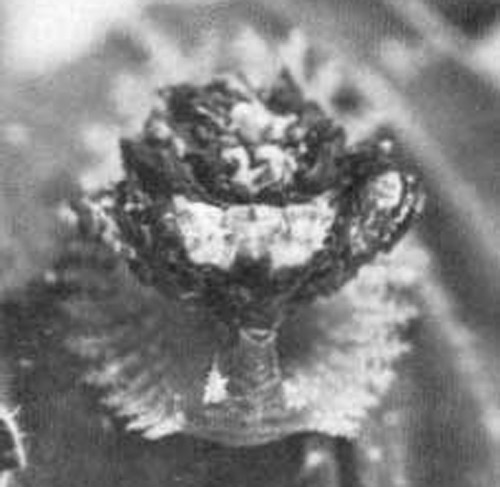
Larva: The larva is a typical tortoise beetle type, but very unlike most other beetle larvae. The last abdominal segment has a special "fecal fork" which permits the attachment of dried fecal matter. This fecal mass is carried over the dorsum in the same form as trash bugs (Neuroptera), and presumably offers a degree of protection through camouflage. The body is green, flattened, and almost entirely fringed with whitish multispiculate projections.
Figure 4. Lateral view of the larva of a clavate tortoise beetle, Plagiometriona clavata (Fabricius). Head of larva is to the right. Anal fork with feces is held above larva. Photograph by Division of Plant Industry.
Figure 5. Posterior view of the larva of a clavate tortoise beetle, Plagiometriona clavata (Fabricius), showing last segment bearing the anal fork. Photograph by Division of Plant Industry.
Hosts and Biology (Back to Top)
Like many other members of the subfamily Cassidinae, this species appears to prefer plants of the family Solanaceae. Host records in the literature are mostly for adults and may not represent actual feeding: linden and oak (Blatchley 1910); sycamore, oak, linden, and Japanese lantern (Wilcox 1954); morning glory (Dillon and Dillon 1961); oak and various species of Solanaceae (Blatchley 1924).
Selected References (Back to Top)
- Arnett Jr RH. 2000. American Insects: A Handbook of the Insects of America North of Mexico. CRC Press. Boca Raton. 1003 pp.
- Balsbaugh Jr EU . 1972. The leaf beetles of Alabama (Coleoptera: Chrysomelidae). Auburn University Agricultural Experiment Station Bulletin 441: 1-223.
- Barber HS. 1918. A review of North American tortoise beetles (Chrysomelidae: Cassidinae). Proceedings of the Entomological Society of Washington 18: 113-127.
- Barber HS. 1946. Correction of name of tortoise beetles. Bulletin of the Brooklyn Entomological Society 41: 161.
- Blatchley WS. 1910. An Illustrated Descriptive Catalogue of the Coleoptera or Beetles Known to Occur in Indiana. Nature Publishing Co., Indianapolis, Ind. 1385 pp.
- Blatchley WS. 1924. The Chrysomelidae of Florida. Florida Entomologist 8: 33-46.
- Boheman CH. 1855. Monographia Cassididarum 3: 1-543; 1 pl. Holmiae, officina Norstedtiana.
- Dejean PFMA. 1837. Catalogue des Coleopteres de la collection d'Auguste Dejean. Third Edition, Paris. 503 pp.
- Dillon ES, Dillon LS. 1961. A Manual of Common Beetles of Eastern North America. Row, Peterson & Co., Evanston, Ill. 884 pp.
- Fabricius JC. 1798. Systema Eleutheratorum. I.
- Fattig PW. 1948. The Chrysomelidae or leaf beetles of Georgia. Emory University Museum Bulletin 6: 1-47.
- Hincks WD. 1950. Some nomenclatorial notes on Chrysomelidae. No. 3. Cassidinae. Annuals of the Magazine of Natural History (Ser. 12) 3: 506-512.
- Hincks WD. 1952. The genera of the Cassidinae (Coleoptera: Chrysomelidae). Transactions of the Royal Entomological Society of London 103: 327-362.
- ITIS. (2010). Plagiometriona clavata (Fabricius, 1798). Integrated Taxonomic Information System. (18 August 2015).
- Riley EG, Clark SM, Gilbert AJ. 2001. New records, nomenclatural changes, and taxonomic notes for select North American leaf beetles (Coleoptera: Chrysomelidae). Insecta Mundi 15: 1-17.
- Spaeth F. 1899. Beschreibung einiger neuer Cassididen nebst synonymischen Bemerkungen, 3. Verh. Zool.-Bot. Gesellsch. Wien 49: 213-221.
- Wilcox JA. 1954. Leaf beetles of Ohio (Chrysomelidae: Coleoptera). Ohio Biological Survey Bulletin 43: 353-506.
- Woodruff R.E. 1965. A tortoise beetle (Hemisphaerota cyanea (Say)) on palms in Florida (Coleoptera: Chrysomelidae). Florida Department of Agriculture, Division of Plant Industry, Entomology Circular 35: 1-2.