common name: Pleurodontid snails of Florida
scientific name: Gastropoda: Pleurodontidae
Introduction - Caracolus marginella - Zachrysia provisoria - Zachrysia trinitaria - Selected References
Introduction (Back to Top)
The Pleurodontidae (superfamily Helicoidea) is a family of air-breathing land snails found throughout much of the tropics. A number of species are known from Central and South America and some Caribbean Islands. Three introduced species (previously listed in the family Camaenidae), Caracolus marginella (Gmelin, 1791), Zachrysia provisoria (Pfeiffer, 1858) and Z. trinitaria (Pfeiffer, 1858), occur in Florida. These Cuban species were apparently released in Miami during the early 20th Century by Charles T. Simpson (Clapp 1919, Pilsbry 1939). The presence of viable populations of Z. provisoria in south Florida has been recognized for many years. Caracolus marginella was rediscovered in the Miami area in 1991, and Z. trinitaria was discovered in 2004.
Caracolus marginella (Gmelin, 1791), banded caracol (Back to Top)
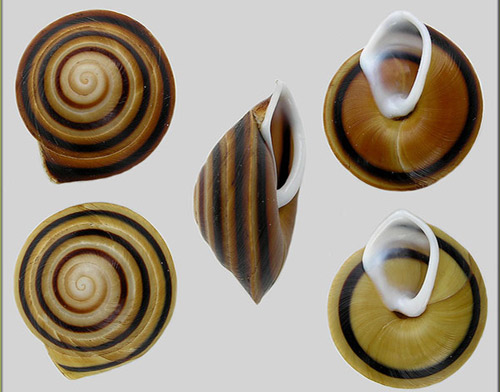
Caracolus marginella has a large shell (35 to 45 mm), lenticular or depressed-trochoid in shape and sharply keeled at periphery of body whorl. There are five to six gradually expanding whorls and the base is slightly swollen. The umbilical area is slightly concave, with the umbilicus occasionally closed by the reflected columellar lip. Shell sculpture is relatively smooth with irregular growth lines. The body whorl descends almost vertically just before aperture, with the apertural lip greatly thickened within, reflected backward and protracted upward and backward at periphery with a thickened parietal callus. The columella is short and stout. Fresh specimens have a tan periostracum, usually eroded from spire, with dark brown and light brown to white bands of variable width and color intensity. The peripheral keel is usually white, while the apertural lip, columella, and parietal callus are white, rose, or brownish in color.
Figure 1. View of shell (ventral) and snail (dorsal) Caracolus marginella (Gmelin, 1791), the banded caracol. Photograph by Phil Poland, Jacksonville Shell Club.
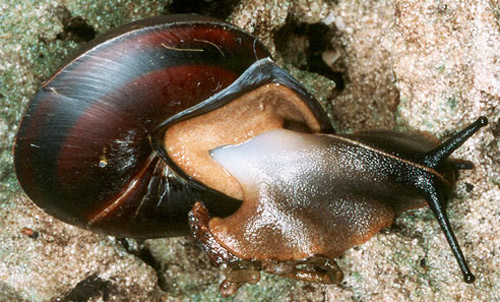
Caracolus marginella is a very distinctive species and cannot be confused with other species occurring in Florida due to its large size and banded color pattern. Although the introduction was first recorded by Clapp (1919), the presence of viable populations of this large species remained unknown until it was rediscovered in 1991 (Auffenberg and Stange). It has been collected from several localities near the former Charles T. Simpson residence at Lemon City, Little River, Dade County (University of Florida Collections). Specimens were collected in leaf litter and on the trunks of the palm, Ptychosperma elegans (R. Br.) Blume.
Caracolus marginella has been observed feeding on fallen calabash flowers and the algae growing on palm trunks. This species is not considered to be an agricultural pest.
Figure 2. Views of shells of Caracolus marginella (Gmelin, 1791), the banded caracol, displaying some of the various color morphs. Photograph by Bill Frank, Jacksonville Shell Club.
Zachrysia provisoria (L. Pfeiffer, 1858), Cuban brown snail (Back to Top)
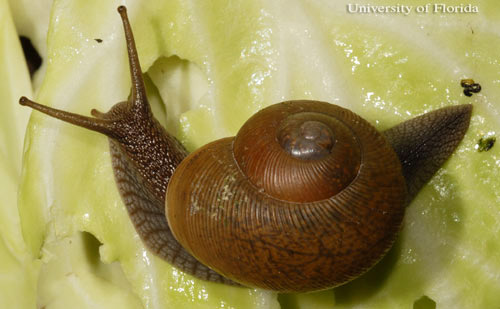
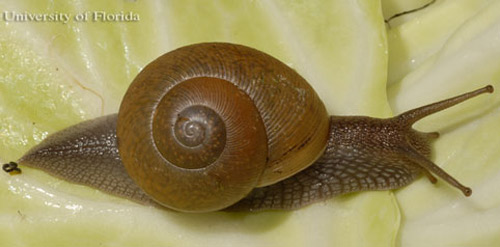
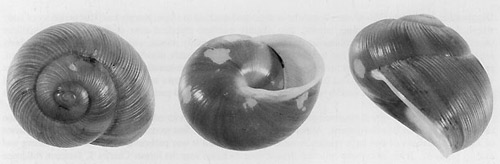
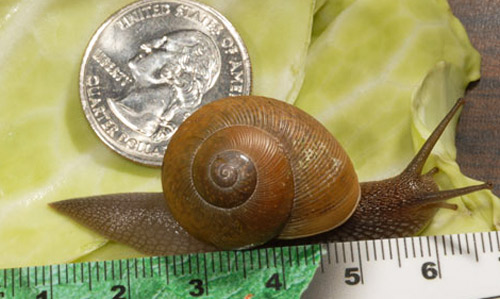
The shell of Zachrysia provisoria is medium-sized (25 to 30 mm width), and globose in shape. There are four to five rapidly expanding whorls, with the body whorl increasing in size more than those of the spire. There is no umbilicus. The shell is sculptured with fairly regular, strong, retractively curved axial ribs, and the body whorl descends greatly near aperture. The base is swollen, fairly smooth and shining. The apertural lip is thickened within, slightly reflected. There is a prominent protuberance or buttress on basal lip near columellar insertion. Fresh specimens have a rich, dark tan periostracum, sometimes with light brown axial streaks, while the apertural lip and columella are white.
Figure 3. Dorsal view of Zachrysia provisoria (L. Pfeiffer, 1858), the Cuban brown snail. Photograph by Lyle J. Buss, University of Florida.
Figure 4. Dorso-lateral view of Zachrysia provisoria (L. Pfeiffer, 1858), the Cuban brown snail. Photograph by Lyle J. Buss, University of Florida.
Figure 5. Three views of the shell of Zachrysia provisoria (L. Pfeiffer, 1858), the Cuban brown snail. Photograph by Division of Plant Industry.
Figure 6. Length and total size comparisons for Zachrysia provisoria (L. Pfeiffer, 1858), the Cuban brown snail. Photograph by Lyle J. Buss, University of Florida.
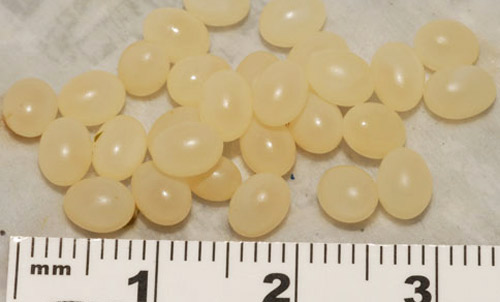
Figure 7. Eggs of Zachrysia provisoria (L. Pfeiffer, 1858), the Cuban brown snail. Photograph by Lyle J. Buss, University of Florida.
Zachrysia provisoria is the only commonly occurring large snail species in south Florida. In addition to the populations in Florida, Z. provisoria (sometimes assigned as a synonym or subspecies of Z. auricoma (Ferussac 1821)) has also been introduced in the Bahamas, Puerto Rico and the Virgin Islands. In Florida, it has been found in Broward, Collier, Dade, Hillsborough, Monroe, Palm Beach, and Pinellas counties (University of Florida Collections). It lives among leaf litter and among ornamental plantings.
Zachrysia provisoria is a voracious herbivore and causes significant damage to ornamental plants in south Florida.
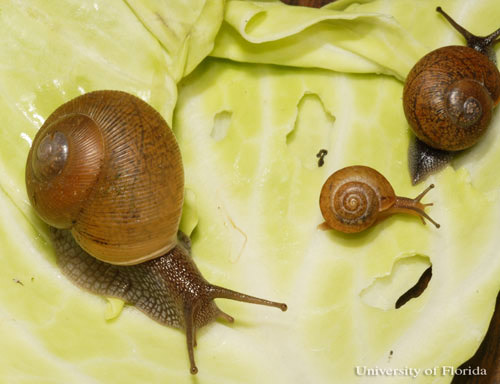
Figure 8. Three different life stages of Zachrysia provisoria (Pfeiller, 1858), the Cuban brown snail, feeding on lettuce in the laboratory. Photograph by Lyle J. Buss, University of Florida.
Zachrysia trinitaria (L. Pfeiffer, 1858) (Back to Top)
Zachrysia trinitaria is very similiar to Z. provisoria, but while larger in size (41 to 45 mm) is not commonly found. Damage by Z. trinitaria is not yet documented.
Selected References (Back to Top)
- Auffenberg K, Stange LA. 1993. New records of the Cuban land snail, Caracolus marginellus (Gmelin, 1791), in Dade County, Florida. Malacological Review.
- Clapp GH. 1919. Cuban mollusks colonized in Florida. The Nautilus 32: 104-105.
- Jacksonville Shell Club. Caracolus marginella (Gmelin, 1791) Banded Caracol. www.jackshells.org. http://www.jaxshells.org/gallery4.htm (13 June 2011).
- Pilsbry HA. 1939. Land Mollusca of North America (North of Mexico). The Academy of Natural Sciences of Philadelphia, Monograph No. 3, Vol. 1: 1-573.