Common name: giant whip scorpion
scientific name: Mastigoproctus giganteus giganteus (Lucas, 1835) (Arachnida: Thelyphonida (=Uropygi): Thelyphonidae)
Introduction - Synonymy - Distribution - Description - Life History and Habitat - Natural Enemies - Selected References
Introduction (Back to Top)
The only whip scorpion found in the United States is the giant whip scorpion, Mastigoproctus giganteus giganteus (Lucas). The giant whip scorpion is also known as a vinegaroon or grampus in some local regions where they occur. To encounter a giant whip scorpion for the first time can be an alarming experience. What seems like a miniature monster from a horror movie is really a fairly benign creature. While called a scorpion, this arachnid has neither the venom-filled stinger found in scorpions nor the venomous bite found in some spiders.
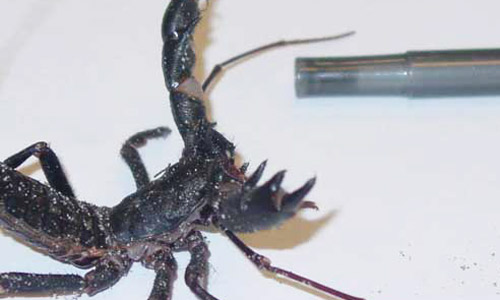
Figure 1. The giant whip scorpion or 'vingaroon,' Mastigoproctus giganteus giganteus (Lucas). Photograph by R. Mitchell, University of Florida.
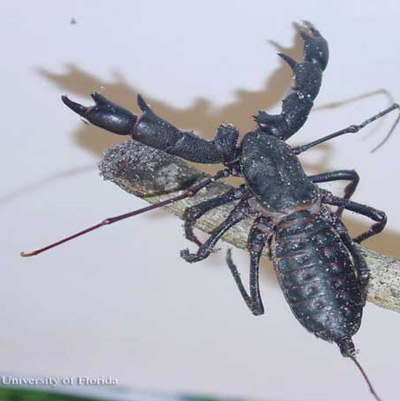
One very distinct and curious feature of whip scorpions is its long thin caudal appendage, which is directly related to their common name "whip-scorpion." The common name 'vinegaroon' is related to their ability to give off a spray of concentrated (85%) acetic acid from the base of the whip-like tail. This produces that tell-tale vinegar-like scent. The common name 'grampus' may be related to the mantis shrimp, also called the grampus. The mantis shrimp is a marine crustacean that can deliver a painful wound with its mantis-like, raptorial front legs. Often captured with shrimp during coastal trawling, shrimpers dislike this creature because of the lightning fast slashing cut mantis shrimp can deliver to an unsuspecting finger during sorting of the shrimp from the by-catch.
Synonymy (Back to Top)
Thelyphonus giganteus Lucas 1835
Thelyphonus excubitor Girard 1854
Thelyphonus rufus Butler 1872
Mastigoproctus giganteus giganteus Lonnberg 1879
Distribution (Back to Top)
Mastigoproctus giganteus giganteus is the only whip scorpion found in the United States. This subspecies occurs in Arizona, Florida, New Mexico, Oklahoma, Texas, and in Mexico. Two other subspecies, Mastigoproctus giganteus mexicanus (Lucas, 1835) and Mastigoproctus giganteus scabrosus (Lucas, 1835) are confined to portions of Mexico.
As a group, whip scorpions are found worldwide in the tropics and subtropics. While more commonly encountered in arid areas, Mastigoproctus giganteus can also be found in grassland, scrub, pine forests and barrier islands.
Table 1. Other species in the genus Mastigoproctus and their general distribution in the Americas.
Species Name |
General Distribution |
M. baracoensis |
Cuba |
M. brasiliensis |
Brazil (Espirito Santo) |
M. butleri |
Brazil |
M. columbianus |
Colombia |
M. formidabilis |
Venezuela |
M. liochirus |
Guatemala |
M. maximus |
Brazil (Mato Grosso) |
M. minensis |
Brazil (Minas Gerais) |
M. nana |
Costa Rica |
M. pelegrini |
Cuba |
M. perditus |
Brazil (Mato Grosso) |
M. proscorpio |
Hispaniola, Martinique |
M. tantalus |
El Salvador |
Description (Back to Top)
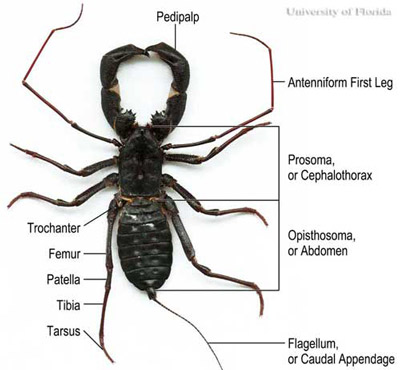
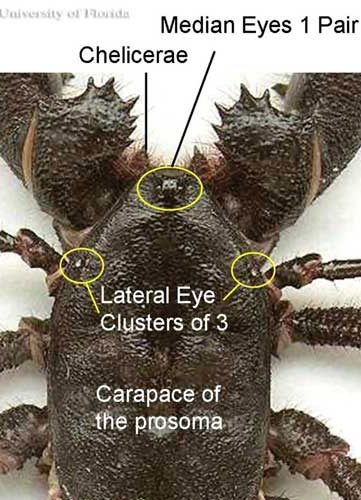
This is a fairly large creature, up to 5 cm long, which does not include the caudal flagellum or telson. Large pedipalps (pincer-like appendages) help whip scorpions catch and kill their prey by crushing them. Mishandled, these pedipalps can give a noticeable pinch. A pair of long, thin, front legs acts almost like antennae as they feel about for their prey in the dark. The whip-like telson also functions as a sensory organ. These three structures apparently help compensate for their eight weak eyes.
Table 2. Measurements of 10 representative females and one male Mastigoproctus giganteus giganteus (Muma 1968).
The telson or caudal flagellum was extremely variable due to breakage, but some had a telson longer than the total body length.
|
Lengths in mm |
||
Females (10) |
Total |
Carapace of Cephalothorax |
Abdomen |
Max |
50.0 |
21.0 |
30.0 |
Min |
38.0 |
11.0 |
24.0 |
Mean |
45.3 |
18.5 |
27.9 |
Male (1) |
|
|
|
|
45.0 |
18.0 |
27.0 |
Table 3. Measurements of 3 Riker mount specimens of Mastigoproctus giganteus giganteus by this author.
|
Lengths in mm |
|||
N= 3 |
Total |
Carapace of Cephalothorax |
Abdomen |
Telson |
Max |
44.0 |
18.0 |
25.0 |
40.0 |
Min |
37.0 |
14.0 |
21.0 |
32.0 |
Figure 2. Dorsal view and anatomical features of the giant whip scorpion or 'vingaroon,' Mastigoproctus giganteus giganteus (Lucas). Photograph by W.H. Kern, University of Florida.
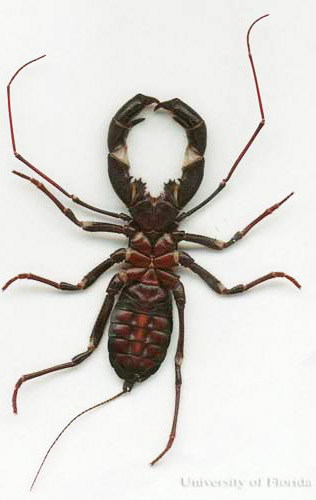
Figure 3. Ventral view of the giant whip scorpion or 'vingaroon,' Mastigoproctus giganteus giganteus (Lucas). Photograph by W.H. Kern, University of Florida.
Figure 4. Close up view of the prosoma (cephalothorax) of the giant whip scorpion or 'vingaroon,' Mastigoproctus giganteus giganteus (Lucas). Photograph by W.H. Kern, University of Florida.
Life History and Habitat (Back to Top)
Whip scorpions are nocturnal predators of other arthropods. During the day they remain out of sight in burrows they dig with their pedipalps. They can often be found under logs, boards, rotting wood, rocks, and other natural dark places. Most whip scorpions occur in moist or seasonally moist forested habitats in tropical or subtropical environments. Mastigoproctus giganteus occur in more arid habitats with well drained soil. They spend the driest periods underground and become active on the surface during Florida's rainy season (May/June-November).
The primary prey of Mastigoproctus giganteus are soft bodied insects like termites, cockroaches, and crickets. One of the common prey of adults in Florida is the Florida woods roach, Eurycotis floridensis. Live food such as crickets and roaches are crushed between special teeth on the inside of the second segment of the pedipalps.
When threatened, vinegaroons seek the refuge of their burrows or put on a bluff display of rearing up and spreading their pedipalps. They can also accurately spray acetic acid from a pore at the base of the caudal filament out to a distance of from a few inches to one foot. This defensive spray is not dangerous to skin but stings severely if it gets into an animal's eyes or nostrils.
Figure 5. The giant whip scorpion or 'vingaroon,' Mastigoproctus giganteus giganteus (Lucas), displaying defensive stance with spread pedipalps. Photograph by R. Mitchell, University of Florida.
Fairly long-lived, whip scorpions can live at least seven years. They grow slowly, molting three times in about three years. Once becoming adults, they live up to another four years.
Mating takes place in the fall. A complex mating ritual lasts eight to 12 hours. The male secretes and transfers a sperm sac (spermatophore) into the female. She carries the eggs internally for several months and then lays 30 to 40 eggs in a fluid filled sac held under her abdomen. She remains in her burrow holding the egg sac off the ground for an additional two months. The mucous membrane helps preserve moisture, allowing the eggs to develop. The young are white in color when they hatch from the eggs and then climb onto their mother's back for about one month. Once the first molt is complete the second instar young look like miniatures of the adults. At this point, they leave their mother's burrow. The mother whip scorpion, completing her life cycle, dies soon after. Immature Mastigoproctus giganteus take a year between each of the next three molts.
Natural Enemies (Back to Top)
Mastigoproctus giganteus is large enough to be a reasonable meal for mammals like raccoons, coatis, armadillos, skunks, and even bear, feral hogs and peccaries.
Selected References (Back to Top)
- BugGuide. (September 2009). Species Mastigoproctus giganteus - Giant Vinegaroon. http://bugguide.net/node/view/29752 (01 May 2020).
- Drees BM, Jackman J. (1999). Vinegaroon. A Field Guide to Common Texas Insects. (01 May 2020).
- Fox R. (June 2006). Thelyphonus © - Whip Scorpion. Invertebrate Anatomy OnLine. http://webs.lander.edu/rsfox/invertebrates/thelyphonus.html (01 May 2020).
- Harvey MS. 2003. Catalogue of the Smaller Arachnid Orders of the World: Amblypygi, Uropygi, Schizomida, Palpigradi, Ricinulei and Solifugae. CSIRO Publishing. 400 pp.
- McMonigle O. 2008. Whipscorpions and Whipspiders: Culturing Gentle Monsters. Elytra & Antenna Publishing. 40 pp.
- Muma MH. 1967. Arthropods of Florida and Neighboring Land Areas Volume 4; Scorpions, Whip Scorpions and Wind Scorpions of Florida. Florida Department of Agriculture and Consumer Services, Division of Plant Industries, Gainesville, FL. 28 pp.