common name: Cape honey bee
scientific name: Apis mellifera capensis Escholtz (Insecta: Hymenoptera: Apidae)
Introduction - Distribution - Description - Biology - Economic Importance - Management - Selected References
Introduction (Back to Top)
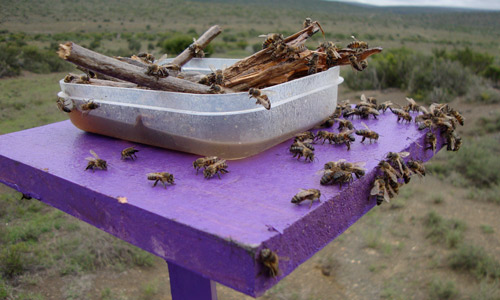
The Cape honey bee, Apis mellifera capensis Escholtz, is a subspecies of the western honey bee, Apis mellifera Linnaeus, that occurs naturally in the Cape region of South Africa (Fig. 1). Upon casual observation, Cape bees look very similar to another subspecies of honey bee present in South Africa, Apis mellifera scutellata Lepeltier (the 'African' honey bee of the Americas). Yet reproductively, Cape bees differ significantly from Apis mellifera scutellata and other honey bee subspecies, making it perhaps the most distinctive subspecies of Apis mellifera worldwide.
Figure 1. Cape honey bees, Apis mellifera capensis Escholtz, at a feeding station in South Africa. Photograph by Anthony Vaudo, University of Florida.
Distribution (Back to Top)
The natural distribution of Cape bees mirrors that of the Fynbos ecoregion in the southwestern section of South Africa. The Fynbos is part of the Cape Floral Kingdom (one of six floral kingdoms worldwide). This distinct ecoregion occupies a narrow strip of land stretching from the southwestern-most corner of South Africa, eastward to Port Elizabeth (Fig. 2). Even though it is small, the Fynbos region contains over 80% of the flower diversity found in the Cape Floral Kingdom, has more plants species than any area in the world, including tropical rain forests, and is able to support a remarkable diversity of life, from insects to higher animals.
Figure 2. Map demonstrating the geographic distribution of the Fynbos ecoregion. Figure by Hugo Ahlenius, UNEP/GRID-Arendal.

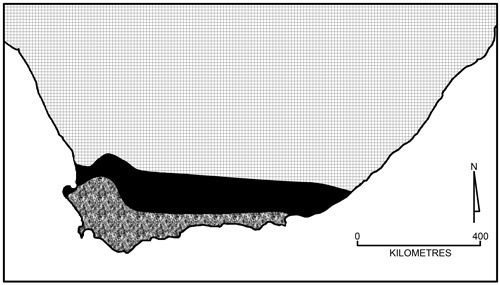
The Cape honey bee distribution appears to be limited to the same geographic area as the Fynbos (Fig 3). Pure Cape honey bees are distributed in the Fynbos belt stretching from southwestern South Africa eastward to Port Elizabeth. However, Cape bees hybridize with Apis mellifera scutellata to the north. This zone of hybridization encompasses a narrow stretch of land just north of the Fynbos region. North of the zone of hybridization is the distribution of the 'pure' Apis mellifera scutellata population.
Figure 3. The distribution of Cape honey bees in South Africa (shaded gray). The area shaded black represents where Apis mellifera capensis and Apis mellifera scutellata hybridize. The checkered area indicates the natural distribution of Apis mellifera scutellata. Figure by Jane Medley, University of Florida, distribution data from Hepburn and Radloff (1998).
Description (Back to Top)
Queen: Under normal circumstances the adult queen bee is the primary reproductive female in a Cape honey bee colony. Her head and thorax are similar in size to that of the worker. However, the queen has a longer and plumper abdomen than a worker.
Workers: Adult worker honey bees are smaller than the queen and their bodies are specialized for pollen and nectar collection. Both hind legs of a worker bee have a corbicula (pollen basket) specially designed to carry large quantities of pollen back to the colony. Worker bees are sexually immature: they have reduced ovaries and are unable to mate.
Drones: Drones are the male caste. The adult drone’s head and thorax are larger than the female castes, and their large eyes appear more ‘fly-like,’ touching in the top center of the head. Their abdomen is thick and blunt at the end, appearing bullet-shaped rather than pointy as with the females.
Cape honey bees undergo complete metamorphosis. This means that they have distinct developmental stages (egg, larvae, pupa, and adult). Typical developmental time from egg to adult varies by caste. Drones have the longest developmental time (24 days), workers are intermediate (21 days), and queens are the fastest (15-16 days).
Eggs: Eggs measure 1 to 1.5 mm long and look like a tiny grain of rice. Eggs are laid in individual hexagonal wax cells in the brood area of the comb. After 3 days, eggs hatch and larvae emerge.
Larvae: The number of days a honey bee spends as a larva varies by caste (worker: 6 days, drone: 6.5 days, queen: 5.5 days). Larvae are white and lay in a curled “C” shape at the bottom of their wax cell. When the mature larvae are ready to molt into pupae they extend their bodies into an upright position in the cell, and adult workers tending to the brood cover the prepupal larvae with a wax capping.
Pupae: Beneath the wax capping, prepupal honey bee larvae molt into pupae. The pupae remain under the wax capping until they molt into an adult and chew their way out of the cell. Similar to the larval stage, pupal developmental time varies by caste (worker: 12 days, drone: 14.5 days, queen: 8 days).
Adults: Adult honey bees are covered in branched hairs and can be divided into three body regions: head, thorax, and abdomen. The primary features of the head are the compound eyes and antennae. Two pair of wings and three pairs of legs attach to the thorax. A slender ‘waist’ is created by a constriction of the second abdominal segment. The most notable external feature of the abdomen is the stinger. Only female honey bees have a stinger, as it originates from a modified ovipositor, and workers have a barbed stinger that is torn, with the poison sac, from the end of their abdomen when they deploy the sting into a tough-skinned victim.
Adult Cape honey bee workers have been distinguished from Apis mellifera scutellata and other subspecies of honey bees using morphometric techniques. Genetic analyses are also being used increasingly as complications with morphometric techniques arise. Most beekeepers in South Africa use other unique characteristics of the Cape honey bee to identify Cape honey bee colonies, namely:
1. the ability of worker bees to produce female offspring
2. the highly developed ovaries in Cape laying-workers, and
3. the identification of small, queenless swarms.
However, these characteristics are only informative once Cape honey bee colonies have already established.
Biology (Back to Top)
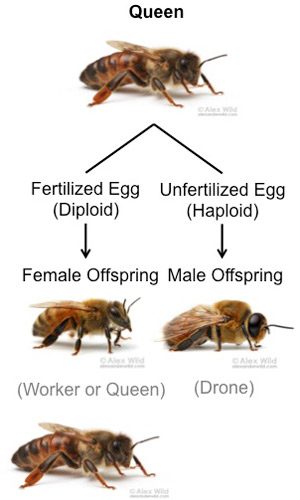
General Honey Bee Reproduction: For the most part, reproduction in Cape bees follows that of other honey bee subspecies. Honey bees have haplodiploid sex determination (Figure 4); unfertilized eggs (no paternal genetic contribution) develop into drones, and fertilized eggs (both maternal and paternal genetic contribution) develop into females. Female larvae that are fed the standard diet of pollen, nectar, and brood food become workers. Female larvae fed a rich diet of royal jelly, pollen, and nectar develop into queens.
Figure 4. Diagram of haplodiploid sex determination in the honey bee. Unfertilized eggs develop into drones, and fertilized eggs develop into females. Photographs by Alex Wild, www.alexanderwild.com. Figure by Ashley Mortensen.
Queens are the reproductive individuals in honey bee colonies. When a queen emerges as an adult she will spend the first 10-14 days of her life maturing and mating. During this time, a queen bee will leave the colony in search of drones. Queens and drones mate in the air, at drone congregation areas, and the drones die while mating. Over the course of 1-3 mating flights a queen will mate with 10-20 drones. Queens store the semen collected in an organ called the spermatheca, and use the stored sperm to fertilize eggs for the rest of her life.
However, honey bee colonies may lose their queens for a number of reasons. This event usually results in the rearing of a new queen, a feat accomplished by worker bees that begin to nurture a young female larva originally produced by the now-deceased queen. Despite this safety mechanism, many colonies fail to requeen themselves before the female larvae in the colony become too old to become queens. Because of this, many colonies become hopelessly queenless and are destined to perish.
Despite the fact that the colony will die without a queen, it does have one last chance to pass its genetics on to other honey bees in the area. When a colony has become hopelessly queenless for a period of time (usually >2 weeks), some workers' ovaries will develop, and those workers will begin to oviposit. Workers are unable to mate so they produce haploid offspring that become drones. Drones produced from laying workers are sexually viable, thus they are able to mate with virgin queens from other colonies in the area.
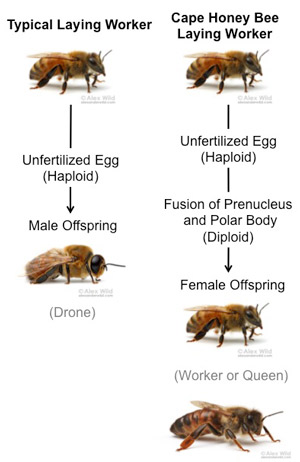
Thelytoky: Unlike the haploid eggs produced by laying workers in other honey bee subspecies, some Cape laying workers can produce diploid eggs. The process in which Cape workers produce diploid eggs is called thelytokous parthenogenesis (Fig. 5) - they can produce male or female offspring without mating. In this system the Cape worker essentially produces a pseudo-clone of herself by fusing the egg pronucleus with one of the polar bodies that results during meiosis, thereby forming a diploid nucleus that continues to develop into a normal female bee (either a queen or worker).
Figure 5. Diagram of thelytokous parthenogenesis in a Cape honey bee laying worker. The Cape honey bee laying worker can produce a pseudo-clone of herself by fusing the egg pronucleus with one of the polar bodies that resulted from meiosis to create diploid offspring from unfertilized eggs. Photographs by Alex Wild, www.alexanderwild.com. Figure by Ashley Mortensen.
A number of hypotheses have been proposed for the prevalence of thelytoky in Cape bees. Perhaps the leading hypothesis is that the Cape region of South Africa is very windy, and Cape colonies experience a significant queen loss when queens leave the colonies to mate. Colonies with thelytokous capabilities would not suffer the loss of a queen the same way as colonies without thelytokous capabilities, thus favoring the propagation of colonies with thelytokous workers.
It is important to note that thelytoky is not an exclusive trait of Cape bees. It is believed that workers from most, if not all, subspecies of honey bees are capable of laying diploid eggs. However, diploid eggs only occurs in <1% of worker-laid eggs of other honey bee subspecies. So while thelytoky is the exception in other honey bee subspecies, it is common in Cape honey bees
Thelytoky in Cape bees leads to a number of different important considerations. For example, worker offspring produced by Cape laying workers are a type of clone, being genetically identical to their mother (who provided both sets of chromosomes). Furthermore, the ability of workers to lay diploid eggs breeds a type of reproductive conflict not seen in colonies of other races of honey bees. For example, queenless Cape colonies have a number of options:
1. produce a new queen from a queen mother egg
2. produce a new queen from a worker-laid egg
3. proceed as a laying worker colony, or
4. proceed as a laying worker colony and later produce a queen from a worker-laid egg
Worker Policing: The ability of Cape workers to produce female offspring elicits another interesting behavior in Cape colonies - worker policing. Workers produced from one Cape laying worker can detect eggs oviposited by other laying workers and destroy or eat those eggs. This establishes a dominance hierarchy within Cape laying worker colonies where females from the same mother police the colony and destroy their aunts' offspring in favor of their own mother's offspring (their sisters).
Worker policing can lead to territory grabbing within colonies of Cape laying workers. Because a Cape laying worker colony is composed of many laying workers, all whose offspring are working to ensure their mother is the dominant laying force in the colony, bees produced by the same laying worker may congregate in the same area of the colony. So within a colony of Cape laying workers, one might find smaller 'sub-colonies,' each headed by a laying worker. This system is truly amazing and has advanced the study of the development of sociality and reproductive castes.
Queenless colonies of Cape bees can survive for some period of time and even rear a new queen from laying worker's eggs. However, if the colony fails to requeen itself, the population will eventually dwindle and the colony will die because even multiple laying workers cannot replace the reproductive output of a single queen.
Social Parasitism: Thelytoky enables the Cape honey bee to become socially parasitic. In that, Cape workers can invade another, non-related, honey bee colony and begin to reproduce clones of themselves that the host colony will rear to adulthood. These clones generally become laying workers themselves and further strain the host colony. Eventually the Cape clones become so numerous that there are not enough non-laying workers to sustain the host colony and the colony dwindles and dies.
Economic Importance (Back to Top)
Although the biology and behavior of Cape bees are fascinating, they present a problem for beekeepers in South Africa. Cape workers can parasitize colonies of any race of Apis mellifera. Migratory beekeepers managing Apis mellifera scutellata in the northern part of South Africa have moved bees into the Fynbos region of South Africa where the Cape bee is present (and the reciprocal also happens). This has allowed Cape workers to parasitize Apis mellifera scutellata colonies.
One example of this in the early 1990’s has been named the ‘capensis calamity.’ About 200 Cape honey bee colonies were moved into the northern part of South Africa and a single clonal linage of Cape laying workers infected more than 30,000 Apis mellifera scutellata colonies.
This is significant problem for beekeepers because if a colony is invaded by Cape bees, there are insufficient tools to ‘fix’ the colony. Once established in a colony of another subspecies Cape laying workers behave like cancer cells; rapidly reproducing and draining colony resources while offering no benefit to the host. Infected colonies eventually dwindle and die at which point the remaining cape workers disperse to new host colonies.
Beekeepers in South Africa often consider Cape bees more of a threat to their colonies than the varroa mite, Varroa destructor Anderson and Trueman. Because of this, researchers globally have taken notice of Cape bees. Many fear that if Cape bees ever spread outside of South Africa, they may be a significant problem for beekeepers worldwide.
Management (Back to Top)
Cape bees are specialist foragers in the Fynbos ecoregion and they often perform poorly when taken outside of this region. So Apis mellifera scutellata colonies parasitized by Cape bees in the northern part of South Africa can become useless to beekeepers. Cape honey bees, colonies should not be moved between regions where Cape bees do and do not inhabit.
However, Cape bees can be managed for pollination and honey production, like all other subspecies of the western honey bee, within their native distribution. In fact, beekeepers in the Fynbos ecoregion use Cape bees as their bee of choice. Furthermore, Cape bees are generally docile, unlike other African bee races (especially Apis mellifera scutellata ). However, other aspects of Cape bees’ behavior are similar to other African races of honey bees. For example Cape honey bees:
1. are 'flighty' on the comb (run on the comb when the colony is disturbed)
2. abscond (completely abandon the nest) readily in response to nest disturbances or diseases/pests
3. have smaller colonies than European races (an artifact of being in a warmer climate)
4. use copious amounts of propolis (resins collected from trees and plants - used as a weather-proofing agent and antibiotic in the colony), and
5. are well-suited to warm climates.
Selected References (Back to Top)
- Du Preez, F. 2014. Fynbos honey - pride of South Africa's cape floristic kingdom. Bee World 91: 16-18.
- Ellis JD, Zettel Nalen CM. Varroa destructor Anderson and Trueman (Arachnida: Acari: Varroidae). University of Florida, IFAS, Entomology and Nematology Department, Featured Creatures, EENY-473.(2013). (23 October 2014).
- Ellis JD, Ellis A. Apis mellifera scutellata Lepeletier (Insecta: Hymenoptera: Apidae). University of Florida, IFAS, Entomology and Nematology Department, Featured Creatures, EENY-429. (2012).(23 October 2014).
- Hepburn HR. 2001. The enigmatic Cape honey bee, Apis mellifera capensis. Bee World 82: 181-191.
- Hepburn HR, Radloff SE. 1998. Honeybees of Africa. Springer-Verlag, Berlin, Germany. 370 pp.
- Johannsmeier MF. 2001. Beekeeping in South Africa. Plant Protection Handbook No. 14, Agricultural Research Council, Pretoria, South Africa. 288 pp.
- Mortensen AN, Schmehl DR, Ellis JD. Apis mellifera Linnaeus, and subspecies (Insecta: Hymenoptera: Apidae). University of Florida, IFAS, Entomology and Nematology Department, Featured Creatures, EENY 568.(August 2013). (23 October 2014).