common name: schoepfia fruit fly
scientific name: Anastrepha interrupta Stone (Insecta: Diptera: Tephritidae)
Introduction - Distribution - Description - Life Cycle - Selected References
Introduction (Back to Top)
The schoepfia fruit fly, Anastrepha interrupta Stone, is native to southern Florida and is one of six Anastrepha species which occur in, or have been established in, Florida at some time. This species was described from southern Florida (Stone 1942) and is thus far known only from coastal counties of south-central Florida to Key West. The schoepfia fruit fly is only known to feed on fruit of the flowering plant Schoepfia chrysophylloides (Weems 1967).
While populations of Anastrepha interrupta fluctuate greatly in different years and at different times of the year, this is the most common of the so-called native species, and it has been taken by traps in every month of the year. Only the Caribbean fruit fly, Anastrepha suspensa (Loew), believed to be a recent re-introduction into Florida, is more abundant and widespread in Florida.
Distribution (Back to Top)
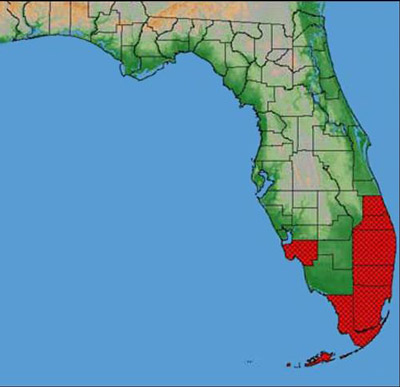
This species is recorded in the following south Florida counties: Brevard, Broward, Collier, Lee, Martin, Miami-Dade, Monroe (including Key West), Palm Beach and St. Lucie. The type locality is Jensen, Florida.
Figure 1. Distribution in Florida of the schoepfia fruit fly, Anastrepha interrupta Stone. Drawing by G.J. Steck and B.D. Sutton, Division of Plant Industry.
Description (Back to Top)
Adult: This is a small yellowish fruit fly, approximately the size of a house fly, with rather long, patterned wings. Except for Anastrepha suspensa, Anastrepha interrupta may be distinguished readily from other members of the genus which occur in Florida by the presence of a black scutoscutellar spot.
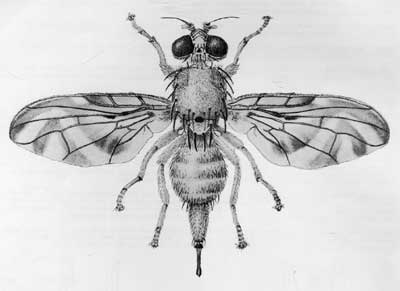
Figure 2. Adult Anastrepha interrupta female. Drawing by Division of Plant Industry.
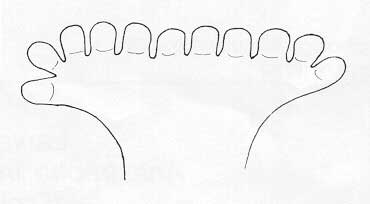
Anastrepha interrupta may be distinguished from Anastrepha suspensa by the shape of the ovipositor of the female. The tip of the ovipositor of interrupta is short and broad, with many fine serrations, whereas that of suspensa is long and tapering, with larger, rounded serrations occupying the apical two-thirds of the tip.
Figure 3. Comparison of the ovipositors of the schoepfia fruit fly, Anastrepha interrupta (left), and the Caribbean fruit fly, Anastrepha suspensa (right). Drawing by Division of Plant Industry.
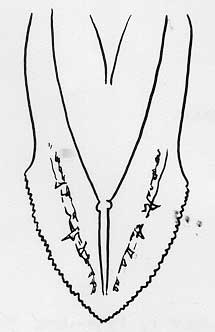
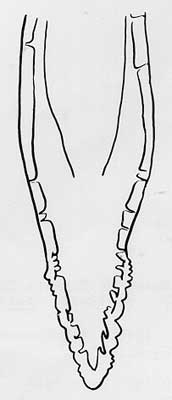
The thoracic spines of interrupta are yellowish brown, while those of suspensa are dark brown to black. The wing patterns of the two species, while similar, show characteristic difference. The wing pattern of interrupta is mostly yellowish with much less infuscation than that of suspensa, and the V band is not connected at its apex with the bands on the anterior portion of the wing, whereas in suspensa the V band is distinctly to narrowly connected with the S band on the anterior portion of the wing.
Anastrepha interrupta is closely related to Anastrepha spatulata Stone, which has been recorded from the Rio Grande Valley in Texas, Tamaulipas and Baja California in Mexico, and in Panama; but the difference in the wing pattern is so constant that there is little difficulty in distinguishing the two. Furthermore, the two species occupy widely separated geographical ranges, having no endemic host species in common.
Larva: The larva is white with the typical fruit fly shape: cylindrical-maggot shape, elongate, anterior end narrowed and somewhat curved ventrally, with anterior mouth hooks, ventral fusiform areas, and flattened caudal end. The last instar larvae range in length from 7.5–9.4 mm. The venter with fusiform areas on segments 2 through 10. The anterior buccal carinae are usually 14–19 in number. The anterior spiracles are nearly straight in lateral view but with ends somewhat curved, and with tubules averaging 10–12 in number.
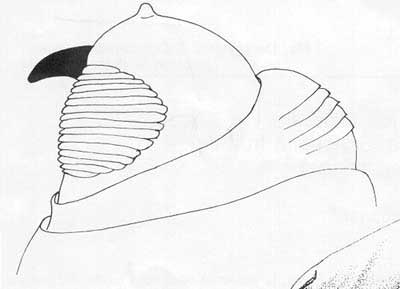
Figure 4. Head and buccal carinae of Anastrepha interrupta larva. Drawing by Division of Plant Industry.
Figure 5. Anterior spiracles of Anastrepha interrupta larva. Drawing by Division of Plant Industry.
The cephalo-pharyngeal skeleton has a large pointed convex mouth hook on each side, with rounded dorsal lobe, and each hook is about 2.5 times the hypostome length. The hypostomium possesses an extended elongate subhypostomium. The posthypostomial plates are curved to the dorsal bridge, and fused with the prominent sclerotized rays of central dorsal wing plate. The parastomium is broadly elongate. The dorsal wing plate has several prominent rays and a small posterior ray split. The dorsal bridge is relatively evenly sclerotized, with a prominent hood on pharyngeal plate.
Figure 6. Cephalo-pharyngeal skeleton of Anastrepha interrupta larva. Drawing by Division of Plant Industry.

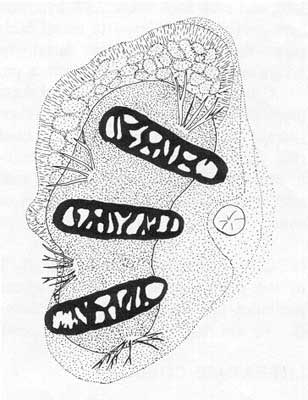
Caudal end with paired dorsal papillules (D1 and D2) angled about 45 degrees from each spiracular plate; intermediate papillules 4 in number, with I1-2 in a nearly equidistant triangle with I4, and I3 distant dorso-laterally; L1 on dorso-lateral edge of caudal end; V1 about equidistant from I4 and anal lobes; posterior spiracles as 3 elongated peritremes (length = 4X width) on each spiracular-plate, with dorsal 2 peritremes angled to center from dorsal direction and remaining peritreme angled from venter; interspiracular processes (hairs) relatively few in number, at 4 sites on each plate, and tips sometimes bifurcate to trifurcate; anal lobes entire.
Figure 7. Caudal end of Anastrepha interrupta larva. Drawing by Division of Plant Industry.
Figure 8. Posterior spiracles of Anastrepha interrupta larva. Drawing by Division of Plant Industry.
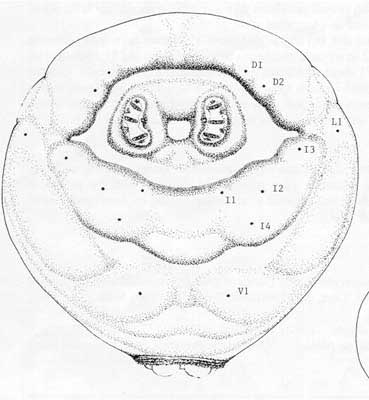
The schoepfia fruit fly larva is particularly distinctive in relation to known Anastrepha larvae by the prominent depression of the entire caudal spiracular plate arrangement, together with the pattern of papillules, particularly the four intermediate pairs; This can be compared to an earlier publication on the Mexican fruit fly, Anastrepha ludens (Loew), and the Caribbean fruit fly, Anastrepha suspensa (Loew) (Heppner 1984).
Life Cycle (Back to Top)
The life history of Anastrepha interrupta has not been ascertained, although adults have been reared several times from the fruit of Schoepfia chrysophylloides (A. Rich.) Planch. (Schoepfiaceae), a flowering plant indigenous to southern Florida.
Selected References (Back to Top)
- Heppner JB. 1984. Larvae of fruit flies I. Anastrepha ludens (Mexican fruit fly) and Anastrepha suspensa (Caribbean fruit fly) (Diptera: Tephritidae). Florida Department of Agriculture and Consumer Services, Division of Plant Industry Entomology Circular 260. 4 pp.
- State Plant Board of Florida Eleventh Biennial Report for the period July 1, 1934-June 30, 1936. Jan. 1937. p. 19-20. Anastrepha, n. sp. "E" Brown.
- Stone A. 1942. The Fruit Flies of the Genus Anastrepha. U.S. Department of Agriculture Miscellaneous Publication 439: 1-112.
- Weems Jr HV. 1965. Anastrepha suspensa (Loew) (Diptera: Tephritidae). Florida Department of Agriculture and Consumer Services, Division of Plant Industry Entomology Circular 38. 4 pp.
- Weems Jr HV. 1967. Anastrepha interrupta Stone (Diptera: Tephritidae). Florida Department of Agriculture and Consumer Services, Division of Plant Industry Entomology Circular 61. 2 pp.