common name: common carpet beetle
scientific name: Anthrenus scrophulariae (Linnaeus) (Insecta: Coleoptera: Dermestidae)
Introduction - Distribution - Description - Life Cycle - Economic Importance - Management - Selected References
Introduction (Back to Top)
The common carpet beetle, Anthrenus scrophulariae (Linnaeus), is a small blackish beetle that is found worldwide. This species is known to infest goods made from animal products, such as carpets, wool, textiles, and also preserved museum specimens.
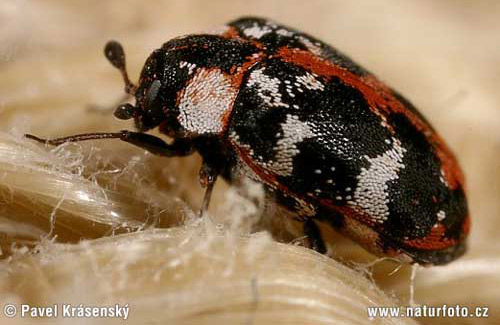
Figure 1. An adult common carpet beetle, Anthrenus scrophulariae (Linnaeus), on carpet fibers. This specimen has reddish scales. Photograph by Pavel Krásenský, www.naturephoto-cz.com.
Distribution (Back to Top)
The common carpet beetle is found worldwide. In the United States, it is most readily found in the north.
Description (Back to Top)
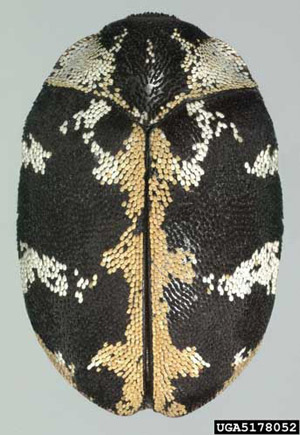
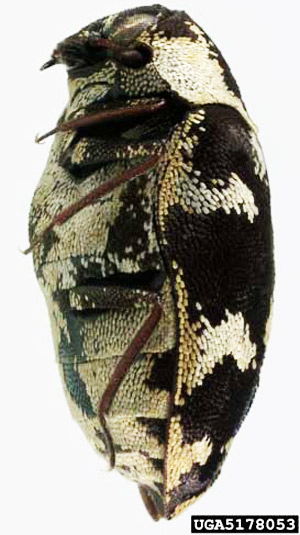
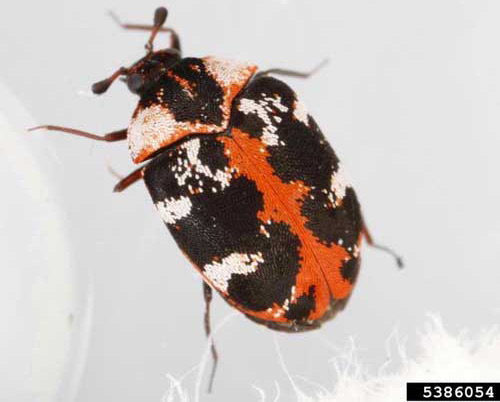
Adults: Adult common carpet beetles are oval in shape and vary from 2.5 to 3.8 mm in length. The head is black, mostly hidden by the prothorax. The thorax and elytra are black with distinct scale patterns. The thorax is covered with white scales except for a large midline. The elytra have orange to red scales down the midline with variable patches of white scales. In older individuals, some or all of the scales may be lost and the color pattern may look different.
Figure 2. Dorsal view of an adult common carpet beetle, Anthrenus scrophulariae (Linnaeus). This specimen has orange scales. Photograph by Natasha Wright, Florida Department of Agriculture and Consumer Services - Division of Plant Industry; bugwood.org.
Figure 3. Lateral view of an adult common carpet beetle, Anthrenus scrophulariae (Linnaeus). This specimen has orange scales. Photograph by Natasha Wright, Florida Department of Agriculture and Consumer Services - Division of Plant Industry; bugwood.org.
Figure 4. An adult common carpet beetle, Anthrenus scrophulariae (Linnaeus). This specimen has orange-reddish scales. Photograph by Joseph Berger, bugwood.org.
Eggs: As is common to the genus Anthrenus, the eggs of the common carpet beetle are small, white, and have projections on them so that the eggs will adhere to surfaces (Black 2004, Smith and Whitman 1996). The female lays between 30 to 60 eggs that will hatch 10 to 20 days after being oviposited.
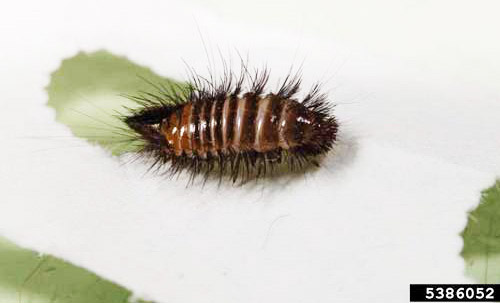
Larvae: The larvae are brown in color. They undergo six instars, taking about 70 days to develop depending on temperature (Griswold and Greenwald 1941, Hasan et al. 2007). In the sixth instar, the larva is reddish brown, covered with many dark hairs, and is 2.5–5.5 mm long (Black 2004, Hasan et al. 2007, Smith and Whitman 1996).
Figure 5. Larva of a common carpet beetle, Anthrenus scrophulariae (Linnaeus). Photograph by Joseph Berger, bugwood.org.
Pupae: Pupation takes place in the last larval skin. The location of pupation is dependent on where the larva was last feeding. For example, the pupae may be found in carpets, carpet pads, or cracks on the floor if the larva was last feeding on the carpet.
Life Cycle (Back to Top)
Adult common carpet beetles live outdoors, feeding on pollen and nectar. It is thought that the pollen and nectar encourage mating and oviposition (Griswold and Greenwald 1941). Outside, the female may lay her eggs in animal nests, bee hives, or on dead animals. Indoors, she may lay her eggs on textiles, carpets, clothing, preserved specimens, or other animal/plant origin material.
The larvae feed on the materials mentioned above and require about 66 days to complete their development at room temperature (Griswold and Greenwald 1941, Hasan et al. 2007). The larvae progress through six larval instars and at the end of the sixth, they pupate in the last larval skin. Pupation lasts between 7 and 15 days (Black 2004, Smith and Whitman 1996). After pupation, the adults emerge and rest in the larval skin for about 18 days before becoming active adults (Black 2004, Smith and Whitman 1996, Hasan et al. 2007). The adults then make their way outdoors to feed and mate.
The adults feed on nectar and pollen, preferring blossoms that are white or cream in color. This includes buckwheat, wild asters, daisies, Spiraea spp. and Ceanothis spp. (Black 2004, Smith and Whitman 1996).
Economic Importance (Back to Top)
It is the larval stage that causes damage. Textiles, carpets, and fabrics will be peppered with irregular holes, while museum specimens will be eaten away, often leaving a fine dust around or beneath the specimen. The common carpet beetle may also cause dermatitis (Cormia 1967), when human skin comes in contact with shed larval skins.
Management (Back to Top)
Prevention: The best way to prevent an infestations of the common carpet beetle is to protect its food source. This is achieved by good sanitation practices such as dusting and vacuuming. Clothes should be regularly washed or dry-cleaned.
Stored materials and specimen collections should be kept in tightly closed containers. Moth balls or flakes (naphthalene) may be placed in the containers to repel the beetles (Koehler et al. 2010). In order for this method to work over long periods of time, the naphthalene products need to be replaced periodically.
Non-chemical control: When infestations are localized, non-chemical methods can be used to eliminate the common carpet beetle. Extreme cold and heat will kill the larvae on or in infested goods. Goods can be placed in plastic bags and put in a -20°F freezer for three hours or exposed to heat above 105°F for four hours (Koehler et al 2010). Placing goods in hot sunlight will cause the larvae to abandon them (Koehler et al. 2010).
Chemical control: The best way to control the common carpet beetle is to prevent the infestation from happening. Given the numerous, inaccessible places that good housekeeping practices often cannot reach—wall voids, air conditioner ducts, crawl spaces, etc.—chemical control may be necessary. For example, spraying non-residual insecticides into wall voids. Use insecticidal dusts to treat cracks, crevices, near baseboards, and around the edges of carpeting. In extreme cases, if the entire structure is infested, fumigation may be the most economic and efficient solution.
Selected References (Back to Top)
- Black J. 2004. Fabric and museum pests. pp. 581-633. In Morland D (ed.), Handbook of Pest Control (Mallis A), Ninth Edition. GIE Media, Inc.
- Cormia FE. 1967. Carpet beetle dermatitis. Journal of the American Medical Association. 200: 799.
- Griswold GH, Greenwald M. 1941. Studies on the Biology of Four Common Carpet Beetles. Cornell Agricultural Experimental Station Memoirs. 240: 1-75.
- Hasan A, Hossain D, Hasan M, Rahman S. 2007. A pest of stuffed museum specimen Anthrenus scrophulariae (L.) (Coleoptera: Dermistidae). University Journal of Zoology, Rajshahi University. 26: 99-102.
- Koehler PG, Buss EA, Kern WH, Pereira RM. 2010. Pests in and Around the Florida Home, 4th ED. University of Florida/IFAS. SP 134. 326 pp.
- Smith EH and Whitman RC. 1996. Fabric & Paper Pests. pp. 5.2.1-5.2.3. In NPCA Field Guide to Structural Pests. National Pest Control Association, Dunn Loring, Virginia.