common name: black carpet beetle
scientific name: Attagenus unicolor (Brahm) (Insecta: Coleoptera: Dermestidae)
Introduction - Distribution - Life Cycle and Description- Medical and Economic Significance - Management - Selected References
Introduction (Back to Top)
The black carpet beetle, Attagenus unicolor (Brahm), is the most common and most destructive of the five important species of carpet beetles in the United States. It damages household products containing keratin, a principal protein found in animal hair and feathers. Plant products such as cereals and grains, as well as synthetic fabrics not derived from animal matter, may also be attacked. Dried insect specimens, such as those found in insect collections, are also devoured.
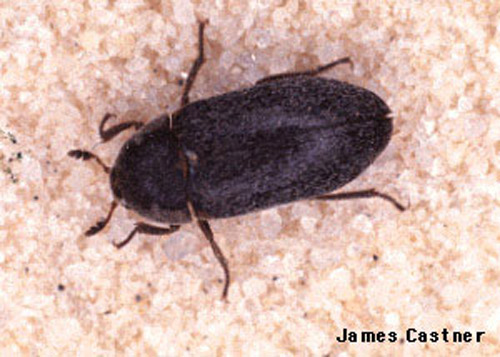
Figure 1. Adult black carpet beetle, Attagenus unicolor (Brahm). Photograph by James Castner, University of Florida.
Distribution (Back to Top)
The black carpet beetle is found throughout the United States, Canada, and Mexico. It is believed that this pest may have been imported to the United States in the early 19th century from Europe where it is not considered a major pest. Humidity plays a large role for development of carpet beetles. In the southern states, high humidity may often cause the black carpet beetle's eggs to become moldy while in the northern states lower humidity is usually favorable for a successful egg hatch.
Life Cycle and Description (Back to Top)
The black carpet beetle undergoes complete metamorphosis, passing through the egg, larva, pupa, and adult stages. This cycle requires two months to two years depending on temperature.
Adults: Dark brown or black adults are oval shaped and 1/8 to 3/16 inch in length. This stage feeds outdoors on pollen and nectar, migrating indoors to lay eggs about a week after emergence. Adults can live nine months to three years depending on food availability and other environmental factors.
Eggs: Females lay about 50 small, white eggs which hatch in six to ten days. Eggs are deposited in lint, cracks, and other areas near larval food supply where they are rarely seen.
Larva: The larva of the black carpet beetle is the damaging stage of this pest. The cigar-shaped larva is long and narrow with short, stiff hairs on a dark brown to black body. Long, bristlelike tails are visible on older larvae. A black carpet beetle larva may grow 1/2 inch long while undergoing five to 11 molts. Cast larval skins are often seen on infested fabrics and can easily be mistaken for living larvae. The larval stage may require three months to nearly two years in order for pupation to occur.
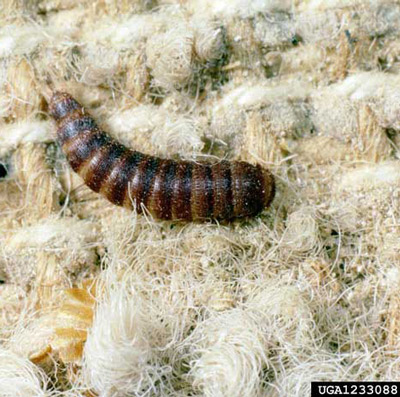
Figure 2. Larva of the black carpet beetle, Attagenus unicolor (Brahm). Photograph by Clemson University; www.insectimages.org.
Pupae: The black carpet beetle pupates in its last larval skin after the majority of larval feeding and growth occurs. The pupal stage lasts six to 24 days.
Medical and Economic Significance (Back to Top)
The black carpet beetle is considered a general feeder but economic damage primarily occurs on fabrics in the household. They are known to eat large, irregular holes through any acceptable food material. They prefer to feed on the surface of wool products or at the base of furs, leaving bare spots on the hide. On most fabrics the nap is usually consumed leaving the base threads intact. Additionally, the black carpet beetle may be a pest of stored products when it invades containers of cereals, nuts, and stored grain. Black carpet beetle damage renders most fabrics aesthetically unappealing and useless. Furthermore, those in close association with black carpet beetles may suffer allergic reactions as a result of exposure to beetle fragments, cast skins, or dust.
Management (Back to Top)
Black carpet beetles can be detected by close inspection of susceptible household goods. Depending on the value of the infested product, some may opt to discard the product while others may choose control options in an effort to salvage the goods.
Careful inspection is the first step in controlling black carpet beetle infestations. All susceptible household fabrics ranging from rugs to mounted animal specimens must be inspected closely for presence of larvae, their cast skins, and damage. Other food sources such as stored grains, bird seed, and cereals should also be examined. Since adult beetles feed on pollen and nectar, all cut flowers from the outdoors should be inspected for black carpet beetle presence. Screens should also be installed around windows, and doors should be tightly fitted to prevent adults from entering the structure. Additionally, black carpet beetles favor animal nests such as those of birds and rodents and can be a source of infestation in the winter when the first sign of cold weather forces the beetles indoors. Location and removal of such nests before winter can also prevent infestation.
Vacuuming may be used to remove debris such as animal hair and lint that serves as a food source for black carpet beetles. When located, infested articles should be disposed of. However, if the item is of high value, several options are available. Items such as furs can be placed in cold storage at temperatures around 40°F. Also, some items may be frozen for a week in an effort to kill all beetle larvae.
In the case of a heavy infestation, insecticide treatment may be necessary. Before using insecticide treatments for carpet beetles, the premises should be thoroughly vacuumed. Cracks and crevices can be treated with a dust such as diatomaceous earth or silica aerogel. These dusts may also be applied at the edge of carpeting near the baseboards in infested rooms. Spot treatment of rugs may be made with residual sprays. Emulsifiable concentrates are the best formulations for treatment of carpets and rugs. Some extreme cases may require fumigation by a pest control professional. Fumigation offers elimination of the current infestation but no residual protection is provided, allowing for reinfestation.
Paradichlorobenzene (moth balls) and napthalene offer little protection against black carpet beetles. Paradichlorobenzene has been shown to slightly inhibit feeding but is not an effective repellent against the black carpet beetle.
Selected References (Back to Top)
- Baker JE. 1986. Influence of larva weight and temperature change on survival and pupation in black carpet beetle (Coleoptera: Dermestidae). Environmental Entomology 15: 1166-1170.
- Bennet GW, Owens JM, Corrigan RM. 1997. Truman's Scientific Guide to Pest Control Operations, 5th Ed. Advanstar Communications, Cleveland.
- Black J. 2004. Fabric and museum pests. pp. 581-633. In Morland D (ed.), Handbook of Pest Control (Mallis A), Ninth Edition. GIE Media, Inc.
- Bry RE, Jurd L, Lang JH, Boatright RE. 1978. Mothproofing: candidate repellents against black carpet beetle larvae, Attagenus megatoma (Coleoptera: Dermestidae). Journal of the Georgia Entomological Society 13: 63-66.
- Bry RE, Lang JH, Boatright RE. 1983. Toxicity of three pyrethroid insecticides to eggs of the black carpet beetle, Attagenus megatoma, and the webbing clothes moth, Tineola bisselliella. Journal of the Georgia Entomological Society 18: 394-398.
- Robinson WH. 1996. Urban Entomology: Insect and Mite Pests in the Human Environment. Chapman & Hall, New York.
- Su NY, Scheffrahn RH. 1990. Efficacy of sulfuryl fluoride against four beetle pests of museums (Coleoptera: Dermestidae, Anobiidae). Journal of Economic Entomology 83: 879-882.