common name: citrus peelminer
scientific name: Marmara gulosa Guillèn and Davis (Insecta: Lepidoptera: Gracillariidae)
Introduction - Distribution - Description and Life Cycle - Hosts - Economic Importance - Management - Selected References
Introduction (Back to Top)
The citrus peelminer is a dark-gray moth with mottled white and brown markings and about 4 mm in length.
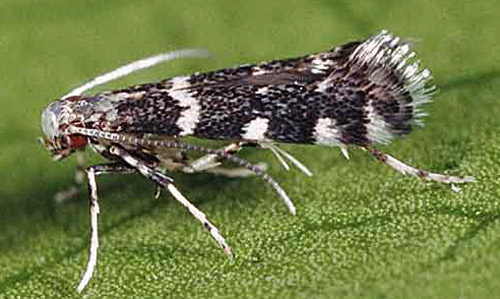
Figure 1. Adult citrus peelminer, Marmara gulosa Guillèn and Davis. Photograph by Jack Clark of the University of California ANR Communication Services in Davis. Photo provided courtesy of Beth Grafton-Cardwell, Director, Lindcove Research and Extension Center, Exeter, CA.
This moth is considered native in the United States, attacking willow (Guillèn et al. 2001). It is believed that a host-shift occurred to multiple non-native plants including all varieties of citrus and cerain ornamentals, such as oleander (Jones 2001). Citrus peelminer has been reported to occur in low numbers in Florida and at least three Marmara species have been identified in the state (Heppner 2000). Recent evaluations of an experimental pheromone lure that is still under development by researchers at the University of California, Riverside have confirmed captures of citrus peelminer (Marmara sp.) in Polk County, Florida.
Distribution (Back to Top)
The citrus peelminer is an economically important pest in California, Arizona, Northern Mexico, and Cuba (Jones 2001). Occurrences have also been reported in Texas and Florida; however, it has not been reported to cause economically important damage in these latter two states (Jones 2001). In Florida, the economically important citrus leafminer, Phyllocnistis citrella Stainton (Lepidoptera: Gracillariidae), has been present since 1993. Damage caused by this pest is similar to that caused by citrus peelminer; however, damage by leafminer occurs primarily on leaves rather than on fruit. It is possible that some portion of fruit damage caused by citrus peelminer in Florida is incorrectly attributed to citrus leafminer given that leafminers primarily infest new flush and only occasionally infest fruit whereas the citrus peelminer exclusively infests fruit and stems.
Biology and Life Cycle (Back to Top)
Adult: The adult moth is crepuscular, with primary activity in the early morning and evening hours. The adult lives approximately 11 days. Females lay multiple (10 to 50 per female) single eggs per lifetime on the surface of fruit or stems.
Egg: The whitish and oval-shaped egg hatches within four to five days and the emerging larva immediately bores into the epidermal cell layer of the fruit peel or stem.
Larva: The larval stage is comprised of three distinct morphological forms (Kerns et al. 2004). The initial form occurs during the first four instars and feeds on sap while mining. This form is flat, yellowish in color and approximately 4 mm in length. Thereafter, the larva molts into a non-feeding intermediate form. During the final stage known as the spinning larva, the peelminer exits the mine, lowers itself via a silken thread to a leaf or bark crevice and pupates.
Pupa: The pupal stage lasts about 10 days and the entire life cycle requires approximately 30 days (Kerns et al. 2004).
Hosts (Back to Top)
The citrus peelminer is very polyphagous. It is known to infest more than 31 different families of plants. In citrus, peelminer favors grapefruit and navel oranges; however, lemons are also infested. Plants that are known to harbor heavy infestation of citrus peelminer include citrus, cotton, cowpeas, eggplant, grape, peppers, plum, pumpkin, and zucchini (Guillèn et al. 2001, Grafton-Cardwell 2001).
Other fruits known to harbor occasional infestations include apple, apricot, avocado, cherry, kiwi, olive, papaya, peach, and watermelon. It also heavily infests certain ornamentals such as Grecian laurel, Japanese maple, oleander, willow, and wisteria as well as weeds such as green amaranth and tall morningglory (Grafton-Cardwell 2001).
Economic Importance (Back to Top)
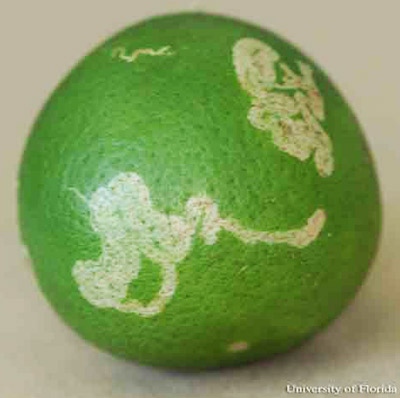
Damage caused by citrus peelminer is apparent on the peel of the fruit and is cosmetic in nature. However, only two to three mines per fruit renders fresh-market fruit commercially unacceptable. Outbreaks in California have had devastating consequences. In 1995, an outbreak in the Coachella Valley caused 80 to 90 % fruit loss in certain groves (Anonymous 2005). It again became a serious problem in the San Joaquin Valley in 2000.
Figure 2. Suspected citrus peelminer, Marmara gulosa Guillèn and Davis, larval damage to grapefruit in Polk County, Florida. Photograph by Michael Rogers, University of Florida.
Management (Back to Top)
Monitoring: Currently, there are no reliable monitoring methods for the adult moths. A sex-attractant pheromone lure is under development by Dr. Jocelyn Millar at the University of California, Riverside. Although the preliminary pheromone does attract males to sticky traps, it does so in very low frequencies and has been inconsistent to date. It is suspected that other minor components of the pheromone have not yet been identified or that perhaps the ratio of components comprising the blend is not yet perfected. This pheromone attracted male citrus peelminers to traps in Polk County, Florida in 2007, but only in low numbers. It is currently unknown whether this is simply due to imperfectness of the current pheromone, low population densities of citrus peelminer in Florida, or a combination of both factors.
Scouting for citrus peelminer larvae can be conducted by inspecting fruit for the presence of developing mines. Fruit on the inside lower canopy is preferred; therefore, scouting should target the lower 4 ft of the tree canopy (Kerns et al. 2004). Citrus peelminer damage on fruit can be distinguished from citrus leafminer in that the latter insect leaves a trail of frass in the leaf mine while the former does not.
Cultural control: Cultural control is an option if growers have the flexibility of avoiding the most susceptible varieties or have the capability of removing highly susceptible neighboring plants. The most susceptible varieties include Fukumoto oranges, grapefruit, and pummelos (Anonymous 2005). Neighboring crops which can increase the incidence of peelminer infestation in citrus groves include cotton and grapes and should be avoided if possible.
Biological control: Biological control of citrus peelminer can be very effective in certain regions. The native eulophid wasp, Cirrospilus coachellae, can provide 60 to 90% parasitism of peelminer larvae, particularly later in the season near the end of August (Guillèn et al. 2003). Although this wasp is a highly effective parasitoid in some areas such as the Coachella Valley of California (Guillèn et al. 2003), it does not survive winters in more northerly regions such as the San Joaquin Valley, where it does not provide sufficient control of this pest (Anonymous 2005). Also, predacious mites, such as the Yuma spider mite, attack the larval stage (Kerns et al. 2004).
Chemical control: Management of citrus peelminer with chemical insecticides has often proven marginally effective because it is difficult to obtain good spray coverage and penetrate the mines where larval feeding occurs. Several insecticides have been evaluated in California with limited success. These include neonicotinoids, organophosphates, and carbamates. It was concluded that chemical control of citrus peelminer with the most effective toxicants would require sprays every three weeks, which is not only expensive but also an unsound IPM practice (Grafton-Cardwell and Reagan 2001). Spinosad, a lactone isolated from the microorganism Saccharopolyspsora spinosa, has been shown to effectively kill larval citrus peelminer; however, inner canopy coverage is required for effective control (Kerns et al. 2004).
Selected References (Back to Top)
- Anonymous. (2005). Citrus peelminer. UC Online Pest Management Guide. (15 April 2013).
- Guillèn M, Davis DR, Heraty JM. 2001. Systematics and biology of a new, polyphagous species of Marmara (Lepidoptera: Gracillariidae) infesting grapefruit in the southwestern United States. Proceedings of the Entomological Society of Washington 103: 636-654.
- Guillèn M, Heraty JM, Luck RF. 2003. Seasonal variation and infestation incidence by Marmara gulosa (Lepidoptera: Gracillariidae) on grapefruit in the Coachella Valley, California. Journal of Economic Entomology 96: 577-583.
- Grafton-Cardwell B, Reagan C. (2001). Citrus peelminer-pesticide trials. Citrus Entomology. (no longer available online)
- Grafton-Cardwell B. (2001). Citrus peelminer-crop list. Citrus Entomology. (no longer available online)
- Heppner J. (2000). A checklist of the Lepidoptera of Florida. Museum of Entomology - FSCA. (15 April 2013).
- Jones J. (2001). Citrus peelminer fact sheet. Cotton Cooperative Extension. (15 April 2013).
- Kerns D., Wright, G., Loghry J. (2004). Citrus peelminer (Marmara gulosa). Citrus Insects Cooperative Extension. (3 March 2016)