common name: citrus blackfly
scientific name: Aleurocanthus woglumi Ashby (Insecta: Hemiptera: Aleyrodidae)
Introduction - Distribution - Description and Life History - Identification - Economic Importance - Management - Selected References
Introduction (Back to Top)
While the citrus blackfly, Aleurocanthus woglumi Ashby (Figure 1), is a serious citrus pest of Asian origin (Dietz and Zetek 1920), it is usually under effective biological control in Florida. Although a member of the whitefly family, the adult of this species has a dark, slate blue appearance that led to it being given the name blackfly.
Distribution (Back to Top)
Citrus blackfly was discovered in the Western Hemisphere in 1913 in Jamaica. It spread to Cuba in 1916, Mexico in 1935 (Smith et al. 1964), and was detected in Key West, Florida in 1934. It was eradicated from Key West in 1937 (Newell and Brown 1939). Rediscovered in Ft. Lauderdale, Florida in 1976 (Dowell et al. 1981), citrus blackfly was detected in Palm Beach and Miami-Dade counties in 1977; Lee, Highlands and Brevard counties in 1979; Manatee County in 1986; Polk County in 1989; Marion and Volusia counties in 1991; and Alachua County in 1992 (Nguyen, unpublished data). At present, it is widely spread from northcentral through south Florida.
Description and Life History (Back to Top)
The life cycle from egg to adult ranges from 45 to 133 days depending on the temperature (Dietz and Zetek 1920). Six generations per year are produced in south Florida (Nguyen et al. 1983).
Eggs: Eggs are laid in a spiral pattern on the underside of the leaf. Each female lays two to three egg-spirals during her 10 to 14 day life span. Eggs hatch within seven to 10 days (Dowell et al. 1981).
Figure 1. Citrus blackfly, Aleurocanthus woglumi Ashby, egg spiral and first instars. Photograph by Division of Plant Industry.
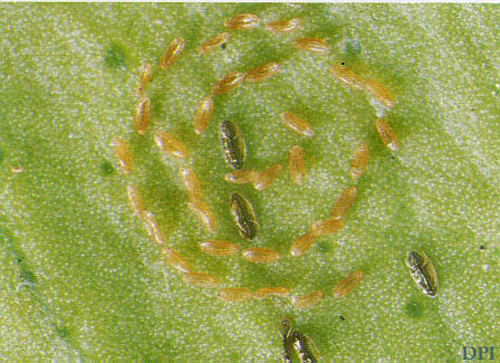
Nymph: The first instar is elongate-oval, averaging 0.30 mm long × 0.15 mm wide and is brown in color, with two glassy filaments curving over the body. The first instar lasts seven to 16 days. The second instar is more ovate and convex than the first instar, averaging 0.40 mm long × 0.20 mm wide, and is dark brown in color with numerous spines covering the body. The second instar lasts seven to 30 days. The third instar is more convex and much longer than the second, averaging 0.87 mm long × 0.74 mm wide. The body is glossy black with spines stouter and more numerous than those in the second instar. The third instar lasts six to 20 days (Dietz and Zetek 1920, Smith et al. 1964).
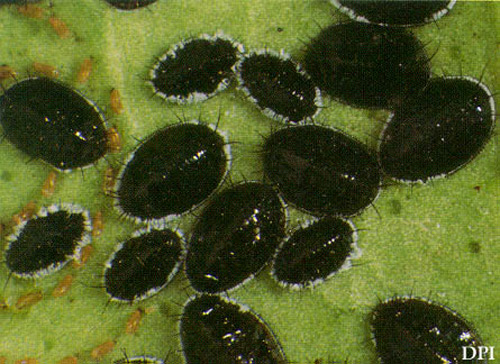
Pupa: The fourth instar, or so-called pupa case, is ovate and glossy black with a marginal fringe of white wax (Figure 2). The sex is readily distinguishable. Females average 1.24 mm long × 0.71 mm wide; males are 0.99 mm long × 0.61 mm wide. The pupal stage lasts 16 to 50 days (Dietz and Zetek 1920, Dowell et al. 1981).
Figure 2. Pupae of the citrus blackfly, Aleurocanthus woglumi Ashby. Photograph by Division of Plant Industry.
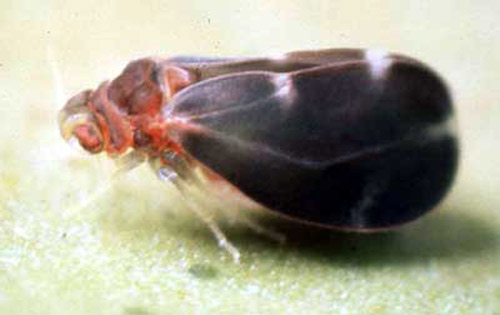
Adult: The adult emerges from a T-shaped split appearing in the anterior end of the pupal case. At emergence, the head is pale yellow, legs are whitish, and eyes are reddish-brown (Figure 3). Within 24 hours after emergence, the insect is covered with a fine wax powder, which gives it a slate blue appearance (Dietz and Zetek 1920).
Figure 3. Adult citrus blackfly, Aleurocanthus woglumi Ashby. Photograph by Division of Plant Industry.
Identification (Back to Top)
The identification key provided here is designed to identify the four major species of whiteflies that commonly infest citrus in Florida. Another key that covers 16 species of whiteflies that may infest Florida citrus is available on the World Wide Web. The WWW key, developed by the Florida Department of Agriculture and Consumer Services' Division of Plant Industry, uses color photographs of nymphs to assist in identification. It is available at: Key to whitefly fourth instars on citrus.
1a. The whitefly adult is white or white with dark spots on the wings. Nymphs are difficult to see or identify. . . . . 2
1b. The whitefly adult is slate blue in color, eggs are present and laid in spirals. Nymphs are black with prominent spines. . . . . citrus blackfly
2a. The whitefly adult is all white without any dark spots on wings. . . . . citrus whitefly
2b. The whitefly adult is white with a darkened area at the end of each wing. Occasionally a yellow fungus is present. . . . . cloudywinged whitefly
2c. The whitefly female adult is all white and is surrounded by waxy filaments. Eggs are laid in a circle with the female at rest in the center. . . . . woolly whitefly
Economic Importance (Back to Top)
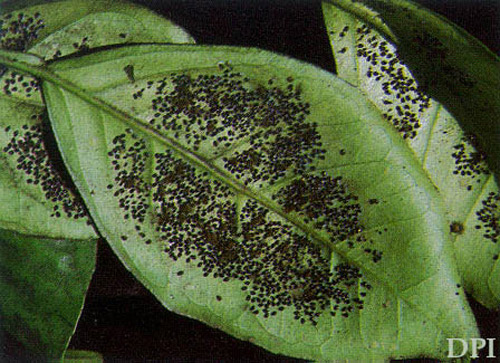
Citrus blackfly infests over 300 host plants, but citrus is the most suitable for large population development (Figure 4). It damages citrus by sucking nutrients from foliage, which weakens the plants. Citrus blackflies excrete honeydew on which sooty molds develop. Sooty molds coat citrus leaves, causing them to appear black. Sooty molds can severely impair leaf respiration and photosynthesis.
While this species is found in very low numbers in most groves, it is normally under effective biological control and pest populations rarely require treatment (Browning et al. 2006).
Figure 4. Heavy infestation of citrus blackfly, Aleurocanthus woglumi Ashby, on citrus leaves. Photograph by Division of Plant Industry.
Management (Back to Top)
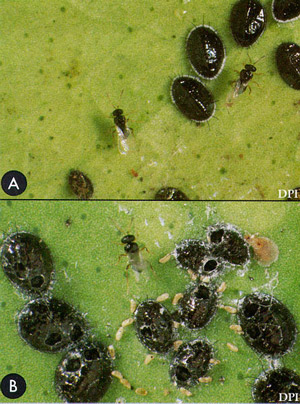
Biological control: Citrus blackfly has several natural enemies. In Florida, the most effective agents for controlling citrus blackfly are the parasitic wasps, Encarsia perplexa Huang & Polaszek (Huang and Polaszek 1998) and Amitus hesperidum Silvestri (Hart et al. 1978). A female citrus blackfly larva will support two and occasionally three or four parasites while a male citrus blackfly larva will support only one parasite.
Development of Amitus hesperidum (Figure 5) is synchronized with its host, in that adult female parasites are ready to lay eggs when the susceptible larval stages of citrus blackfly are present. Each female parasite can produce up to 70 offspring in four to five days with adequate hosts available. Female Amitus hesperidum lay eggs in all three larval stages of citrus blackfly with a preference for the first stage. However, this parasite has poor searching ability and a short life span. Amitus hesperidum is most effective with high density citrus blackfly populations, especially during cool temperature and high humidity seasons. An Amitus hesperidum population will expire soon after suppression of the citrus blackfly population (Nguyen et al. 1983).
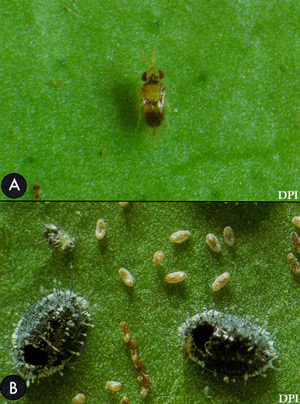
Encarsia perplexa (Figure 6) has a lower rate of reproduction than Amitus hesperidum, but has better searching ability. Generally, Encarsia perplexa can maintain a citrus blackfly population at a lower level than Amitus hesperidum. Mated females of Encarsia perplexa lay a single diploid egg in any larval stage of the host, although the second stage appears preferable. This egg will produce a female parasite. Adult females may survive up to six weeks. Virgin female Encarsia perplexa may deposit a haploid egg in a fully-developed female larva of Encarsia perplexa (her own species) and this egg will produce a male parasite (adelphoparasite). The sex ratio in the field is 1:7 (male:female) (Smith et al. 1964, Nguyen 1987).
Figure 5. Pupae of citrus blackfly, Aleurocanthus woglumi Ashby, and the adult parasitoid, Amitus hesperidum Silvestri(A). Pupal cases of the citrus blackfly, Aleurocanthus woglumi Ashby, from which the parasitoid has emerged. Egg spirals of the citrus blackfly are also evident (B). Photograph by Division of Plant Industry.
Figure 6. Adult Encarsia perplexa Huang & Polaszek (A), and pupal cases of the citrus blackfly, Aleurocanthus woglumi Ashby, from which the parasitoid has emerged (B). Photograph by Division of Plant Industry.
Chemical control: Whiteflies also are controlled by sprays applied primarily for control of scale insects. Spraying of commercial citrus exclusively for whitefly control is seldom practiced in Florida. Recommended control measures for commercial or dooryard citrus are significantly different. Please consult the specific management guide, Florida Citrus Management Guide for whiteflies in commercial groves, for your situation.
It is important to note that spraying with copper for control of harmful fungal diseases will inhibit growth of "friendly fungi" resulting in an increase in whitefly populations. Also, more than one application of sulfur per year can have an adverse effect on parasites. Spray oil has some insecticidal properties, but is primarily used to remove sooty mold that grows on the fruit and leaves.
Selected References (Back to Top)
- Dietz HF, Zetek J. 1920. The blackfly of citrus and other subtropical plants. USDA Bulletin 885: 1-55.
- Dowell RV, Cherry RH, Fitzpatrick GE, Reinert JA, Knapp JL. 1981. Biology, plant-insect relations, and control of the citrus blackfly. Florida Agricultural Experiment Station Bulletin 818: 1-48.
- Hart WG, Selhime A, Harlan DP, Ingle SJ, Sanchez-R M, Rhode RH, Garcia CA, Caballero J, Garcia RL. 1978. The introduction and establishment of parasites of citrus blackfly, Aleurocanthus woglumi in Florida (Hem.: Aleyrodidae). Entomophaga 23: 361-366.
- Huang J, Polaszek A. 1998. A revision of the Chinese species of Encarsia Forster (Hymenoptera: Aphelinidae): parasitoids of whiteflies, scale insects and aphids (Hemiptera: Aleyrodidae, Diaspididae, Aphidoidea). Journal of Natural History 32: 1825-1966.
- Newell W, Brown AC. 1939. Eradication of the citrus blackfly in Key West, Fla. Journal of Economic Entomology 32: 680-682.
- Nguyen R. 1987. Encarsia opulenta (Silvestri) a parasite of Aleurocanthus woglumi Ashby (Hemiptera: Atherinidae). Florida Department of Agriculture & Consumer Services, Division of Plant Industry. Entomology Circular 301. 2 pp.
- Nguyen R, Brasil JR, Poucher C. 1983. Population density of the citrus blackfly, Aleurocanthus woglumi Ashby (Homoptera: Aleyrodidae), and its parasites in urban Florida in 1979-81. Environmental Entomology 12: 878-884.
- Smith HD, Maltby HL, Jimenez EJ. 1964. Biological control of the citrus blackfly in Mexico. USDA-ARS. Technical Bulletin No. 1311: 1-30.