common name: giant swallowtail
scientific name: Papilio cresphontes Cramer (Insecta: Lepidoptera: Papilionidae)
Introduction - Distribution - Description - Life Cycle - Host Plants - Management - Selected References
Introduction (Back to Top)
The giant swallowtail, Papilio cresphontes Cramer, is a striking, wonderfully exotic-looking butterfly that is very abundant in Florida. The adult butterfly is a welcome visitor to butterfly gardens and to general landscape plantings. The larval or caterpillar stage can be considered a pest due to its habit of feeding on the foliage of most Citrus species. A few orangedogs, as the larvae are commonly called, can quickly defoliate small or young plants. However, larvae can be tolerated on large dooryard citrus trees in order to enjoy the soon-to-develop magnificent adult butterfly stage.
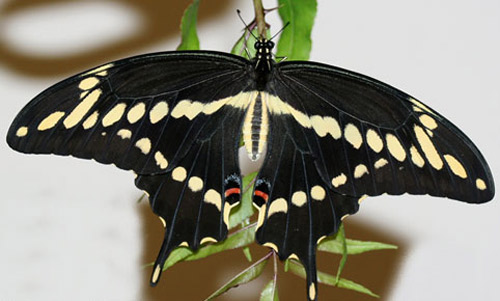
Figure 1. Adult giant swallowtail, Papilio cresphontes Cramer, dorsal view. Photograph by Donald Hall, Entomology and Nematology Department, University of Florida.
Distribution (Back to Top)
The giant swallowtail is widely distributed throughout the American continent. Its range extends from southern New England across the northern Great Lakes states, into Ontario, through the southern portions of the Central Plains to the Rocky Mountains. The species ranges southward to Florida and the Caribbean, into the southwestern United States, and on through Mexico to Central and South America. The giant swallowtail is very common throughout the entire state of Florida. It is active throughout the year in southern Florida, and is common in northern Florida, except in January and February.
Description (Back to Top)
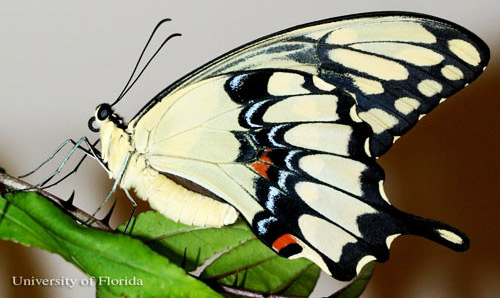
Adult: Adult giant swallowtails are large butterflies with a forewing span of 11.7 to 17.5 cm) (avg. 14 cm) for males and a span of 13.5 to 18.8 cm (avg. 14.7 cm) for females. The dorsal wing surfaces of the butterfly are black with a striking diagonal yellow bar across the forewings. The ventral wing surfaces are primarily yellow. The giant swallowtail is very distinct from all other swallowtails found in Florida, except for the endangered Schaus' swallowtail, Papilio aristodemus ponceanus, which is confined to the Florida Keys. The giant swallowtail can be distinguished from the Schaus' swallowtail by the yellow-filled tails (Schaus' swallowtail tails are all black), and the small, brick-red patch just interior to the blue median band on the ventral hind wing.
Figure 2. Adult giant swallowtail, Papilio cresphontes Cramer, with wings closed. Photograph by Donald Hall, Entomology and Nematology Department, University of Florida.
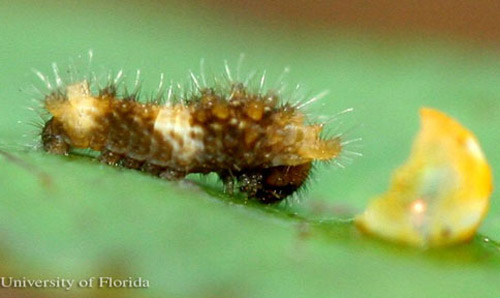
Larva: The five larval instars differ in appearance but they all share a resemblance to bird droppings. Younger instars are more realistic bird-dropping mimics due to their smaller size. Mature larvae usually rest on stems or leaf petioles (Hagen 1999), but younger larvae often rest in plain view on the upper surfaces of leaves where bird droppings would be expected.
Figure 3. Young larva of the giant swallowtail, Papilio cresphontes Cramer, (illustrating bird dropping mimicry) on Ptelea trifoliata leaf. Head is to the top. Photograph by Donald Hall, Entomology and Nematology Department, University of Florida.
Figure 4. Full-grown larva of the giant swallowtail, Papilio cresphontes Cramer. Photograph by Donald Hall, Entomology and Nematology Department, University of Florida.
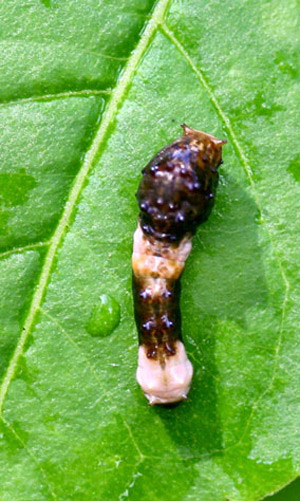
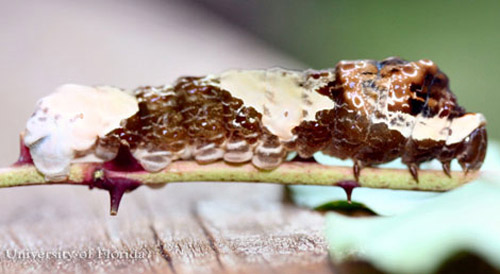
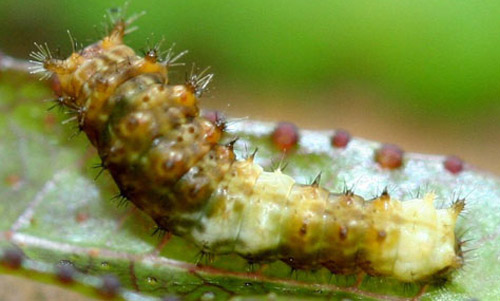
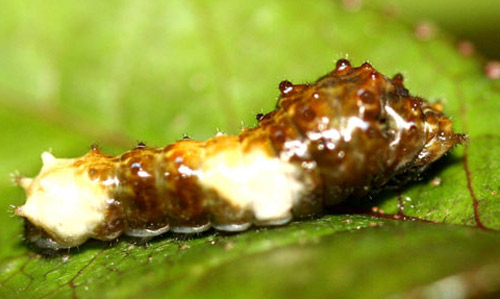
The younger instars are predominantly black or brown with a white saddle, while the older instars are mottled dark brown with a posterior that is white or cream-colored. Younger instars also have setae (hairs) on prominent knobs. Setae are lacking and knobs are reduced in older instars.
Figure 5. Newly hatched larva of the giant swallowtail, Papilio cresphontes Cramer, with partially-eaten egg shell. Head is to the right. Photograph by Donald Hall, Entomology and Nematology Department, University of Florida.
Figure 6. Three-day-old larva of the giant swallowtail, Papilio cresphontes Cramer. Photograph by Donald Hall, Entomology and Nematology Department, University of Florida.
Figure 7. Five-day-old larva of the giant swallowtail, Papilio cresphontes Cramer. Photograph by Donald Hall, Entomology and Nematology Department, University of Florida.
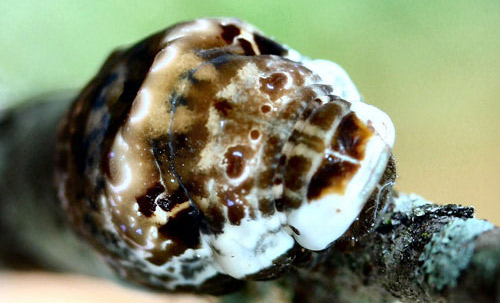
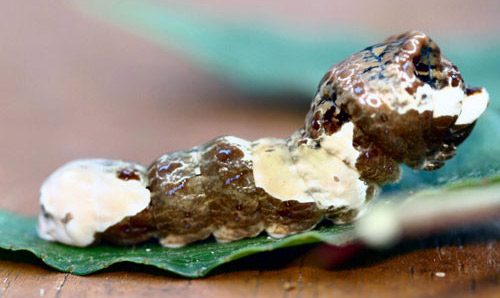
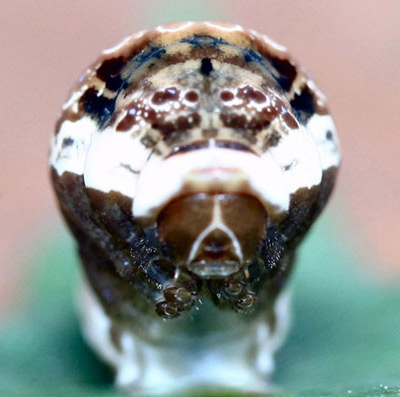
It has been suggested that the older instars resemble small snakes.
Figure 8. Mature larva of the giant swallowtail, Papilio cresphontes Cramer, showing the greatly swollen thorax that resembles a snake head. The larva's head is to the right. Photograph by Donald Hall, Entomology and Nematology Department, University of Florida.
Figure 9. Larva of the giant swallowtail, Papilio cresphontes Cramer, in snake-like "striking" pose. Head is to the right. Photograph by Donald Hall, Entomology and Nematology Department, University of Florida.
Figure 10. Front view of larva of the giant swallowtail, Papilio cresphontes Cramer, in snake-like "striking" pose. Photograph by Donald Hall, Entomology and Nematology Department, University of Florida.
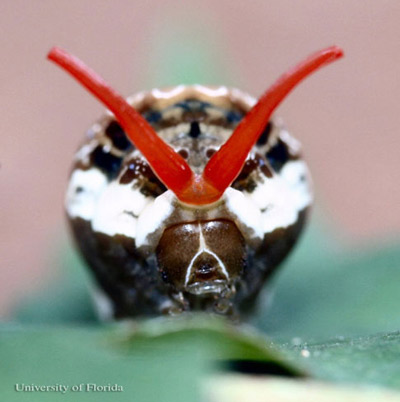
Figure 11. Frontal view of larva of the giant swallowtail, Papilio cresphontes Cramer, showing the osmeterium everted and possibly resembling the forked tongue of a snake. Photograph by Donald Hall, Entomology and Nematology Department, University of Florida.
Life Cycle (Back to Top)
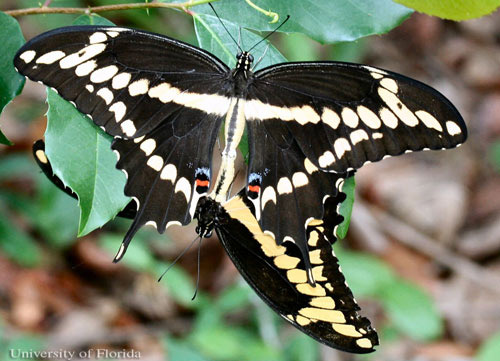
Adult butterflies sip nectar from many flowers and are common, but spectacular, visitors to butterfly gardens. Identified nectar sources include azalea, bougainvillea, Japanese honeysuckle, goldenrod, dame's rocket, bouncing Bet, and swamp milkweed. They may also sip liquid from manure. Adult males patrol flyways through pine woods or citrus groves searching for females. Flight is very strong and leisurely, and the butterflies may glide long distances between wing beats. Courtship and copulation occur in the afternoon.
Figure 12. A mating pair of the giant swallowtail, Papilio cresphontes Cramer, with the female above. Photograph by Donald Hall, Entomology and Nematology Department, University of Florida.
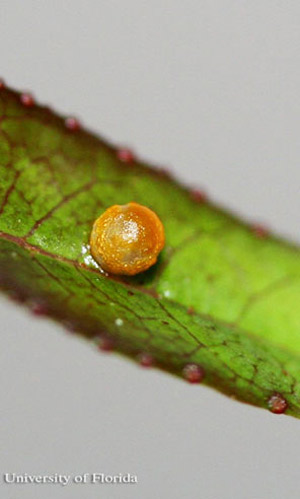
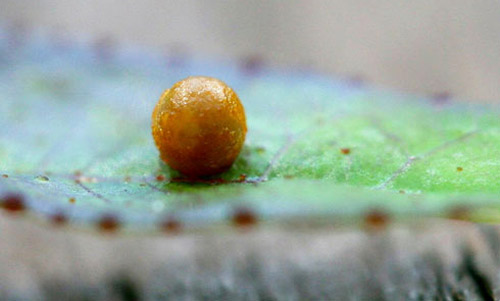
Mated females usually lay their eggs singly on the upper surface of leaves of host plants. The 1 to 1.5 mm spherical eggs are cream to brown and typically have an irregular coating of an orange secretion that is reminiscent in appearance of orange peel. Larvae progress through five instars. Larval feeding usually takes place during the night.
Figure 13. Dorsal view on an egg of the giant swallowtail, Papilio cresphontes Cramer, on Hercules club, Zanthoxylum clava-herculis L. Photograph by Donald Hall, Entomology and Nematology Department, University of Florida.
Figure 14. Lateral view on an egg of the giant swallowtail, Papilio cresphontes Cramer, on Hercules-club, Zanthoxylum clava-herculis L. Photograph by Donald Hall, Entomology and Nematology Department, University of Florida.
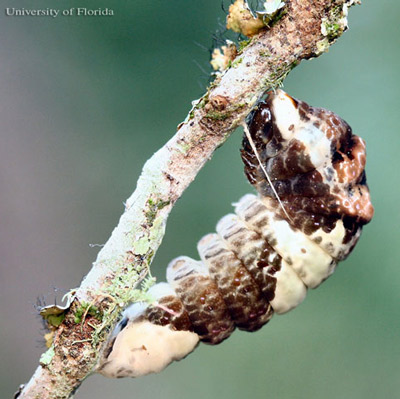
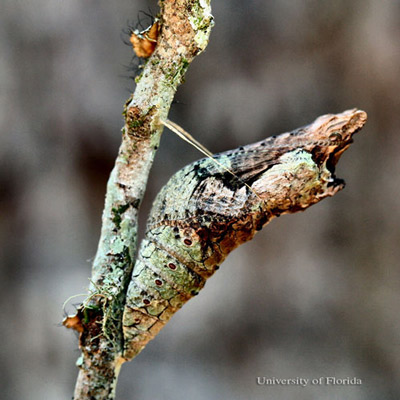
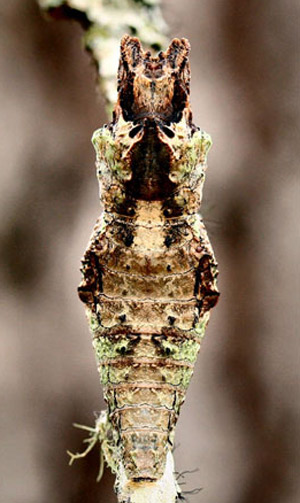
Larvae may pupate on small twigs on the host plant on which they were feeding or they may travel a short distance to a vertically-oriented structure, such as a fence or other plant. The brownish chrysalis is typically oriented at 45° to the pupation substrate, its posterior end attached directly to a silken pad on the substrate by its Velcro-like cremaster, and its anterior end attached via a thin silken thread to the substrate. At least two, and probably three, generations occur each year in Florida.
Figure 15. Prepupa of the giant swallowtail, Papilio cresphontes Cramer. Photograph by Donald Hall, Entomology and Nematology Department, University of Florida.
Figure 16. Lateral view of a chrysalis of the giant swallowtail, Papilio cresphontes Cramer. Photograph by Donald Hall, Entomology and Nematology Department, University of Florida.
Figure 17. Dorsal view of a chrysalis of the giant swallowtail, Papilio cresphontes Cramer. Photograph by Donald Hall, Entomology and Nematology Department, University of Florida.
Host Plants (Back to Top)
The larva is the well-known "orangedog" and is considered a minor pest of sweet orange, (Citrus × sinensis (L.) Osbeck (pro sp.). Host plants of the larvae besides sweet orange include native members of the citrus family (Rutaceae) including northern pricklyash (Zanthoxylum americanum Mill.), Hercules-club (Zanthoxylum clava-herculis L.), lime pricklyash (Zanthoxylum fagara [L.] Sarg.), hoptree (Ptelea trifoliata L.), sea torchwood (Amyris elemifera L.), Mexican orange (Choisya dumosa [Torr.] A. Gray), and a variety of exotic Rutaceae including gasplant (Dictamnus albus L.) and white sapote (Casimiroa edulis Llave & Lex.). Plant names are from the USDA Plant Database (2009), Wunderlin and Hansen (2003), or Wunderlin and Hansen (2008).
Figure 18. Hercules-club, Zanthoxylum clava-herculis L., a host of the giant swallowtail, Papilio cresphontes Cramer. Photograph by Donald Hall, Entomology and Nematology Department, University of Florida.
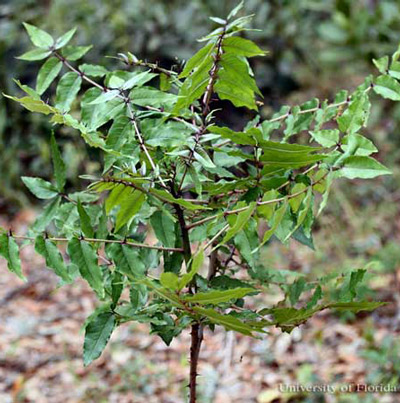
Figure 19. Lime pricklyash, Zanthoxylum fagara [L.] Sarg., a host of the giant swallowtail, Papilio cresphontes Cramer. Photograph by Donald Hall, Entomology and Nematology Department, University of Florida.
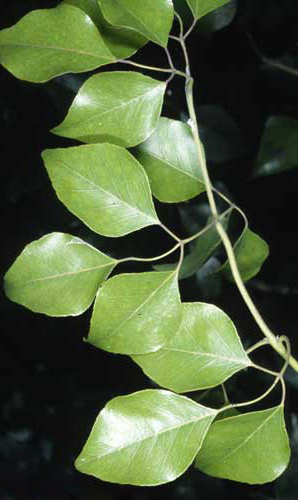
Figure 20. Sea torchwood, Amyris elemifera L., a host of the giant swallowtail, Papilio cresphontes Cramer. Photograph by Donald Hall, Entomology and Nematology Department, University of Florida.
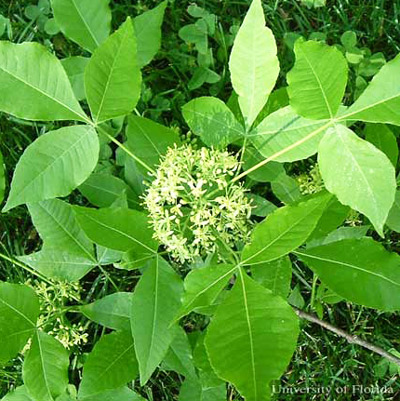
Figure 21. Hoptree, Ptelea trifoliata L., in bloom; a host of the giant swallowtail, Papilio cresphontes Cramer. Photograph by Donald Hall, Entomology and Nematology Department, University of Florida.
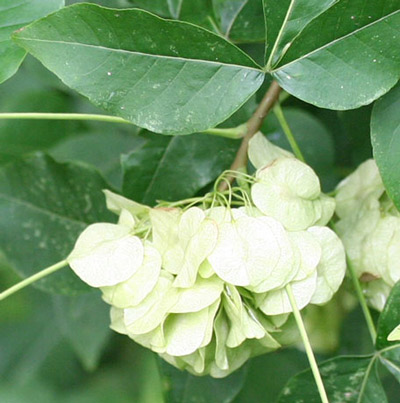
Figure 22. Hoptree, Ptelea trifoliata L., with fruit; a host of the giant swallowtail, Papilio cresphontes Cramer. Note the typical wafer-shaped fruit from which hoptree derives one of its common names, "wafer ash." Photograph by Donald Hall, Entomology and Nematology Department, University of Florida.
![Lime pricklyash, Zanthoxylum fagara [L.] Sarg., a host of the giant swallowtail, Papilio cresphontes Cramer.](papilio_cresphontes19.jpg)
Management (Back to Top)
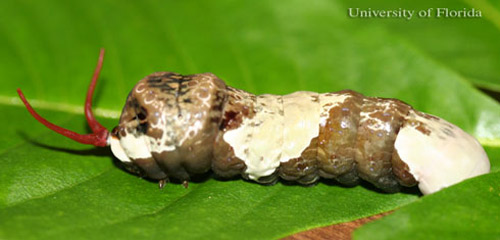
Biological control. Giant swallowtail pupae are immobile and defenseless against parasitic insects. Pupae may be parasitized by Lespesia rileyi (Williston), a tachinid fly; Brachymeria robusta (Cresson), a chalcidid wasp; and Pteromalus cassotis Walker and Pteromalus vanessae Howard, two pteromalid wasps. However, the larval stages appear to be more protected against natural enemies than the pupal stage. Larvae defend themselves against predators (both insects and vertebrates) and parasitic insects by being less visible through cryptic coloration and pattern (i.e., by resembling bird droppings). In addition, larvae possess an osmeterium, an orange or reddish Y-shaped eversible gland that is located mid-dorsally behind the head. When attacked by small predators, the larva extrudes the gland and attempts to wipe it against the attacker. The osmeterium of fourth and fifth instars contains a highly noxious, pungent mixture of chemicals (40:60 mixture of isobutyric acid and 2-methyl butyric acid) that smells like rancid butter. This glandular secretion is repellent and toxic to small predators, such as ants and spiders. Studies have shown that birds are not repelled by these secretions but still rarely eat giant swallowtail larvae. It is thought that larvae may also contain internal toxins (obtained from their food plants).
Figure 23. Mature larva of the giant swallowtail, Papilio cresphontes Cramer, with everted osmeterium. Head is to the left. Photograph by Donald Hall, Entomology and Nematology Department, University of Florida.
Mechanical control. Homeowners may find that just a few larvae of the giant swallowtail can defoliate small, potted or planted citrus plants. Larvae should be hand-picked from these small plants so that blossom and fruit yield are not drastically reduced. Mature dooryard trees are large enough to withstand some defoliation.
Chemical control. Mature commercial citrus trees can withstand infestation by many larvae. However, nursery stock and young grove trees can be protected with Bacillus thuringiensis and synthetic insecticides when necessary, as described in the Florida Citrus Pest Management Guide for chewing insects (see "orangedog") .
Selected References (Back to Top)
- Cech R, Tudor G. 2005. Butterflies of the East Coast: An Observer's Guide. Princeton University Press. Princeton, New Jersey. 345 pp.
- Crocker RL, Simpson BJ. 1979. Mexican orange, Choisya dumosa (Rutaceae), a potential ornamental is host for orangedog, Papilio cresphontes (Lepidoptera: Papilionidae). Southwest Entomologist 4: 11-13.
- Daniels JC. 2003. Butterflies of Florida: Field Guide. Adventure Publications, Inc. Cambridge, Minnesota. 256 pp.
- Eisner T, Pliske TE, Ikeda M, Owen DF, Vazquez L, Perez H, Franclemont JG, Meinwald J. 1970. Defense mechanisms of arthropods. XXVII. Osmeterial secretions of papilionid caterpillars (Baronia, Papilio, Eurytides). Annals of the Entomological Society of America 63: 914-915.
- Gerberg EJ, Arnett Jr. RH. 1989. Florida Butterflies. Natural Science Publications, Inc. Baltimore, Maryland.
- Glassberg J, Minno MC, Calhoun JV. 2000. Butterflies through Binoculars: Florida. Oxford University Press. New York, New York. 256 pp.
- Hagen RH. 1999. Prolegs of Papilionini (Lepidoptera: Papilionidae): alternative solutions to the problem of attachment. pp. 237-251. In Byers GW, Hagen RH, Brooks RW. Entomological Contributions in Memory of Byron A. Alexander. Natural History Museum, University of Kansas, Lawrence, Kansas, USA.
- Kimball CP. 1965. Arthropods of Florida and Neighboring Land Areas. Vol. 1. Division of Plant Industry, Florida Department of Agriculture, Gainesville, Florida. 363 pp.
- Leslie AJ, Berenbaum MR. 1990. Role of the osmeterial gland in swallowtail larvae (Papilionidae) in defense against an avian predator. Journal of the Lepidoptera Society 44: 245-251.
- Minno MC, Butler JF, Hall DW. 2005. Florida Butterfly Caterpillars and their Host Plants. University Press of Florida. Gainesville, Florida. 341 pp.
- Minno MC and Emmel TC. 1993. Butterflies of the Florida Keys. Scientific Publishers. Gainesville, Florida. 168 pp.
- Minno MC and Minno M. 1999. Florida Butterfly Gardening: A Complete Guide to Attracting, Identifying, and Enjoying Butterflies of the Lower South. University Press of Florida. Gainesville, Florida. 210 pp.
- Opler PA, Krizek GO. 1984. Butterflies East of the Great Plains. An Illustrated Natural History. The Johns Hopkins University Press, Baltimore, Maryland. 294 pp.
- Scriber MC, Tsubaki Y, Lederhouse RC. 1995. Swallowtail Butterflies: Their Ecology & Evolutionary Biology. Scientific Publishers. Gainesville, Florida. 459 pp.
- USDA. (2009). Plant Database. USDA National Resources Conservation Service. http://plants.usda.gov/ (8 April 2009).
- Wunderlin RP and Hansen BF. 2003. Guide to the Vascular Plants of Florida. 2nd ed. University Press of Florida. Gainesville, Florida. 787 pp.
- Wunderlin RP, Hansen BF. (2008). Atlas of Florida Vascular Plants. Institute for Systematic Botany. http://www.plantatlas.usf.edu/ (8 April 2009).