common name: black and yellow lichen moth (suggested common name)
scientific name: Lycomorpha pholus (Drury) (Insecta: Lepidoptera: Noctuidae: Arctiinae: Lithosiini)
Introduction - Synonymy - Distribution - Description - Life Cycle - Hosts - Mimicry - Selected References
Introduction (Back to Top)
The black and yellow lichen moth, Lycomorpha pholus (Drury), is a member of the subfamily Arctiinae, tiger moths and woolly bears. The common names of the subfamily refer to the bright wing color patterns found in adults and the long setae covering many of its caterpillars.
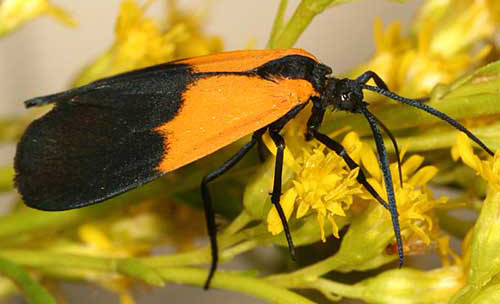
Figure 1. Adult black and yellow lichen moth, Lycomorpha pholus (Drury). Photograph by Tom Murray, University of Florida.
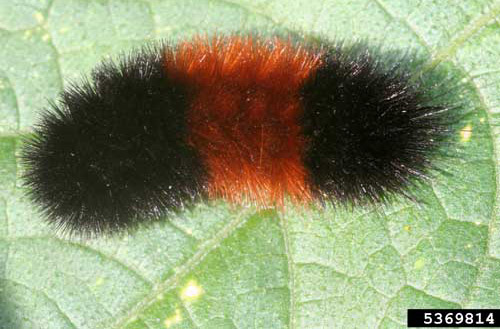
Figure 2. The banded woolly bear caterpillar, Pyrrharctia isabella (Smith). Photograph by Whitney Crenshaw, Colorado State University, Bugwood.org.
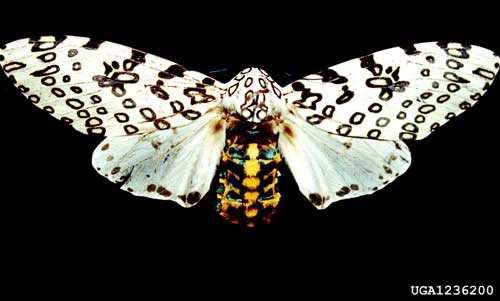
Tiger moths are found in all of the zoogeographical regions (six geographical divisions of the world that are used to study the occurrence of land animals) including the Nearctic (North America). However, they are most common in the Neotropics (Mexico south of the Tropic of Cancer, Central and South America, and the West Indies) (Scoble 1995). Species found in Florida include the bella moth, Utetheisa bella (Linnaeus); the oleander moth, Syntomeida epilais (Walker); and the giant leopard moth, Hypercompe scribonia (Stoll).
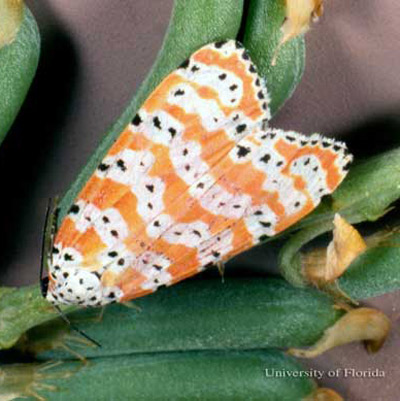
Figure 3. Adult bella moth, Utetheisa bella (Linnaeus), a tiger moth. Photograph by Don Hall, Entomology and Nematology Department, University of Florida.
Figure 4. Adult oleander moth, Syntomeida epilais (Walker), a tiger moth. Photograph by Howard Ensign Evans, Colorado State University, Bugwood.org.
Figure 5. Adult giant leopard moth, Hypercompe scribonia (Stoll), a tiger moth. Photograph by USDA Cooperative Extension Slide Series, Bugwood.org.
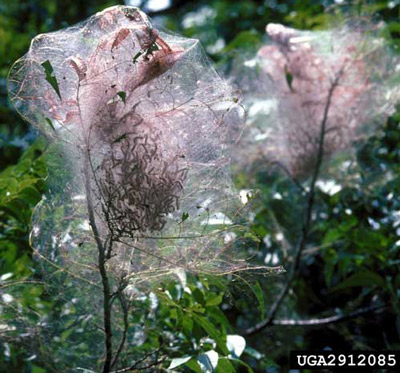
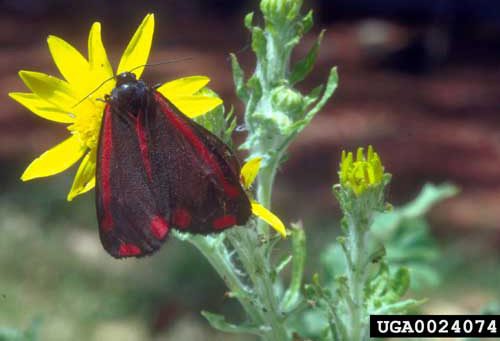
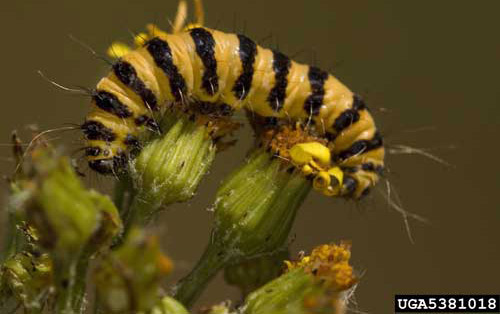
Some caterpillars in the tiger moth subfamily are considered nuisance species, including the fall webworm, Hyphantria cunea (Drury). Others, such as the caterpillar of the cinnabar moth, Tyria jacobaeae (Linnaeus), are beneficial. The cinnabar moth caterpillar is used as a successful biological control agent of tansy ragwort in the Pacific Northwest.
Figure 6. Fall webworm larvae, Hyphantria cunea (Drury), in protective webbing. Photograph by G. Keith Douce, University of Georgia, Bugwood.org.
Figure 7. Adult cinnabar moth, Tyria jacobaeae (Linnaeus), nectar feeding on tansy ragwort. Photograph by Eric Coombs, Oregon Department of Agriculture, Bugwood.org.
Figure 8. Caterpillar of a cinnabar moth, Tyria jacobaeae (Linnaeus), feeding on tansy ragwort. Photograph by David Cappaert, Michigan State University, Bugwood.org.
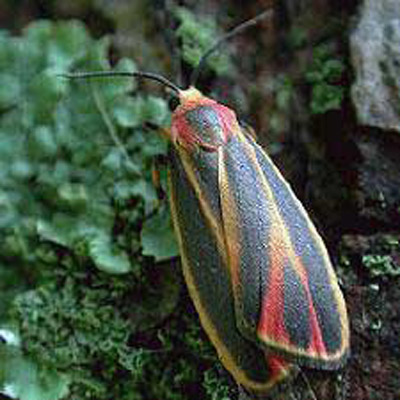
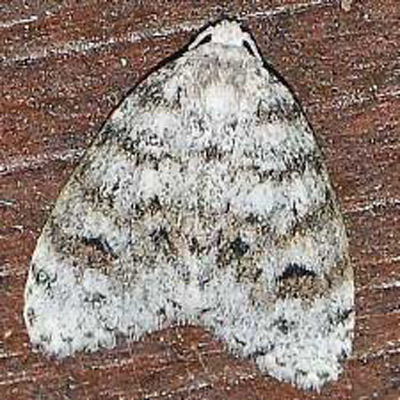
The black and yellow lichen moth is also a member of the tribe Lithosiini (subfamily Arctiinae), the lichen moths. The common name of the tribe refers to the frequent choice of lichens as food sources by the caterpillars. Like other tiger moths, the lichen moths are also most common in the Neotropics. They are generally smaller than other tiger moths, and the adults may be either brightly colored or drab.
Figure 9. The painted lichen moth, Hypoprepia fucosa Hübner, an example of a brightly colored adult lichen moth. Photograph by John Himmelman, University of Alberta.
Figure 10. Adult little white lichen moth , Clemensia albata Packard, an example of a lichen moth with drab coloration. Photograph by Phil Huntley-Franck, University of Alberta.
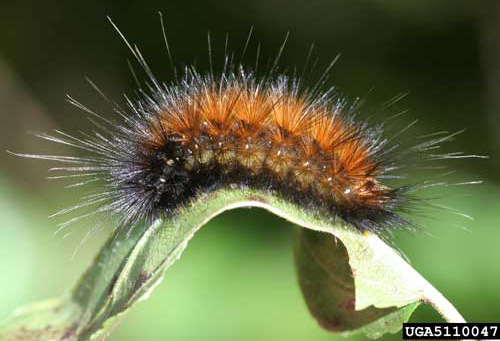
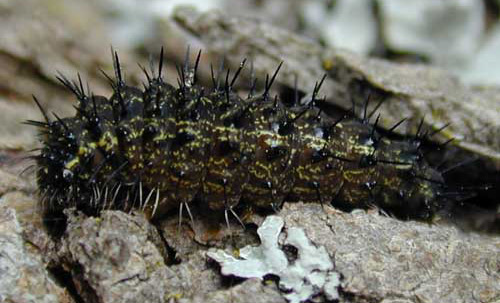
The caterpillars in Lithosiini also have much fewer setae covering their bodies, making them appear bare in comparison to the woolly bears.
Figure 11. Yellow woolly bear caterpillar, Spilosoma virginica (Fabricius). Photograph by David Cappaert, Michigan State University, Bugwood.org.
Figure 12. Lichen moth caterpillar of Hypoprepia miniata (Kirby) feeding on lichens. Photograph by Jason Dombroskie, University of Alberta.
Synonymy (Back to Top)
Sphinx pholus Drury 1773
Distribution (Back to Top)
The range of the black and yellow lichen moth is restricted to North America. It occurs as far north as Ontario and Quebec, Canada. It is found in the eastern United States from Maine to Florida and as far west as the Rocky Mountains (Powell and Opler 2009).
Description (Back to Top)
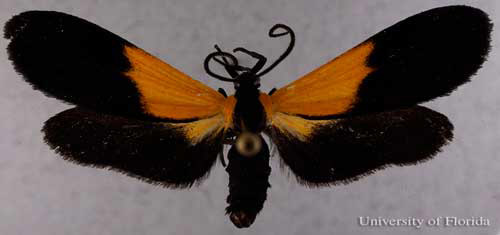
Adults: Both male and female adult black and yellow lichen moths are similar in appearance. Their wingspan ranges from 2.5 to 3.2 cm (1 to 1.3 inches) (Covell 1984). The head, thorax (chest), legs, and abdomen are all black with an iridescent blue sheen. The tegula (shoulders), the half of the forewing closest to the body (basal half), and a patch on the front (costal) margin of the hind wing next to the body are all orange-yellow.
Figure 13. Adult black and yellow lichen moth, Lycomorpha pholus (Drury) (pinned specimen). Photograph by Clare Scott, University of Florida.
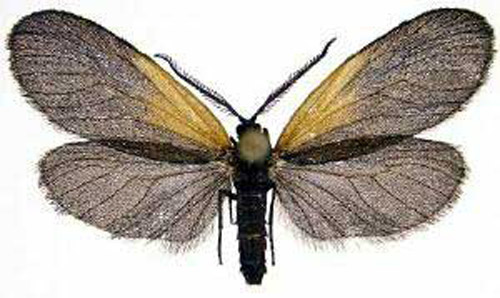
The orange-patched smoky moth, Pyromorpha dimidiata Herrich-Schäffer, has a similar color pattern. This moth has a range that partially overlaps that of the black and yellow lichen moth. However, it only occurs as far west as Missouri (Covell 1984). Both moths can be found flying at the same time of the year and both are diurnal (active during the day). The orange-patched smoky moth can be distinguished from the black and yellow lichen moth because the former has no orange-yellow scales on its hind wing. Also, its wings appear somewhat translucent, unlike the black and yellow lichen moth.
Figure 14. Adult orange-patched smoky moth, Pyromorpha dimidiata Herrich-Schäffer, with wings spread to demonstrate the lack of orange-yellow scales on the hindwing. Photograph by Jim Vargo, Moth Photographers Group.
Larvae: The caterpillars of the black and yellow lichen moth are described as having sparse hairs and being similar in appearance to those of the genus Hypoprepia (Forbes 1960).
Life Cycle (Back to Top)
The black and yellow lichen moth flies from July to September in Eastern North America (Covell 1984) and from late June to August in Western North America (Powell and Opler 2009). This moth is only active during the day. It is found nectar feeding at flowers of goldenrod (Solidago spp.), Apocynum spp., and Ericameria nauseosa (Powell and Opler 2009). Wagner et al. (2008) found that multiple generations can occur during the time when the adults are flying, and third instar larvae from later generations will overwinter by entering diapause. This is a period of no growth that can only be broken by receiving an appropriate number of cold hours.
The adults and caterpillars of the subfamily, Arctiinae, are often defended from predators, including birds and bats, and from parasitoids, such as some flies and wasps, by chemical compounds. The compounds are often obtained from the hosts on which the caterpillars feed. The compounds are transferred to the adults when the caterpillar pupates. For the black and yellow lichen moth, these chemicals are lichen phenolics, defensive compounds produced by the fungal component of the lichen.
Hosts (Back to Top)
Caterpillars of the black and yellow lichen moth have been raised to adults on the lichen Physcia millegrana (Wagner et al. 2008).
Mimicry (Back to Top)
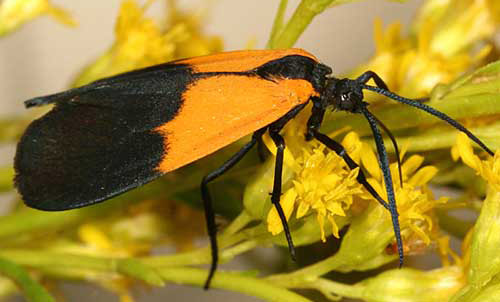
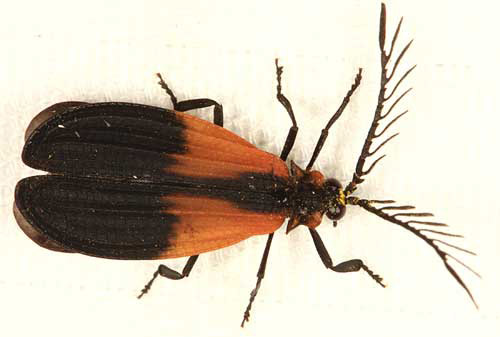
The color pattern found on adult black and yellow lichen moths occurs on other species in the tiger moth subfamily: members of the genera Dycladia and Correbia, the orange-patched smoky moth in the family Zygaenidae, and in some net-wing beetles in the family Lycidae. All of these individuals are regarded as Müllerian mimics (Simmons 2009), which means that all of them possess chemicals of some kind that make them distasteful to predators.
Figure 15. Adult black and yellow lichen moth, Lycomorpha pholus (Drury). Photograph by Tom Murray.
Figure 16. Adult orange patched smoky moth, Pyromorpha dimidiata Herrich-Schäffer. Photograph by Robert Patterson, Moth Photographers Group.
Figure 17. Caenia dimidiata (Fabricius), an adult lycid beetle. Photograph by Tom Murray, University of Florida.
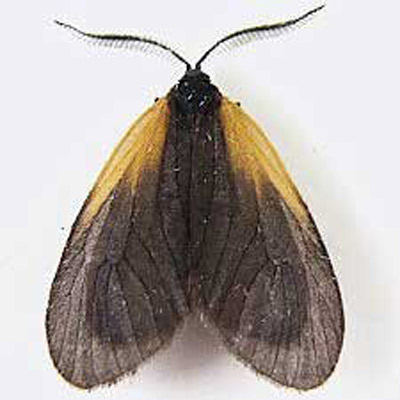
Caterpillars and adult moths from the family Zygaenidae, including the orange-patched smoky moth, are chemically defended by hydrocyanic acid that they release when threatened (Powell and Opler 2009).
Selected References (Back to Top)
- Conner WE. (editor) 2009. Tiger Moths and Woolly Bears: Behavior, Ecology, and Evolution of the Arctiidae. Oxford University Press. New York, New York. 303 pp.
- Covell CV. 1984. A Field Guide to Moths of Eastern North America. Special Publication Number 12. Virginia Museum of Natural History. Martinsville, Virginia. 496 pp.
- Forbes WTM. 1960. Lepidoptera of New York and Neighboring States, part IV: Agaristidae through Nymphalidae including Butterflies. Cornell University Agriculture Experiment Station Memoir 371. Cornell University, Ithaca, NY.
- Powell JA, Opler PA. 2009. Moths of Western North America. University of California Press. Berkeley, California. 369 pp.
- Scoble MJ. 1995. The Lepidoptera Form, Function and Diversity. The Natural History Museum. Oxford University Press. New York, New York. 404 pp.
- Simmons, R. 2009. Adaptive coloration and mimicry. In Tiger Moths and Woolly Bears: Behavior, Ecology, and Evolution of the Arctiidae. (Conner WE, editor). Oxford University Press. New York, New York.
- Wagner DL, Rota J, McCabe TL. 2008. Larva of Abablemma (Noctuidae) with notes on algivory and lichenivory in macrolepidoptera. Annals of the Entomological Society of America 101: 40-52.