common name: bigeyed bugs (of Florida)
scientific name: Geocoris spp. (Insecta: Hemiptera: Geocoridae)
Introduction - Distribution - Description - Key to Species of Adult Geocorinae in Florida - Key to Late Instar Nymphs of Florida Species - Life Cycle and Biology - Hosts - Selected References
Introduction (Back to Top)
The bigeyed bugs, Geocoris spp., are small insects (approximately 1/6 inch long) that occur in many parts of the world. They are generally regarded as beneficial because they prey upon numerous kinds of insect and mite pests of turf, ornamental and agricultural crops. Bigeyed bugs are among those insects receiving research attention in Florida (and elsewhere) for their value as predators. To aid in identification of bigeyed bugs in Florida, a key to adults and late instar nymphs is provided in this publication.
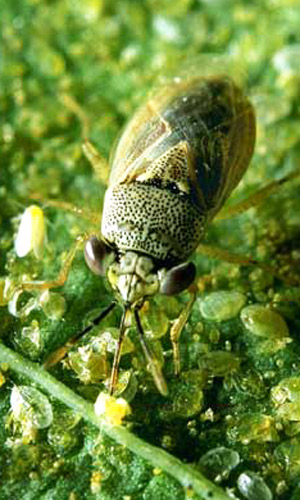
Figure 1. Adult bigeyed bug, Geocoris sp., feeding on a whitefly nymph. Photograph by Jack Dykinga, USDA.
Distribution (Back to Top)
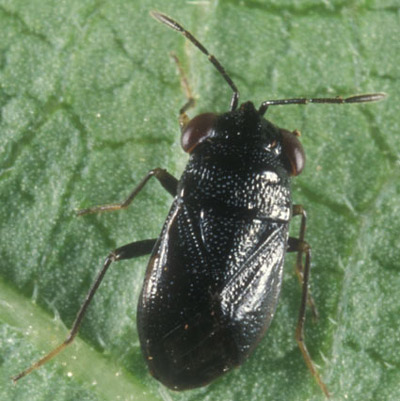
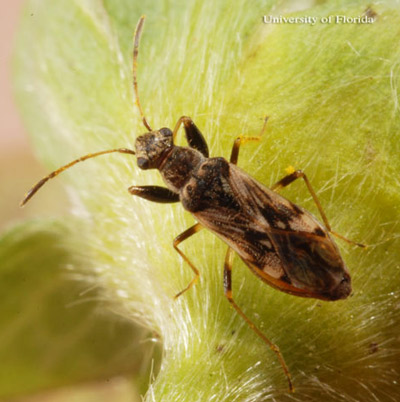
Geocoris uliginosus (Say) ranges over most of the United States and southern Canada. In Florida, Geocoris uliginosus is known at least as far south as Ft. Myers.
Figure 2. Adult Geocoris uliginosus (Say), a bigeyed bug. Photograph by Lyle J. Buss, University of Florida.
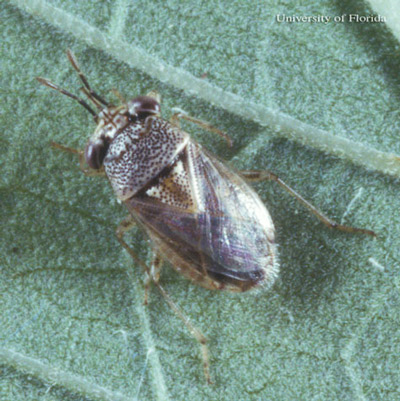
Geocoris punctipes (Say) is primarily an Austroriparian species, common throughout Florida, and ranging from New Jersey west to southern Indiana and Colorado south and southwest to Texas, Arizona, California and Mexico. Other localities include Guatemala, Panama and Hawaii.
Figure 3. Adult Geocoris punctipes (Say), a bigeyed bug. Photograph by Lyle J. Buss, University of Florida.
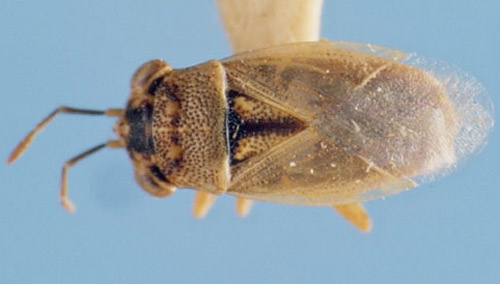
Geocoris bullatus (Say), the large bigeyed bug, is widely distributed in the United States and Canada, from coast to coast. There are numerous Florida records from the northern border south to Key West.
Figure 4. Adult Geocoris bullatus (Say), the large bigeyed bug. Photograph by Julieta Brambila, USDA.
Description (Back to Top)
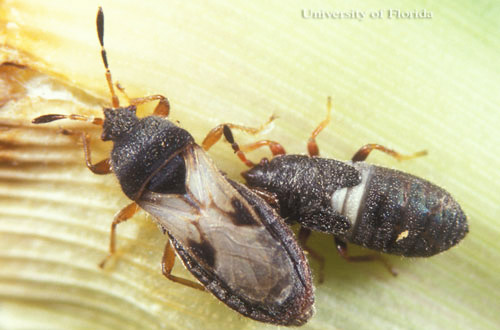
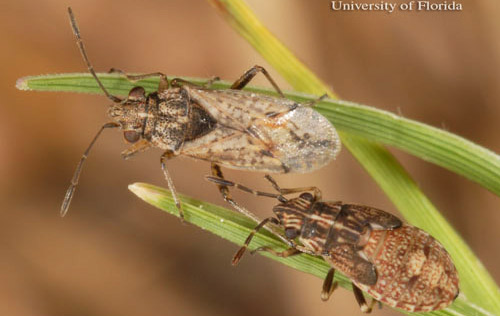
Bigeyed bugs are small, oblong-oval lygaeids with a head that is broader than it is long, and prominent eyes that curve backward and overlap the front of the pronotum. The stylus has a longitudinal groove. These features can be seen on nymphs as well as adults and serve to separate bigeyed bugs from similar bugs. A distinguishing feature of adult bigeyed bugs is the very short or absent claval commissure. Lygaeids such as chinch bugs, Blissus spp.; false chinch bugs, Nysius spp.; and pamera bugs, Neopamera spp. are sometimes confused with bigeyed bugs, but these genera have a claval commissure (Fig 5.) approximately half as long as the scutellum. Also, the head has more of a triangular shape in these lygaeids. Caplan (1968) emphasized the need for turf specialists to distinguish between bigeyed bugs and chinch bugs. Misidentification could result in a chinch bug spray directed against geocorines, resulting in needless loss of money and beneficial insects.
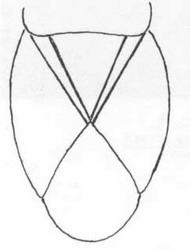
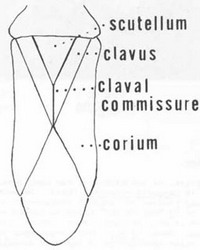
Figure. 5. A comparison of the claval commissure on a bigeyed bug, Geocoris sp. (left), and apamera bug, Neopamera sp. (right).
Figure 6. Adult (left) and nymph (right) chinch bugs, Blissus sp. Photograph by Lyle J. Buss, University of Florida.
Figure 7. Adult (left) and nymph (right) false chinch bugs, Nysius raphanus Howard. Photograph by Lyle J. Buss, University of Florida.
Figure 8. Adult pamera bug, Neopamera sp. Photograph by Lyle J. Buss, University of Florida.
Key to Species of Adult Geocorinae in Florida (Back to Top)
The following key to geocorines in Florida does not include two species of Hypogeocoris, which have been reported in Florida, but apparently are scarce or rare. Some minor variations in Geocoris bullatus (Say) and Geocoris uliginosus (Say) have been formalized as subspecies, but will not be considered here.
1. Beak with segment I (basal) longer than II; head (except in Geocoris punctipes) punctulate (with small pits) or rugulose (minutely wrinkled) . . . . . Geocoris 2
1'. Beak with segment I subequal to or shorter than II; head smooth, impunctate, shining . . . . . Hypogeocoris
2. Nearly all black above except for pale border along each side; scutellum entirely black (Fig. 2, above) . . . . . Geocoris uliginosus (Say) 1832
2'. Mostly pale above; scutellum with a pair of pale areas or spots (Fig. 3, 4 above) . . . . . 3
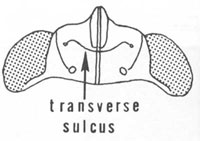
3. Scutellum with a pair of prominent, smooth (impunctate), calloused basolateral, pale spots, the spots sometimes extending posteriorly (extension punctulate); pronotum with a pair of somewhat lunate impunctate callosities, usually shiny black but sometimes invaded by various amounts of yellow; head smooth, polished, not at all granulose; inner posterior margin of corium not marked with fuscous or at most weakly so; groove of tylus extending back onto vertex and crossed near middle by an arcuate, transverse sulcus (Fig. 9, below), length 3.5 to 4.2 mm (Fig. 3, above) . . . . . Geocoris punctipes (Say) 1832
Figure. 9. Dorsal aspect of the head of Geocoris punctipes.
3'. Scutellum with a pair of punctate, non-calloused, submedial, pale-yellow areas; the shape and extent of pale areas variable but usually oblong and partially angulate; pronotum with the pair of impunctate callosities nearly round, pale-yellow; head granulose; inner posterior margin of corium marked with two fuscous "spots", the posterior one larger; groove of tylus not extending back onto vertex; vertex lacking transverse sulcus; length 3.0 to 3.5 mm (Fig. 4, above) . . . . . Geocoris bullatus (Say) 1832, the large bigeyed bug
Key to Late Instar Nymphs of Florida Species of Geocoris (Back to Top)
To make sure a nymph is a lygaeid, consult the key by Herring and Ashlock (1971) and/or the one by DeCoursey (1971). To key a lygaeid nymph to genus, consult Sweet and Slater (1961).
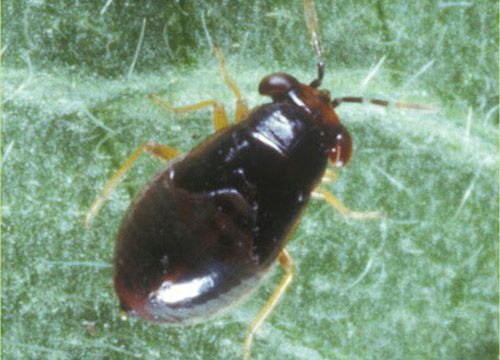
1. Dorsal ground color of head and thorax dark brown (Fig. 10, below) . . . . . Geocoris uliginosus (Say)
1'. Dorsal ground color of head and thorax pale (irregular dark spots often present) . . . . . 2
Figure 10. Nymph of Geocoris uliginosus (Say), a bigeyed bug. Photograph by Lyle J. Buss, University of Florida.
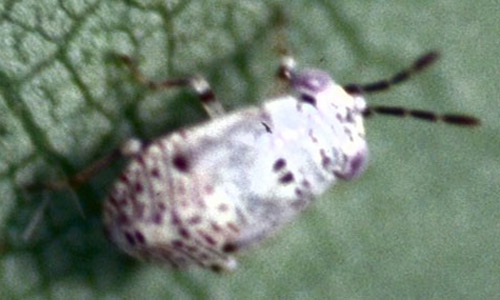
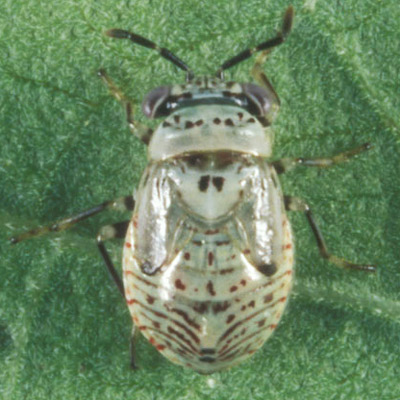
2. Mesothoracic wing pads (developing forewings) either unmarked or with only one apical brown spot; scutellum with two pairs of linear brown marks, sometimes coalesced into one large pair, these marks basolateral; pronotum usually with three pairs of brown spots, variable in shape and degree of pigmentation, often inconspicuous; antennal segments I through III each with prominent dorsoapical pale spot (Fig. 11, below) . . . . . Geocoris bullatus (Say), the large bigeyed bug
Figure 11. Nymph of the large bigeyed bug, Geocoris bullatus (Say). Photograph by Ronald Smith, Auburn University; bugwood.org.
2'. Mesothoracic wing pads each with four or five brown marks (usually three basal streaks, one middle dot, and one prominent apical spot); scutellum with three to five pairs of dark brown marks (usually four pairs), the most prominent pair near middle; pronotum with five to six pairs of conspicuous dark brown irregular spots; antennal segments I to III each without dorsoapical pale spot (Fig. 12, below) . . . . . Geocoris punctipes (Say)
Figure 12. Nymph of Geocoris punctipes (Say), a bigeyed bug. Photograph by Lyle J. Buss, University of Florida.
Life Cycle and Biology (Back to Top)
The literature on the food habits and life histories of Geocoris spp. is too extensive for more than a token review here. The most abundant bigeyed bug in Florida and the southeastern United States is Geocoris punctipes (Say). McGregor and McDonough (1917) reported the life history of Geocoris punctipes at Batesburg, South Carolina, finding the average development time from egg to adult was 30 days. York (1944) reported that adult Geocoris required either free moisture or plant moisture as well as insect prey. Sweet (1960) found that Geocoris adults can survive on sunflower seeds and water, without insect food. Dumas et al. (1962) found more Geocoris punctipes in the morning than at midday or evening, either by sweep net sampling or complete plant examination in Arkansas soybean fields. Stoner (1970) found that Geocoris punctipes apparently needed prey for proper development and fecundity.
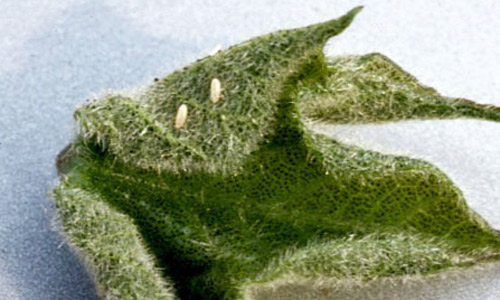
Figure 13. Eggs of Geocoris bullatus (Say), the large bigeyed bug. Photograph by Ronald Smith, Auburn University; www.insectimages.org.
Hosts (Back to Top)
Bell and Whitcomb (1964) reported that, in Arkansas, Geocoris punctipes and Geocoris uliginosus were among the most abundant and important predators of bollworm eggs, Helicoverpa (=Heliothis) zea (Boddie) on cotton from mid-June until September. Whitcomb and Bell (1964) reported that bigeyed bugs preyed upon aphids, plant bugs, eggs, and young larvae of the bollworm and cotton leafworm in Arkansas cotton fields. On the negative side, however, the prey occasionally were beneficial species (Orius spp.). Champlain and Sholdt (1967) reported on the life history of Geocoris punctipes in the laboratory. Lingren et al. (1968) reported Geocoris punctipes was a more effective predator than Geocoris uliginosus against Helicoverpa (=Heliothis) spp. Nymphs consumed an average of 47 mites, and adults an average of 83 red spider mites on cotton per day. Orhanides et al. (1971) reported that Geocoris punctipes was an effective predator of the pink bollworm, Pectinophora gossypiella (Saunders), in southern California cotton fields. Tamaki and Weeks (1972) listed 46 references, itemized from the literature the prey list of Geocoris spp., and presented extensive research results from a five year project on Geocoris in the Yakima Valley of Washington, including data on Geocoris bullatus.
Selected References (Back to Top)
- Anonymous. (May 2000). Color photographs of adult Geocoris bullatus (Say) and Geocoris uliginosus (Say). Cedar Creek Natural History Area. (11 December 2014).
- Bell KO, Whitcomb WH. 1964. Field studies on egg predators of the bollworm, Heliothis zea (Boddie). Florida Entomologist 47: 171-180.
- Blatchley WS. 1926. Heteroptera or true bugs of Eastern North America, with especial reference to the faunas of Indiana and Florida. Nature Publishing Co., Indianapolis. 1116 pp.
- Caplan I. 1968. Some chinch bugs aren't. Weeds Trees and Turf 7: 31-32.
- Champlain RA, Sholdt LL. 1967. Life history of Geocoris punctipes (Hemiptera: Lygaeidae) in the laboratory. Annals of the Entomological Society of America 60: 883-885.
- DeCoursey RM. 1971. Keys to the families and subfamilies of the nymphs of North American Hemiptera-Heteroptera. Proceedings of the Entomological Society of Washington 73: 413-428.
- Dumas BA, Boyer WP, Whitcomb WH. 1962. Effect of time of day on surveys of predaceous insects in field crops. Florida Entomologist 45: 121-128.
- Herring JL, Ashlock PD. 1971. A key to the nymphs of the families of Hemiptera (Heteroptera) of America north of Mexico. Florida Entomologist 54: 207-212.
- Lingren PD, Ridgay RL, Jones SL. 1968. Consumption by several common arthropod predators of eggs and larvae of two Heliothis species that attack cotton. Annals of the Entomological Society of America 61: 613-618.
- McGregor EA, McDonough FL. 1917. The red spider on cotton. USDA Bulletin 416: 41-43.
- Orhanides GM, Gonzalez D, Bartlett BR. 1971. Identification and evaluation of pink bollworm predators in southern California. Journal of Economic Entomology 64: 421-424.
- Stoner A. 1970. Plant feeding by a predaceous insect, Geocoris punctipes. Journal of Economic Entomology 63: 1911-1915.
- Sweet MH. 1960. The seed bugs: A contribution to the feeding habits of the Lygaeidae (Hemiptera: Heteroptera). Annals of the Entomological Society of America 53: 317-321.
- Sweet MH, Slater JA. 1961. A generic key to the nymphs of North American Lygaeidae (Hemiptera: Heteroptera). Annals of the Entomological Society of America 54: 333-340.
- Tamaki G, Weeks RE. 1972. Biology and ecology of two predators, Geocoris pallens Stäl and G. bullatus (Say). U.S. Department of Agriculture Technical Bulletin 1446. 46 pp.
- Whitcomb WH, Bell K. 1964. Predaceous insects, spiders, and mites of Arkansas cotton fields. Arkansas Agricultural Experiment Station Bulletin 690. 84 pp.
- York GT. 1944. Food studies of Geocoris spp., predators of the beet leafhopper. Journal of Economic Entomology 37: 25-29.